

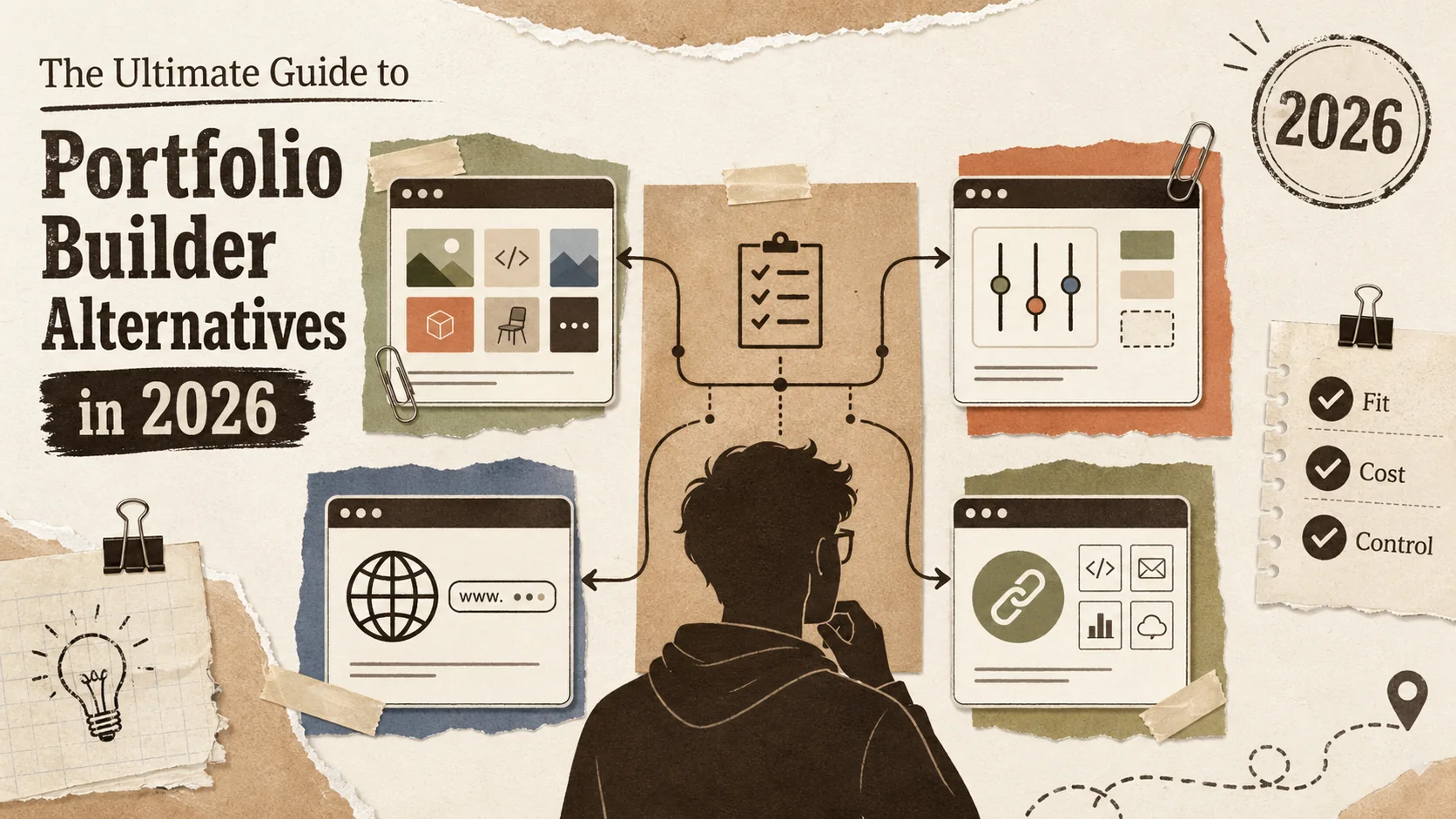
[INSERT_IMAGE: A developer looking thoughtfully at multiple portfolio website options on different screens]
Your portfolio is your digital handshake. In 2026, a static list of projects isn't enough to stand out to recruiters and hiring managers. You need a dynamic, professional showcase that tells your story, highlights your skills, and proves your value—fast. While our platform helps thousands of developers create beautiful portfolios in minutes, we understand that every tech professional has unique needs. Maybe you crave deeper customization, need a specific integration, or are exploring all your options before committing.
This comprehensive guide cuts through the noise to present the best portfolio builder alternatives available in 2026. We’ll break down who each tool is for, what it costs, and its real strengths and weaknesses, so you can choose the platform that will best help you land your next role or client.
How We Evaluated These Alternatives {#how-we-evaluated-these-alternatives}
Short answer: We scored each platform on portfolio-specific criteria — project showcase quality, custom domain support, responsive templates, and cost-effectiveness — using hands-on testing and aggregated user reviews from G2, Capterra, and Product Hunt.
To create this list, we focused on platforms that serve tech professionals—developers, designers, and engineers. We prioritized tools that offer:
- A focus on showcasing projects and professional work.
- Custom domain support for a personal brand.
- Modern, responsive templates suitable for technical portfolios.
- Value for money, especially for those early in their career.
Our goal is to give you the clear, actionable information you need to make the best choice for your personal brand in 2026. If you're still weighing whether a portfolio matters at all, read our guide on why your portfolio — not your resume — will get you hired in 2026.
Top Portfolio Builder Alternatives in 2026 {#top-portfolio-builder-alternatives-in-2026}
Short answer: The top five portfolio builders for tech professionals in 2026 are DevPort (GitHub-centric), ShowcaseFrame (visual-first), CareerCanvas (resume integration), VersaSite Builder (maximum design control), and LinkHub Pro (link-in-bio hub). Each serves a distinct workflow — choose based on whether your priority is code showcase, visual design, job applications, or social media traffic.
1. DevPort {#1-devport}
[INSERT_IMAGE: DevPort platform screenshot showing a developer portfolio template]
Best for: Developers who want a portfolio tightly integrated with their GitHub activity.
Description
DevPort has carved out a niche by directly targeting software engineers. Its core philosophy is to automate the tedious parts of portfolio maintenance. By deeply connecting with your GitHub, GitLab, or Bitbucket account, it can pull in your repositories, populate project details, and even update your portfolio automatically when you push new code. According to Stack Overflow's 2025 Developer Survey, 87% of professional developers use GitHub, making this integration especially relevant. This is a compelling choice for developers who want their portfolio to be a living, breathing extension of their development work.
Key Features
- GitHub Sync: Automatically imports and updates projects from your GitHub repositories.
- Code Highlighting: Integrates syntax-highlighted code snippets directly into project showcases.
- "Live Project" Embeds: Allows you to embed live, interactive project demos (like CodePen or Glitch) on your portfolio pages.
- Technical Skill Tags: Visually highlights programming languages, frameworks, and tools used in each project.
- Resume PDF Generator: Creates a styled, downloadable PDF resume from your portfolio data.
- Basic Analytics: Tracks page views and project click-through rates.
Pricing (2026)
| Plan | Price (Monthly) | Key Features |
|---|---|---|
| Hobby | Included | 3 projects, DevPort subdomain, basic templates |
| Pro | $12/month | Unlimited projects, custom domain, GitHub sync, analytics |
| Teams | $29/month | Collaborative portfolios, team branding, admin controls |
What Users Say
"As a full-stack developer, I love that my portfolio updates almost by itself. Every new GitHub project becomes a portfolio piece without me lifting a finger. The Pro plan is worth it for the custom domain alone." — Review on G2
Pros
- Huge time-saver for active GitHub users.
- Authentic showcase that directly reflects your actual coding work.
- Clean, developer-focused templates that look professional without needing design skills.
Cons
- Less design flexibility than general website builders; you're more locked into their templates.
- The included plan is very limited, making the Pro plan almost essential for serious use.
- Can feel overly technical for roles that also require emphasizing soft skills or design thinking.
2. ShowcaseFrame {#2-showcaseframe}
[INSERT_IMAGE: ShowcaseFrame dashboard showing a grid of visual project thumbnails]
Best for: Designers and front-end developers who prioritize visual project presentation.
Description
If your work is highly visual — think UI/UX design, front-end development, game design, or 3D modeling — ShowcaseFrame is built for you. Designers who currently host work on Behance or Dribbble often look for a self-hosted alternative that gives them more brand control. ShowcaseFrame fills that gap: it moves away from the blog-like format and centers on a visual, gallery-style experience. Think of it as a minimalist art gallery for your projects. It offers sophisticated grid layouts, full-screen image/video viewers, and smooth animations to make your visual work the undeniable star of the show.
Key Features
- Visual-First Grid Builder: Drag-and-drop interface to create custom project grids and galleries.
- High-Resolution Media Support: Optimized for large images, videos, and GIFs without slowing down your site.
- Client Proofing Sections (Team Plan): Create private galleries for client feedback and approvals.
- Customizable Project Pages: Each project gets a dedicated page with space for descriptions, your role, and tools used.
- Password Protection: Lock specific projects or the entire site with a password.
- Integrated Basic Store: Sell digital assets or templates directly from your portfolio.
Pricing (2026)
| Plan | Price (Monthly) | Key Features |
|---|---|---|
| Personal | $9/month | 10 projects, custom domain, basic grids |
| Professional | $19/month | Unlimited projects, video hosting, password protection |
| Team | $49/month | Client proofing, team member accounts, white-labeling |
What Users Say
"Finally a portfolio tool that understands designers. My animations and UI mockups look incredible in their full-screen viewer. It makes my work feel premium, which helps justify my freelance rates." — Review on Capterra
Pros
- Unmatched visual presentation for image and video-based work.
- Intuitive drag-and-drop editor that feels natural for visually-minded people.
- Fast loading times even with high-resolution media, which is crucial for UX.
Cons
- Less ideal for text-heavy content like technical case studies or blog posts.
- Pricing climbs quickly for the features visual pros need (like video hosting).
- Limited built-in blogging tools, if you want to write about your process.
3. CareerCanvas {#3-careercanvas}
[INSERT_IMAGE: CareerCanvas interface showing a resume-style layout being edited]
Best for: Job-seeking developers and engineers who want a tightly integrated portfolio-and-resume combo.
Description
CareerCanvas tackles a specific pain point: the disconnect between your resume and your portfolio. According to LinkedIn’s 2025 Hiring Trends report, 72% of recruiters say they want to see a candidate’s project work before scheduling an interview. CareerCanvas is built on the idea that your application materials should be unified. It provides structured sections not just for projects, but for work experience, education, certifications, and skills — all formatted to be both human-readable and ATS (Applicant Tracking System) friendly. It’s a strategic choice for anyone actively applying to jobs and wanting to present a completely cohesive professional profile. For more data on what recruiters look for, see our article on portfolio metrics that matter to recruiters.
Key Features
- ATS-Optimized Resume Builder: Creates single-page resumes designed to parse well through automated systems.
- "One-Click Apply" Integration: Generates a unique link that packages your resume and portfolio together for job applications.
- Skills Matrix Visualizer: Creates charts and graphs to visually represent your proficiency across different skills.
- Cover Letter Generator: AI-assisted tool that drafts cover letters based on your portfolio and a job description.
- Application Tracker: (Premium feature) A simple dashboard to track jobs you've applied to.
- Export Options: Export your profile to PDF, Word, or plain text.
Pricing (2026)
| Plan | Price (Monthly) | Key Features |
|---|---|---|
| Starter | Included | Basic resume, portfolio with 5 projects, CareerCanvas subdomain |
| Premium | $14.99/month | ATS resume, custom domain, cover letter generator, application tracker |
| Lifetime | $299 (one-time) | All Premium features, permanent access, unlimited updates |
Pros
- Extremely focused on job search success, reducing the friction of applying.
- Saves significant time by unifying your resume and portfolio creation.
- The lifetime deal offers exceptional long-term value for committed users.
Cons
- Portfolio presentation is more functional than flashy; it won't win design awards.
- Can feel overly structured for freelancers or those showcasing creative work.
- The included plan includes branding (CareerCanvas subdomain), which looks less professional.
4. VersaSite Builder {#4-versasite-builder}
[INSERT_IMAGE: VersaSite Builder showing a wide selection of template thumbnails]
Best for: Tech professionals who want maximum design flexibility and control in a no-code environment.
Description
VersaSite Builder is a powerful, general-purpose website builder that competes with giants like Wix or Squarespace, but with a stronger focus on performance and clean code—factors important to tech-savvy users. It offers an incredibly deep level of design customization without touching code, including custom CSS/JS fields for those who want to dive deeper. If you have a very specific vision for your portfolio's look and feel and don't want to be constrained by developer-specific templates, VersaSite provides the canvas.
Key Features
- Advanced Drag & Drop Editor: Pixel-level control over every element on the page.
- Custom Code Injection: Add your own HTML, CSS, and JavaScript in dedicated panels.
- Huge Template Marketplace: Thousands of professional templates, with many tagged for "portfolio" or "developer."
- Built-in SEO & Performance Tools: Automated image optimization, minification, and SEO recommendations.
- E-commerce Ready: Full online store capabilities, useful for selling templates, e-books, or courses.
- Member Areas: Create gated content for courses or client resources.
Pricing (2026)
| Plan | Price (Monthly) | Key Features |
|---|---|---|
| Basic | $16/month | Custom domain, basic editor, 100+ templates |
| Professional | $29/month | Advanced editor, custom code, SEO tools, no ads |
| Business | $49/month | E-commerce, member areas, priority support |
What Users Say
"I tried simpler portfolio tools but needed more control over the layout. VersaSite lets me build exactly what I imagine. The custom code option is a lifesaver for adding little interactive touches." — Review on G2
Pros
- Unmatched design freedom in a no-code builder.
- Scalable beyond a portfolio to a full blog, business site, or store.
- Strong performance and SEO foundations, which matters for Google rankings.
Cons
- Steeper learning curve than purpose-built portfolio tools.
- Can be overkill if you just need a simple, fast portfolio.
- Higher cost for the advanced features you might need.
5. LinkHub Pro {#5-linkhub-pro}
[INSERT_IMAGE: LinkHub Pro showing a mobile view of a link-in-bio style page]
Best for: Developers and creators who need a central, link-in-bio hub for all their online presence.
Description
In the age of social media, your profile is scattered across GitHub, LinkedIn, Behance, Dribbble, Twitter/X, Medium, and more. LinkHub Pro solves this by creating a sleek, mobile-optimized single page that houses all your important links. While not a traditional multi-page portfolio, it's become an essential complementary tool — similar to Linktree alternatives we've covered. It's perfect for your social bio, email signature, or as a supplement to a full portfolio, directing traffic to your key projects, resume, social profiles, and content. For a deeper look at the bio-link strategy, check our guide to bio-link digital curb appeal.
Key Features
- Dynamic Link Grid: Add buttons, social icons, and embeds for all your important URLs.
- Integrated Email Collector: Build your mailing list with a built-in signup form.
- Click Analytics: See real-time data on which links get the most clicks.
- Custom Branding: Match colors and fonts to your personal brand.
- Scheduling: Schedule links to appear/disable at specific times (e.g., for a product launch).
- Digital Business Card QR Code: Generate a QR code that points to your LinkHub.
Pricing (2026)
| Plan | Price (Monthly) | Key Features |
|---|---|---|
| Included | $0 | 10 links, basic analytics, LinkHub branding |
| Starter | $6/month | Unlimited links, custom branding, email collector |
| Growth | $15/month | Advanced analytics, link scheduling, QR code |
Pros
- Incredibly effective at driving traffic from social media to your key destinations.
- Super fast and easy to set up in under 10 minutes.
- Valuable analytics show you what your audience is most interested in.
Cons
- NOT a replacement for a full portfolio; it lacks space for project details and case studies.
- Limited creative presentation; it's a list of links, not a narrative showcase.
- The included plan includes prominent branding, which dilutes your personal brand.
Side-by-Side Comparison: Portfolio Builders (2026) {#side-by-side-comparison-portfolio-builders-2026}
Short answer: For developers, DevPort offers the best GitHub automation. For designers moving off Behance or Dribbble, ShowcaseFrame provides gallery-grade presentation. For active job seekers who need ATS-friendly output, CareerCanvas wins. LinkHub Pro is best paired with a full portfolio as a traffic hub. For a single platform that balances speed, design, and cost, Popout Page leads the comparison.
| Feature / Platform | Our Platform | DevPort | ShowcaseFrame | CareerCanvas | VersaSite Builder | LinkHub Pro |
|---|---|---|---|---|---|---|
| Best For | Fast, beautiful portfolios | GitHub-centric devs | Visual creators | Active job seekers | Max design control | Link-in-bio hub |
| Starting Price | Included tier available | Included | $9/month | Included | $16/month | Included |
| Custom Domain | Yes (on paid) | Yes (on Pro) | Yes (all paid) | Yes (on Premium) | Yes (all plans) | Yes (on paid) |
| Core Strength | Speed & dev templates | GitHub Automation | Visual Gallery | Resume Integration | Design Flexibility | Link Aggregation |
| Blogging Tools | Basic | Limited | Limited | No | Advanced | No |
| Best Integrations | GitHub README tools | GitHub/GitLab | Dropbox, Google Drive | LinkedIn, Job Boards | Everything | Social Media |
| Ideal User | Dev wanting a pro site fast | Active open-source dev | UI/UX Designer | Engineer job hunting | Control-focused creator | Social media influencer |
Frequently Asked Questions (2026) {#frequently-asked-questions-2026}
Short answer: Included tiers on CareerCanvas and LinkHub Pro are the best starting point for budget-conscious graduates. Recruiters absolutely look at portfolios — especially for technical roles. Mobile responsiveness is non-negotiable, and building with a framework like Next.js is only worth it if demonstrating front-end skill is part of your goal.
Q: I'm a new graduate with a tight budget. What's the best included option?
A: Start with the included plan of CareerCanvas or LinkHub Pro. CareerCanvas helps you build a presentable resume-portfolio hybrid, while LinkHub Pro is perfect for consolidating your GitHub, LinkedIn, and project links. As soon as you can, invest in a custom domain (usually $10-15/year) on a paid plan — it makes a huge difference in perceived professionalism. See our guide on the portfolio cold-start problem for more tips on building from zero.
Q: Do recruiters and hiring managers actually look at portfolios?
A: Absolutely, especially for technical roles. A 2025 survey by LinkedIn found that 68% of hiring managers check a candidate's online presence before the first call. A portfolio is the difference between a claim and proof — it answers the critical question: "Can they actually build things?" A well-maintained portfolio often gets more attention than a resume alone during the screening process in 2026. We break this down further in 54% of recruiters rejected you before reading your resume.
Q: Can I use one of these builders if I already have a personal website?
A: Yes, in two ways. First, you could use a tool like LinkHub Pro as a dedicated "link in bio" page that funnels traffic from social media to your main site and key projects. Second, you could use a subdomain (e.g., portfolio.yourname.com) built with ShowcaseFrame or DevPort to create a specialized project gallery that complements your more blog-focused main site.
Q: How important is mobile responsiveness?
A: It's non-negotiable. The majority of recruiters and peers will first view your portfolio on a phone or tablet. Every tool listed here creates responsive sites, but always preview your portfolio on multiple devices. Tools with "visual-first" editors, like VersaSite, give you the most control over the mobile experience.
Q: Should I build my portfolio with a framework like Next.js instead?
A: This depends entirely on your goals. If your goal is to get hired as a developer, a custom-built site can be a fantastic showcase of your skills. If your goal is to get hired for any role (developer or otherwise) quickly and reliably, a dedicated portfolio builder is the faster, more focused path. In 2026, using a builder doesn't reflect poorly; it shows you're efficient and understand personal branding.
Conclusion & Final Recommendations for 2026 {#conclusion-final-recommendations-for-2026}
Short answer: Match the tool to your workflow. GitHub-heavy developers should pick DevPort. Visual designers leaving Behance or Dribbble will prefer ShowcaseFrame. Active job seekers benefit most from CareerCanvas. For the fastest path to a polished, professional portfolio, Popout Page remains the top recommendation.
Choosing the right portfolio builder is about aligning the tool with your immediate career goals. There is no single "best" option — only the best option for you right now.
Choose Our Platform if: You're a developer or tech professional who values speed and simplicity. You want a professional, modern portfolio with a custom domain and analytics, and you want it live in an afternoon without any fuss. [Information not available on specific features for comparison].
Choose DevPort if: Your GitHub is your primary workspace. You want your portfolio to automatically reflect your latest coding work and you love the efficiency of automation.
Choose ShowcaseFrame if: Your work is visual (design, front-end, gaming). You believe the impact of your projects is best communicated through high-quality images, videos, or interactive demos.
Choose CareerCanvas if: You are actively, aggressively job hunting. You want a seamless system that unifies your resume, cover letters, and project proof into one manageable application machine.
Choose VersaSite Builder if: You have a very specific design vision and need granular control. You see your portfolio potentially growing into a larger personal website or blog and want a scalable foundation.
Choose LinkHub Pro if: You are active on social media and need a powerful, central hub to direct your audience. Use it alongside, not instead of, a full portfolio.
Your portfolio is the cornerstone of your professional identity in tech. In 2026, not having one means you're invisible to a huge number of opportunities. The good news? You don't need to be a master designer or spend weeks coding. Pick the tool that matches your goal, dedicate a weekend to setting it up, and start showcasing the amazing work you do. For step-by-step guidance, read our guide to building a portfolio that converts visitors or our developer portfolio creation guide. Your next career step is waiting.
Other Doved Studio projects
Related tools from the same studio you might find useful:
- Ralphable: Generate structured Claude Code skills that iterate until pass/fail criteria are met.
- Glean: Turn scrolling time into a daily action plan. Capture, process, execute.
- Doved Studio: Studio indie derrière cette app et une dizaine d'autres outils.