The 2026 Portfolio Stack: Why Single-Page Sites Are Replacing Traditional Resumes

In January 2026, a tech recruiter for a major FAANG company posted a simple, viral tweet: "When I get a candidate's application, I don't open the PDF resume first. I Google their name. The first thing I want to find is their portfolio hub. If I can't find it in 30 seconds, my interest drops by 80%."
This sentiment, echoed across LinkedIn and X by hiring managers globally, signals a fundamental shift. The static, one-page resume—a relic of the paper era—is being rapidly supplanted by a dynamic, living digital presence. This new ecosystem, now widely termed the "portfolio stack," is the non-negotiable career asset for 2026.
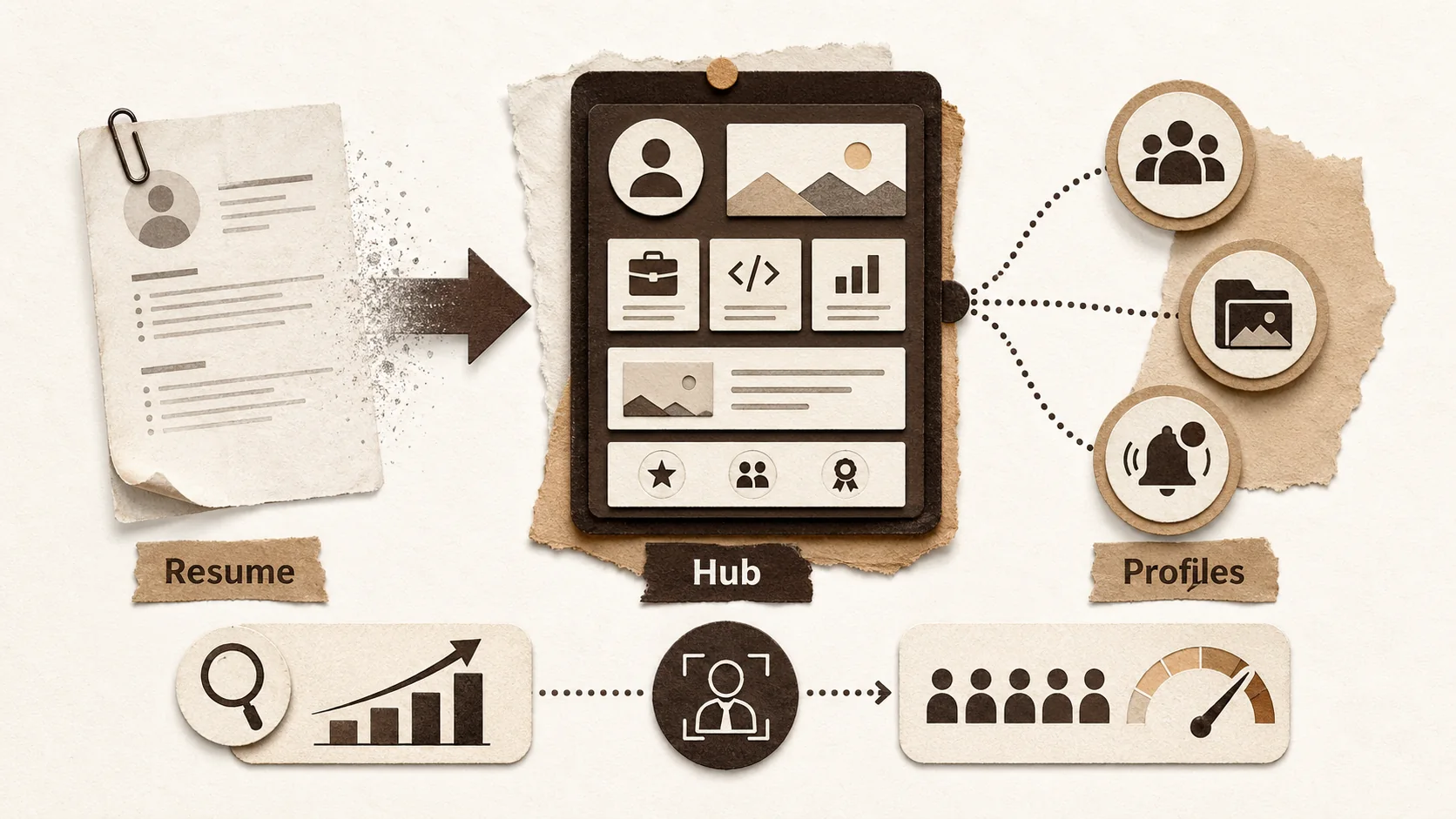
The portfolio stack isn't one tool; it's a strategic architecture. At its core is a central, linkable, single-page portfolio that acts as your professional command center. This hub is then intelligently layered with active profiles on platforms like LinkedIn (for network and credibility) and X or GitHub (for real-time proof of work and thought leadership). Together, they create a cohesive, discoverable, and compelling narrative that a PDF simply cannot match.
This article will deconstruct the 2026 portfolio stack, explain why single-page sites are winning, and provide a actionable blueprint for building yours.
The Death of the Static Resume: Why Context Matters
Over 90% of recruiters now Google candidates before scheduling interviews, and a portfolio stack -- a central single-page hub layered with active LinkedIn, GitHub, and Dribbble profiles -- provides the contextual proof of skill, culture fit, and currency that a static PDF resume cannot deliver.
For decades, the resume was the gatekeeper. It was a formatted list of past job titles, responsibilities, and education, designed to be skimmed in 30 seconds. Its fatal flaw? It exists in a vacuum. It tells a hiring manager what you did, but rarely how you did it, why it mattered, or, most importantly, who you are as a professional.
In a digital-first world, this lack of context is a deal-breaker. Consider these 2026 realities:
- The Google Search is the First Interview: Over 90% of recruiters use search engines and social media to research candidates. Your digital footprint is your first impression.
- Skills are Demonstrated, Not Listed: Saying you're a "skilled UX designer" on a resume is weak. Linking to a case study on your portfolio that walks through your design process, research, and final interactive prototype is powerful.
- The "Culture Add" Imperative: Companies hire for fit and potential. A single-page site can showcase your personality, side projects, writing, and speaking engagements—dimensions a resume actively filters out.
- The Speed of Change: In fast-moving fields like tech and marketing, your skills from six months ago might be outdated. A live portfolio can be updated weekly with new learnings, projects, or publications, while a resume is perpetually out of date.
The traditional resume reduces a multidimensional professional to a two-dimensional sheet. The portfolio stack re-inflates you into a full, dynamic person.
Anatomy of the 2026 Portfolio Stack
Three layers form the stack: Layer 1 is a single-page hub (your Popout page) with a value proposition, featured work, social proof, and CTA; Layer 2 is LinkedIn as validation engine using the "Featured" section to link back to case studies; Layer 3 is real-time proof platforms like GitHub, Dribbble, Behance, or X where consistent activity signals current engagement.
The modern portfolio stack is a multi-layered approach to professional storytelling. Each layer serves a distinct purpose, but they all interconnect to drive traffic and credibility back to your central hub.
Layer 1: The Central Hub (Your Single-Page Portfolio)
This is the cornerstone. Think of it as your professional homepage—a clean, fast-loading, SEO-optimized site that consolidates your entire professional identity.
Core Components of a Winning Hub:
- Hero Section with a Value Proposition: Immediately state who you are, what you do, and who you help. "Frontend Developer building accessible, performant web apps for SaaS companies" is stronger than "John Smith - Software Engineer."
- Featured Work with Case Studies: Don't just list projects. For 2-3 key projects, provide context: the problem, your specific role, the tools/technologies used, and—critically—the outcome or impact (e.g., "Increased user sign-ups by 15%").
- Dynamic "Now" Page/Link: A simple section or linked page showing what you're currently working on, learning, or reading. It signals curiosity and continuous growth.
- Integrated Social Proof: Testimonials from clients or colleagues, logos of companies you've worked with, or badges from certifications.
- Clear, Multi-Channel CTA: What do you want the visitor to do? "View my full case study," "Schedule a call," "Download my technical whitepaper," or "Follow me on X." Your Popout page excels here by allowing you to group all these key links beautifully.
- Contact & Link Aggregation: Every other profile you own should link back here, and this hub should have clear links to your LinkedIn, GitHub, etc. It's the spider in the web.
This hub solves the "link in bio" problem for professionals. Instead of sending someone to a disjointed LinkedIn profile or a dormant Twitter feed, you send them to a controlled, comprehensive experience. For more on crafting this essential hub, explore our guide on why your portfolio will get you hired in 2026. To understand how your first impression plays out, see the portfolio first 5 seconds rule.
Layer 2: The Validation Engine (LinkedIn)
LinkedIn is the formal record-keeper and network amplifier of your stack. It's where people go to verify your employment history, see your connections, and read recommendations.
Your LinkedIn Strategy in a Stack World:
- Keep it Updated, But Concise: Your LinkedIn profile should mirror the key dates and titles on your hub, but the deep dives belong on your portfolio.
- Use the "Featured" Section Aggressively: This is LinkedIn's built-in portfolio module. Feature links to your key case studies, articles on your hub, or videos of talks.
- Publish Updates that Point Back: When you update your central hub with a new project, publish a LinkedIn post about the lesson learned or challenge overcome, and link to the full case study on your site. You're using LinkedIn to drive qualified traffic to your owned property.
Layer 3: The Real-Time Proof (X, GitHub, Dribbble, etc.)
This layer is for activity and authenticity. It's the proof that you're engaged, skilled, and thoughtful in your field right now.
- For Developers (GitHub): Your commit history is your real-time resume. A pinned repository that aligns with the projects on your hub is gold. A green contribution graph shows consistent activity. Publishing packages on npm or PyPI adds another discovery layer.
- For Creators & Thinkers (X, Substack, Hashnode): Sharing insights, commenting on industry news, and publishing short-form thoughts establishes you as a knowledgeable professional. Your X bio's link should 100% be your portfolio hub.
- For Designers (Dribbble/Behance): These are extensions of your hub's work section. Post in-progress shots or additional concepts, but always ensure your full case study lives on your central site. Use Figma prototypes to add interactive depth.
The magic happens when these layers work together. A tweet about a coding challenge links to the solution on your GitHub, which is linked from your portfolio's "Projects" section, which is featured on your LinkedIn. You create multiple, reinforcing pathways for discovery.
Why Single-Page Portfolios Are Winning the SEO & Attention Game
Single-page portfolios win on five fronts: frictionless scrolling UX, near-perfect Google Core Web Vitals scores, controlled narrative flow, simplified maintenance that encourages frequent updates, and native mobile-first design -- all of which compound into higher recruiter save rates and better search rankings according to 2026 A/B test data.
You might wonder: why a single-page site? Aren't multi-page websites more professional? In the context of a personal portfolio stack, the single-page model has decisive advantages.
- Frictionless User Experience: A hiring manager or potential client can scroll and get the complete story without clicking through menus or waiting for pages to load. Information is consumed linearly and quickly.
- Unbeatable Core Web Vitals: With minimal assets and no page redirects, a well-built single-page site achieves near-perfect scores for loading performance, interactivity, and visual stability. Google loves this, and so do impatient users.
- Perfect for Storytelling: It allows for a controlled narrative flow. You guide the visitor from your introduction, through your best work, to your proof elements, and finally to your call-to-action.
- Simplified Maintenance: Updating one page is faster and less error-prone than managing a multi-page site. This encourages more frequent updates, which is a positive signal to both algorithms and humans.
- Mobile-First by Design: The long-scroll format is native to mobile devices. It ensures your portfolio is as impactful on a phone as it is on a desktop—a non-negotiable in 2026.
This approach is central to the concept of a hub portfolio, a centralized, link-optimized page designed to be the anchor of your entire online presence.
Building Your 2026 Portfolio Stack: A Practical Blueprint
A four-phase plan -- audit and consolidate (Week 1), build the hub with 3 case studies (Week 2), cross-link all LinkedIn, GitHub, Behance, and social bios to the hub (Week 3), and activate with stack posts and bi-weekly micro-updates (ongoing) -- takes one month to establish and 15 minutes per fortnight to maintain.
Ready to build or refine your stack? Follow this action plan.
Phase 1: Audit & Consolidate (Week 1)
- Google Yourself. What comes up? Note the good, the bad, and the missing. Use Google Alerts to monitor ongoing mentions.
- List All Your Profiles. LinkedIn, X, GitHub, Instagram, Medium, Behance, Dribbble, etc.
- Choose Your Central Hub Platform. You need a tool that makes creating a beautiful, fast, single-page site effortless. This is where a dedicated portfolio builder like Popout is purpose-built for the job, letting you create a stunning hub in minutes without code.
- Choose 1-2 "Proof" Platforms. Focus on the platforms most relevant to your field. Quality over quantity.
Phase 2: Build the Hub (Week 2)
- Craft Your Core Narrative: Write your 1-sentence value prop and a short bio.
- Select 3 Killer Projects: Choose work that best represents the direction you want to go, not just everything you've ever done. Build simple case studies for each.
- Gather Assets: Screenshots, logos, testimonials, headshots.
- Build the Page: Assemble it on your chosen platform. Prioritize clarity, speed, and visual appeal.
Phase 3: Connect the Stack (Week 3)
- Link Everything TO the Hub: Change the link in every single social media bio to point to your new portfolio.
- Link FROM the Hub: Add clear icons/links to your key social profiles (LinkedIn, GitHub, etc.) on your portfolio.
- Update LinkedIn: Refresh your headline, summary, and most importantly, use the "Featured" section to link to your new portfolio case studies.
Phase 4: Activate & Iterate (Ongoing)
- Make Your First "Stack Post": Share an update on LinkedIn/X about a challenge from one of your featured projects, and link to the full story on your hub.
- Commit to a Micro-Update Rhythm: Every two weeks, spend 15 minutes updating something—a new line in your "Now" section, a new small project on GitHub, a thoughtful comment on industry news.
- Review Analytics: Use the analytics on your portfolio platform (a key feature of Popout) to see what links are getting clicks and where your traffic is coming from. Double down on what works.
For a detailed comparison of tools that can help you build this system, check out our breakdown of the ultimate guide to portfolio builder alternatives in 2026.
The Future is Stacked
The portfolio stack -- central hub plus active LinkedIn, GitHub, and niche platform profiles -- is not a trend but a structural shift in how professional value is discovered, validated, and acted upon by recruiters, clients, and collaborators in 2026.
The trend is clear. The professionals who get noticed, hired, and funded in 2026 and beyond will be those who strategically manage their digital ecosystem. They won't have just a resume; they'll have a portfolio stack—a living, breathing professional presence with a powerful single-page hub at its heart.
This stack does more than get you a job; it builds your reputation, attracts opportunities passively, and gives you a platform you own and control. It turns you from a candidate into a curator of your own career narrative.
The best time to build your portfolio stack was yesterday. The second-best time is today.
Create Your Popout Page and start building your central hub in minutes. For a fast-track approach, follow our 3-day portfolio refresh guide. And to make sure your digital trail supports rather than undermines your stack, read about portfolio digital exhaust.
Frequently Asked Questions (FAQ)
What exactly is a "portfolio stack"?
A portfolio stack is a modern approach to professional branding that uses a combination of online tools to create a cohesive and discoverable presence. Its core component is a central, single-page portfolio website (the "hub") that showcases your best work and narrative. This hub is then integrated with active profiles on platforms like LinkedIn (for validation and network) and X or GitHub (for real-time activity and proof). Together, they form a stack that is more effective than any single platform or a traditional resume alone.
I have a LinkedIn profile. Isn't that enough?
While a strong LinkedIn profile is essential, it's often not enough on its own. LinkedIn is a standardized platform where you compete for attention in a crowded feed and are constrained by its format. Your own portfolio hub gives you complete creative control, allows for deeper storytelling through case studies, improves your personal SEO (Google can rank your personal site higher than your LinkedIn), and serves as a centralized link you can use everywhere. Think of LinkedIn as a powerful branch office, but your portfolio is your headquarters.
How is a single-page portfolio better than a multi-page website?
For personal portfolios, single-page sites offer significant advantages: Better Performance: They load faster, which is critical for user retention and SEO. Simpler Navigation: Visitors scroll instead of click, reducing friction. Stronger Narrative Flow: You can guide the viewer through a deliberate story from introduction to call-to-action. Easier Maintenance: Updating one page is quicker, making you more likely to keep it current. They are perfectly suited for the "link in bio" use case that drives most traffic to a professional's site.
What should I put on my portfolio hub if I'm just starting out or changing careers?
This is a common concern. Focus on potential and process, not just past job titles.
- Personal Projects: Build something that solves a problem or demonstrates the skills you want to be hired for. Document the process.
- Coursework & Certifications: Showcase significant learning milestones with a brief description of what you mastered.
- Thoughtful Analysis: Write a short case study analyzing a product or website in your target industry. What works? What would you improve?
- "Now" Page: Be transparent about your journey. "Currently transitioning into Data Analytics, building projects with Python and SQL, and completing the XYZ certification." The goal is to show proactive skill acquisition and critical thinking. If writing project descriptions feels daunting, our guide on using AI co-pilots to build a better portfolio walks through the process in 30 minutes.
How often should I update my portfolio stack?
Aim for different update cycles for each layer:
- Central Hub (Portfolio): Do a quarterly review. Add any major new projects, update your "Now" section, and refresh testimonials.
- LinkedIn: Update concurrently with any major hub change (new job, big project). Post smaller insights or industry commentary 1-2 times per month.
- Real-Time Platforms (X, GitHub): This is for daily to weekly activity. A few commits per week, sharing an interesting article with your take, or posting a work-in-progress shot. Consistency here signals an active, engaged professional.
Can a portfolio stack work for non-technical fields (e.g., marketing, management, operations)?
Absolutely. The principles are the same; the content shifts.
- Marketers: Showcase campaign results (with metrics), content samples, marketing plans, or competitive analyses.
- Managers & Operations: Use case studies to describe how you improved a process, led a team through a challenge, or managed a budget. Quantify results (e.g., "reduced operational overhead by 20%").
- All Professionals: Your hub can include writing (blog posts, whitepapers), speaking engagements (slides, videos), and a clear articulation of your professional philosophy. The stack demonstrates strategic thinking and communication skills valuable in any field.
Other Doved Studio projects
Related tools from the same studio you might find useful:
- Ralphable: Generate structured Claude Code skills that iterate until pass/fail criteria are met.
- Glean: Turn scrolling time into a daily action plan. Capture, process, execute.
- Doved Studio: Studio indie derrière cette app et une dizaine d'autres outils.
Written by
popout
Content Team