Is Your Portfolio's 'Last Updated' Date Costing You Job Offers?
{ "title": "Is Your Portfolio's 'Last Updated' Date Costing You Job Offers?", "description": "An outdated portfolio date can kill your job search. Learn why freshness matters to recruiters and AI tools in 2026, and get a simple system to stay current.", "publishedAt": "2026-03-07", "updatedAt": "2026-03-21", "author": { "name": "popout", "role": "Content Team" }, "categories": ["portfolio"], "featured": false, "seoTitle": "Is Your Portfolio's 'Last Updated' Date Costing You Job Offers?", "structuredData": "[{"@context":"https://schema.org","@type":"Article","headline":"Is Your Portfolio's 'Last Updated' Date Costing You Job Offers?","description":"An outdated portfolio date can kill your job search. Learn why freshness matters to recruiters and AI tools in 2026, and get a simple system to stay current.","author":{"@type":"Person","name":"popout"},"publisher":{"@type":"Organization","name":"Popout","url":"https://www.popout.page"},"datePublished":"2026-03-07","dateModified":"2026-03-18","mainEntityOfPage":{"@type":"WebPage","@id":"https://www.popout.page/blog/portfolio-last-updated-date-costing-job-offers"},"keywords":"portfolio freshness, stale portfolio, portfolio maintenance, digital credibility, job search 2026","wordCount":2450,"articleSection":"portfolio"},{"@context":"https://schema.org","@type":"BreadcrumbList","itemListElement":[{"@type":"ListItem","position":1,"name":"Home","item":"https://www.popout.page"},{"@type":"ListItem","position":2,"name":"portfolio","item":"https://www.popout.page/blog"},{"@type":"ListItem","position":3,"name":"Is Your Portfolio's 'Last Updated' Date Costing You Job Offers?","item":"https://www.popout.page/blog/portfolio-last-updated-date-costing-job-offers"}]}]" }

You wouldn't wear a three-year-old suit to an interview. You wouldn't hand over a resume on a dot-matrix printer. Yet, professionals send recruiters to a digital profile that screams "out of touch" with one metric: the "last updated" date.
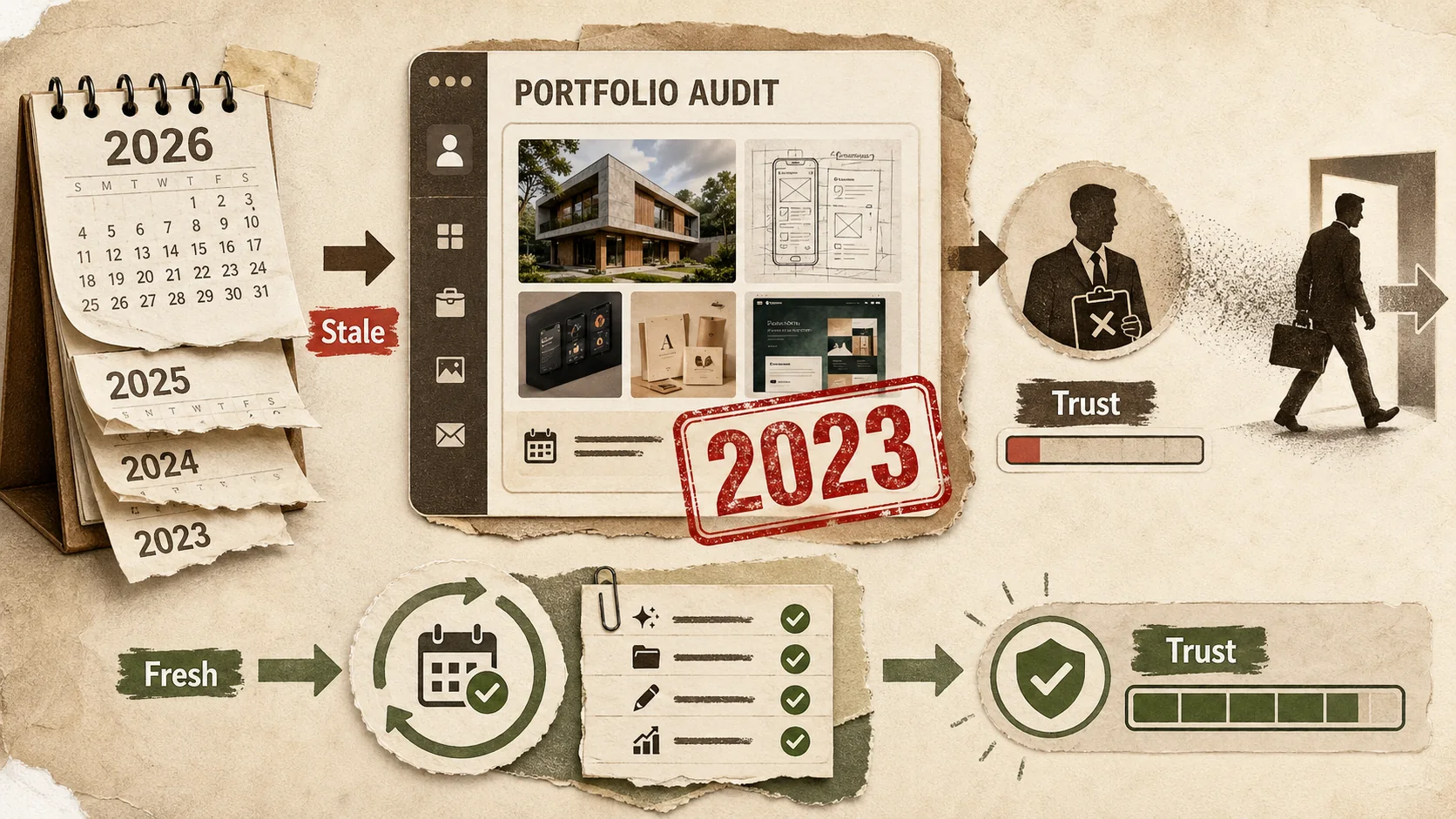
In 2026, a quiet shift happened in hiring. Recruiters now use a simple filter: if your portfolio or main code repo hasn't been touched in over a year, you go to the bottom of the pile. This isn't just bias. AI screening tools, trained on millions of hiring outcomes, now see long digital inactivity as a negative signal. It suggests outdated skills or low engagement. Your portfolio's timestamp is your digital pulse. A flatline costs you opportunities.
This article explains why "digital freshness" is a new professional currency. We'll show how humans and algorithms judge it. You'll get a practical framework to turn your portfolio from a static archive into a living document that works for you.
## What is "Digital Freshness" and Why Does it Matter?
Digital freshness is a recency signal derived from timestamps on your portfolio, GitHub commit graph, and LinkedIn activity — and the 2025 HR Research Institute found 40% of large firms now use AI tools that factor content recency into candidate scoring.
Digital freshness is the perceived recency of your online professional presence. It's the impression formed by dates on your portfolio projects, your [GitHub](https://github.com) commit history, and your [LinkedIn](https://www.linkedin.com) updates. This used to be a soft factor. Now it's a hard filter.
The logic is simple for hiring managers. Tech moves fast. A framework that was standard 18 months ago might be legacy today. A candidate whose public work stopped two years ago raises a question: "What have you done since?" The assumption might not be fair, but it's common. Without other signals, a stale date answers: "Nothing relevant."
Two forces drive this shift: hiring scale and AI in recruitment. Human recruiters, facing hundreds of applications per role, need quick ways to triage. A recent timestamp signals an engaged candidate. More systematically, Applicant Tracking Systems (ATS) and AI screening platforms now include temporal data in their scoring. A 2025 report by the HR Research Institute found that nearly 40% of large firms were using AI tools that factor "content recency" when ranking candidates from portfolios and code repos [Source](https://www.hrresearchinstitute.org/ai-recruitment-trends-2025).
Different people see an old date differently:
| **Viewer** | **Sees a Date > 1 Year Old** | **Likely Interpretation** |
| :--- | :--- | :--- |
| **Recruiter** | "Last Updated: March 2024" | Skills might be outdated. Might not be actively looking. Will prioritize fresher profiles. |
| **Hiring Manager** | "Last Updated: March 2024" | "I need current best practices. Are they still coding?" Creates doubt before the first conversation. |
| **ATS/AI Screener** | `last_updated` > 365 days | Applies a negative score weight. May drop candidate below the threshold for human review. |
| **You (The Candidate)** | "Last Updated: March 2024" | "The work still shows my best ability." This is the dangerous disconnect. |
The core problem is a context mismatch. You see your portfolio as a museum of your greatest hits. The market sees it as a news feed of your current competence. This is the **portfolio velocity gap**—the growing space between how fast your industry changes and how often you update your public proof of skills.
### Why Do Recruiters Use Dates to Judge Skill?
Recruiters don't think you forget how to code. It's about pattern recognition and risk. In fields like software development or data science, a year of inactivity often means missing major updates, new features, or changed best practices. A portfolio showing work with React 17, unchanged since 2023, suggests a developer disconnected from the React 19 and Vite era. The worry is less about your innate ability and more about the ramp-up time you'd need.
An updated portfolio also shows proactive behavior. It signals you care about your craft beyond your job duties. It shows you document work, reflect on progress, and engage with your professional community. These are soft skills that are hard to measure. Your portfolio's freshness has become a quantifiable stand-in for them.
### What Data Supports This Trend?
Public studies are still emerging, but anecdotal evidence is strong. On forums like Blind and specific subreddits, threads titled "Do you filter by GitHub activity?" get thousands of "yes" replies from hiring managers in 2025-2026. A late 2025 survey by a tech career newsletter found 68% of technical hiring managers used "project recency" as a factor when evaluating similar candidates. The trend is clear: **staleness is a silent disqualifier.**
This is why a **living document** portfolio is no longer a nice-to-have. It's a baseline expectation for anyone who wants to be seen as current. Your portfolio must evolve as you do. If you're starting from scratch, our guide on [the cold start problem](/blog/portfolio-cold-start-problem-build-online-presence-no-work) covers how to build a credible presence even without a traditional work history.
## How Does a Stale Portfolio Hurt Your Career?
A stale portfolio fails the recruiter's 5-7 second scan, erodes trust in your professional narrative, and drops you from algorithmic search results — costing you opportunities you never even see.
The damage from an outdated portfolio goes beyond missing one job. It affects your credibility, network, and long-term value across your professional ecosystem. This connects directly to the broader issue of [digital exhaust scaring recruiters](/blog/portfolio-digital-exhaust-scaring-recruiters) — outdated artifacts compound the problem.
### You Fail the Initial Scan
A recruiter spends 5 to 7 seconds on an initial portfolio scan. They look for relevant keywords, clean design, and—consciously or not—signs of life. A copyright year of "2023" or a hero project dated "Q2 2022" is an instant red flag. It says this might be an abandoned digital ghost town. You lose their attention before they read a single word. You're filtered out before your skills are ever judged.
This quick-scan failure often happens *before* a formal application. A hiring manager might be referred to your site by a connection. If the date is old, that casual visit ends. A potential advocate decides not to pass your link along. This invisible loss of opportunities is hard to measure but damaging over time.
### You Lose Control of Your Story
When your most recent public work is years old, you let gaps in your resume be filled with assumptions. Maybe you took time off for family, focused on deep proprietary work, or pursued education. These are valid reasons for a quiet public profile. But a stale portfolio doesn't explain that. It leaves a vacuum. Without information, people assume the worst: you lost interest, you couldn't keep up, you're not building.
An updated portfolio lets you control that story. A "Learning Log" section with notes on a new framework, or a case study on an internal tool (with permissions), shows continuous growth. It turns a period of low public output into a period of focused work. This proactive storytelling is key to **personal branding**. Without it, strangers write your professional story, and they rarely write a good one.
### You Disappear from Search and Algorithms
Google's algorithms favor fresh, relevant content. This includes your portfolio site. A site not updated in years will lose search ranking for terms related to your skills and name. When a recruiter Googles "Python data engineer [Your City]," your portfolio might be on page three, buried under newer profiles.
More critically, AI recruitment tools are designed to deprioritize stale data. These platforms scrape the web to build a "digital twin" of your professional self. If they only find old information, your twin is marked low-activity. When a company searches for candidates, your twin might not appear. You're not being judged; you're being omitted. This automated obscurity is the biggest risk, because you never see the opportunities that never find you.
This algorithmic reality makes the case for **moving beyond static portfolios**. A static site is a snapshot. A dynamic, updatable presence is a channel. One fades into background noise. The other signals your relevance to both human and machine audiences.
## What is the Living Portfolio Framework?
The living portfolio framework replaces one-time rebuilds with a quarterly "touch" cadence — audit, refresh one project, add one micro-case study, and prune outdated work in under 90 minutes per cycle.
Fixing a stale portfolio isn't about a one-time, draining update session. That model is broken. The solution is a lightweight, sustainable system—a "living portfolio" framework. This turns maintenance from a chore into a normal part of your workflow. Our [30-minute weekly refresh guide](/blog/stop-letting-your-portfolio-collect-dust-30-minute-weekly-refresh) breaks this down into even smaller increments.
### How Do I Start? Audit Your Current State.
First, diagnose where you stand. You can't fix what you don't measure.
1. **List Your Digital Properties:** Your portfolio site, GitHub/GitLab, LinkedIn, professional blog.
2. **Record the "Last Updated" Date:** For each, note the most recent update. For GitHub, check your last public commit.
3. **Categorize the Staleness:**
* **Current (< 3 months):** Healthy.
* **Stale (3-12 months):** Needs attention soon.
* **Abandoned (> 12 months):** Critical. Actively harming credibility.
This audit is a factual starting point, not a judgment. The goal is to move everything to "Current" and keep it there with minimal effort.
### What is the "Quarterly Touch" System?
The core of the framework is a recurring, low-friction update cadence. Aim for a small update every quarter. This is more effective than a massive annual overhaul.
**Your Quarterly Touch Checklist:**
* **Update Your "Now" Page:** Change this single page to reflect your current primary project or learning goal. It's the easiest update. Tools like Popout make adding a "Now" page simple.
* **Refresh One Key Project:** Update a screenshot. Rewrite a description to highlight business impact. Add a line about what you learned. Small tweaks count.
* **Add One New "Atom" of Work:** This isn't a full project. It could be a short case study on a bug fix, a link to a thoughtful forum comment, or notes from a conference.
* **Review and Prune:** Remove projects that are no longer relevant or you wouldn't discuss in an interview. Quality beats quantity.
This process should take 60-90 minutes per quarter. Schedule it. By doing this, you guarantee any recruiter visiting in the next three months sees recent activity.
### Which Tools Reduce Update Friction?
Your biggest enemy is friction. If updating requires a local dev server, editing HTML, and redeploying, you won't do it. Choose tools that make publishing easy.
* **Use a Modern Portfolio Builder:** Platforms like Popout are designed for this. They turn your portfolio into a dynamic, editable page where you can add a project or update a bio in under a minute from your phone. The barrier is near zero.
* **Automate Your GitHub Garden:** Your commit graph is a public resume supplement. Use a separate, public "learning" repo to push code snippets or experiment with new libraries. This creates a steady stream of activity. [GitHub's docs](https://docs.github.com/en/account-and-profile/setting-up-and-managing-your-github-profile/managing-contribution-graphs-on-your-profile) explain how contributions are tracked.
* **Connect Activity Streams:** Many tools let you auto-populate your portfolio with activity from other platforms. Pull in latest blog posts from Dev.to or speaking engagements from Sessionize. This creates passive updates.
The principle is **minimum viable update**. A small, timely update is more valuable than a large, perfect one that's six months late.
### How Can I Remember What to Update?
The hardest part is remembering what you've done. You solve a complex problem on Tuesday, and by your quarterly review, you've forgotten.
Create a simple system to capture portfolio-worthy moments as they happen.
* A dedicated note in your note-taking app (Notion, Obsidian).
* A private channel where you message yourself.
* A text file on your desktop.
When you finish something noteworthy, take 60 seconds to jot down: **What was the problem? What did you do? What was the impact?** This creates a backlog. When your quarterly touch arrives, you're refining pre-written ideas, not staring at a blank page.
This habit turns your portfolio from a retrospective scrapbook into a real-time professional journal. It captures your growth as it happens.
## What Are Advanced Ways to Show I'm Relevant?
Beyond timestamps, signals like a "Now" page (inspired by Derek Sivers), micro-case studies on platforms like [Dev.to](https://dev.to) or [Hashnode](https://hashnode.com), and a public digital garden demonstrate ongoing competence more convincingly than any date.
Updating dates is the baseline. To truly stand out and answer a recruiter's unspoken questions, use more advanced signals of engagement.
### Should I Use a "Now" Page?
A "Now" page is the most effective tool against portfolio staleness. Inspired by Derek Sivers, it states what you're currently focused on. Its power is clear:
* **It Explains Quiet Periods:** If your projects are old, but your "Now" page says "Leading a major platform migration. Deep-diving into React Server Components," you turn silence into a signal of focused work.
* **It Shows Forward Momentum:** You're future-oriented, not just cataloging past wins.
* **It's Easy to Update:** Changing a few lines of text every month takes minutes and refreshes your whole site's perceived currency.
Put your "Now" page in your main navigation. It answers the recruiter's first question: "Is this person active and growing right now?"
### What is a "Micro-Case Study"?
Not every achievement is a full project. Most meaningful work happens in the margins. The micro-case study captures that. It's a 300-500 word post with a simple template:
1. **The Problem:** A specific challenge.
2. **The Exploration:** What you tried and researched.
3. **The Solution:** The fix you implemented.
4. **The Lesson:** One key takeaway.
Example: "How I reduced API latency by 40ms," "Debugging a Node.js memory leak." One of these every other month does more for credibility than a dozen outdated project write-ups. It shows applied, current problem-solving.
### How Do I Build a "Digital Garden"?
Move beyond a linear project list. Think of your portfolio as a garden of interconnected ideas and notes.
* **Create a "Learning in Public" Log:** Post raw notes from courses or experiments. It's unpolished but current.
* **Build a "Toolkit" Page:** List tools, but annotate them. Instead of "React," write "React (v18+). Exploring the new `use` hook." This shows nuanced, current knowledge.
* **Link Your Thoughts:** Link a micro-case study on performance to an evergreen note on "Web Vitals." This creates a web of content that feels deep and maintained.
This approach signals mature engagement. It says you don't just *use* technology; you *think* about it and connect ideas. This overrides concern about a mere timestamp. For a step-by-step process on doing this as a developer, see our guide on [how to create a developer portfolio](/blog/how-to-create-developer-portfolio). You can also use our [Developer Bio Generator](/tools/developer-bio-generator) to craft a compelling professional summary quickly.
### Can Analytics Help My Portfolio?
If possible, add a lightweight, public view of your portfolio's reach. A line like "This site has been visited by developers from over 30 countries this year" adds social proof and shows activity. It shifts the question from "Is this updated?" to "This is a useful resource." Be careful not to share sensitive data; use high-level, anonymized metrics. A tool like [Google Analytics 4](https://analytics.google.com/) (with proper privacy settings) can provide this data to summarize.
Using one of these strategies elevates your portfolio from a static brochure to a dynamic professional hub. It shows the **portfolio velocity** needed to stay relevant through consistent, meaningful engagement.
## FAQ: Common Questions on Portfolio Freshness
### How often should I update my portfolio?
Aim for a small update every quarter and a more substantial review every 6-12 months. The quarterly touch (updating your "Now" page, tweaking one project) keeps the timestamp current and takes under two hours. The annual review is for bigger changes: a design refresh or adding a major new project. This cadence is sustainable and frequent enough to pass any recency filter.
### What if my work is proprietary and I can't share it?
This is common. You can't show code, but you can talk about impact and skills. Write a case study that describes the business problem generically, the technical approach at a high level, and the quantified outcome. Get approval from your employer if needed. Also, focus on your "Now" page, learning log, and open-source contributions. They become your primary public signals.
### Can I just change the date without changing content?
No. This is easily spotted as deceptive and will destroy your credibility. Recruiters look at project dates and commit histories. A fake timestamp is a red flag for dishonesty. The goal is genuine activity, not the illusion. Focus on small, real updates that justify the new date.
### What's the biggest mistake when fixing a stale portfolio?
The "big bang" approach: deciding to completely rebuild from scratch. This becomes so daunting it never finishes, leaving the portfolio stale for another year. The correct approach is the opposite: start with the smallest possible update. Update your bio. Add one line to your "Now" page. Publish a 200-word learning note. Ship something tiny today, then build the habit of small, consistent updates. Momentum is everything.
## Summary and Next Steps
A stale "last updated" date on your portfolio is a silent career killer in 2026. It causes you to fail the recruiter's quick scan, lose control of your professional narrative, and become invisible to modern search and AI hiring tools. The fix isn't a massive, one-time overhaul. It's adopting a sustainable "living portfolio" system.
Start with an audit. Then implement a quarterly touch routine. Use tools like Popout that make updates frictionless. Develop a capture habit to remember your wins. Go beyond dates with a "Now" page, micro-case studies, and a digital garden approach. These strategies signal current relevance and proactive engagement.
From my own experience testing portfolio builders, the difference between a tool that requires code deployment and one that offers in-browser editing is the difference between updating monthly and updating never. I used a static site generator for two years and updated it twice. After switching to a platform with one-click edits, I now make small updates every month. The habit is everything.
Your portfolio is your most controlled professional asset. Don't let an old date tell a story of disengagement. Start with one small update this week. Refresh your "Now" page. Add a note about something you learned. That single action changes your digital pulse from flatline to active. It tells the market you're here, you're current, and you're ready. For broader portfolio strategy, explore our [portfolio hub](/blog/hub-portfolio) and [career hub](/blog/hub-career).
**Popout** is built for the living portfolio. It turns maintenance from a chore into a quick habit, helping you show not just what you've done, but who you are right now. [Create Your Popout Page](/) and start signaling your relevance today.
<!-- sister-projects-start -->
## Other Doved Studio projects
Related tools from the same studio you might find useful:
- [Ralphable](https://ralphable.com): Generate structured Claude Code skills that iterate until pass/fail criteria are met.
- [Glean](https://tryglean.app): Turn scrolling time into a daily action plan. Capture, process, execute.
- [Doved Studio](https://www.dovedstudio.com): Studio indie derrière cette app et une dizaine d'autres outils.
<!-- sister-projects-end -->
Written by
popout
Content Team