
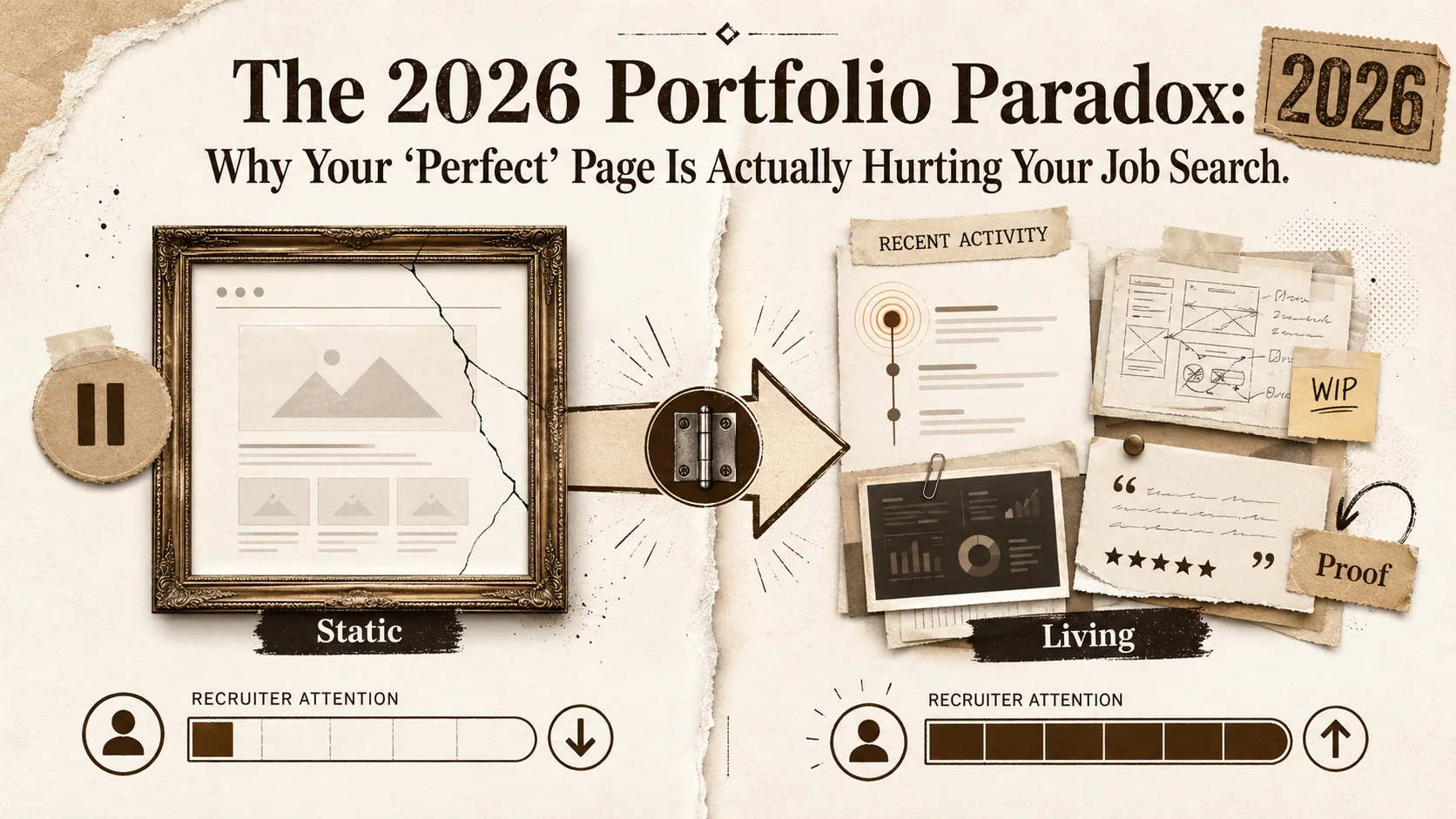
The 2026 Portfolio Paradox: Why Your 'Perfect' Page Is Actually Hurting Your Job Search

You spent weeks, maybe months, crafting it. You agonized over the perfect hero image, the most elegant layout, and the most impressive-sounding project descriptions. Your portfolio is a masterpiece of digital perfection—a static monument to your skills. Yet, the job offers aren't coming. The interviews are sparse. What’s going wrong?
Welcome to the 2026 Portfolio Paradox. In a stunning reversal of conventional wisdom, the very "perfection" you've been taught to strive for is now working against you. A January 2026 report from The Hiring Lab revealed a critical insight: recruiters spend 37% less time on portfolios that look like templated 'brochureware' and show no recent activity. Concurrently, social media discourse on LinkedIn and X is buzzing with terms like "portfolio fatigue" and a demand for "living documents" over static showcases.
The game has changed. The polished, one-and-done portfolio is no longer the golden ticket. In 2026, authenticity, dynamism, and proof of ongoing problem-solving are the new currency. This article will dissect this paradox, explain why your perfect page might be a liability, and provide a blueprint for building a portfolio that actually gets you hired.
The Rise and Fall of the "Perfect" Portfolio
Templated portfolios backfired because recruiter AI tools now flag generic content -- a 2025 Greenhouse report found that 41% of recruiters actively deprioritize portfolios with no recent commits on GitHub or activity updates on LinkedIn, treating "polish without proof" as a negative signal.
For years, the advice was consistent: create a flawless, professional online presence. Use a sleek template, write polished case studies, and present a cohesive narrative. This approach made sense in an era of digital scarcity, where simply having an online portfolio set you apart.
However, this strategy has led to a sea of sameness. As portfolio builders and templates have proliferated, a strange homogeneity has emerged. Recruiters and hiring managers are now inundated with pages that look eerily similar—same layouts, same stock photography, same vague "I led a team to success" project summaries. They’ve become adept at spotting the difference between genuine work and filler content designed to look impressive.
The 2026 shift is driven by two powerful forces:
- Algorithmic Skepticism: Applicant Tracking Systems (ATS) and recruiter-side platforms are increasingly using AI not just to parse keywords, but to assess authenticity. They can flag content that is overly generic, lacks specific metrics, or shows no signs of recent updates. A static page last updated in 2024 signals inactivity, not perfection.
- Human Craving for Authenticity: After years of polished corporate speak and AI-generated content, humans are craving realness. A hiring manager wants to see how you think, not just a sanitized summary of what you did. They want evidence of iteration, failure, learning, and adaptation—the messy, beautiful process of creating value.
The Three Sins of the "Static Showcase"
Static portfolios fail on three axes: an authenticity gap (over-polished pages feel like marketing brochures, not real work), a proof problem (claims without GitHub commit trails, Behance process shots, or Dribbble iteration logs), and an engagement black hole (no return-visit incentive for recruiters who scan 50+ candidate profiles per week).
Why exactly does the old model fail? Let's break down the three critical flaws of the perfect-but-static portfolio.
1. The Authenticity Gap
A portfolio that is too polished creates a disconnect. It feels like a marketing brochure, not a window into a professional's mind. When every project is described as a "massive success that increased KPIs by 300%," it raises red flags. Recruiters are left wondering: Where are the challenges? What did you actually do? The lack of nuance makes the candidate seem inauthentic and potentially difficult to vet.
2. The Proof Problem
Saying you're a "problem-solver" or a "great designer" is meaningless without evidence. Static portfolios often tell, but don't show. A dynamic portfolio, however, demonstrates. It can include:
- Work-in-progress snippets: Code commits on GitHub, design iterations on Figma, or early-stage concepts shared via Behance project boards.
- Real-time updates: A link to a recently published article on Medium or Dev.to, a launched feature, or an updated GitHub repo.
- Process documentation: Sketches exported from Dribbble, meeting notes (sanitized), or A/B test results from Hotjar or Google Analytics 4.
This is "dynamic proof"—tangible, time-stamped evidence of your active skills.
3. The Engagement Black Hole
A static page is a dead end. A visitor looks, maybe clicks a link or two, and leaves. A dynamic portfolio invites engagement and return visits. By regularly adding content—like a brief case study on a recent bug fix, a reflection on a new tool learned, or a link to a side project update—you signal that you are an active, engaged professional. This not only impresses humans but can also positively influence SEO, driving more organic traffic from recruiters searching for specific, current skills.
Introducing the "Dynamic Proof" Portfolio
A Dynamic Proof Portfolio replaces static claims with time-stamped evidence -- GitHub contribution graphs, LinkedIn activity feeds, embedded Loom walkthroughs, and live Cloudflare deployment links -- so recruiters verify your skills in seconds instead of taking your word for it.
The antidote to the portfolio paradox is the Dynamic Proof Portfolio. This isn't just a website; it's a living, breathing professional hub that evolves with your career. It prioritizes authentic evidence over polished claims and ongoing engagement over one-time perfection.
Core principles of a Dynamic Proof Portfolio:
- Project-Centric, Not Page-Centric: The focus shifts from a single, perfect "Work" page to individual, detailed project modules that can be easily added and updated.
- The Process is the Product: Showcase not just final outcomes, but your thinking, iterations, and lessons learned.
- Regular Micro-Updates: Instead of a massive annual overhaul, incorporate small, frequent updates that reflect your current work.
- Integrated Evidence: Seamlessly embed or link to live work—GitHub repositories, published articles, design prototypes, video demos—directly on your page.
This model aligns perfectly with the needs of modern creators, developers, and freelancers who are constantly shipping work and learning new skills. It turns your portfolio from a historical record into a compelling, real-time professional narrative. The concept maps directly to proof-of-work elements replacing references in the modern hiring process.
For a deeper dive into structuring this kind of page, explore our guide on how to create a developer portfolio, which emphasizes showcasing active code and problem-solving.
Building Your Dynamic Proof Portfolio: A 2026 Action Plan
The transition takes four steps: a proof audit of every claim on your current page, converting wins into micro-case studies, adding a "living links" section fed by GitHub, Dev.to, and Dribbble activity, and scheduling quarterly 30-minute refresh sessions to prevent decay.
Transitioning from a static showcase to a dynamic proof engine is simpler than you think. Follow this actionable framework.
Step 1: Conduct a "Proof" Audit of Your Current Portfolio
Go through each project and ask:
- Claim: What skill or achievement am I stating here?
- Proof: What tangible, specific evidence do I provide? (e.g., "Improved performance" vs. "Increased page load speed by 40% via code splitting, evidenced by Lighthouse report snapshot [link]")
- Recency: When was this last updated? Does it feel current?
Replace vague assertions with concrete evidence.
Step 2: Embrace the "Micro-Case Study"
Not every project needs a 2000-word case study. Create space for smaller wins:
- "How I Solved [Specific Problem] in a Week": Detail a technical challenge, your debugging process, and the solution.
- "A Quick Redesign: Before & After Thinking": Share a before/after of a UI tweak with a short explanation of the user feedback that drove it.
- "Learning [New Tool]: My First Project": Show what you built while learning a new framework or language.
These snippets are fast to create and rich with authentic proof.
Step 3: Implement a "Living Links" Section
Move beyond a static list of links. Create a dedicated, easily updatable space for:
- Your latest blog post or article.
- Your most recent GitHub commit or repository.
- A current side project demo.
- A link to your latest speaking engagement or conference talk.
This section signals that your page is a current portal to your active professional life. Platforms that facilitate this kind of easy, modular updating are becoming essential. For a look at the landscape, check out our analysis of the ultimate guide to portfolio builder alternatives in 2026. To understand how freshness affects perception specifically, see is your last updated date costing you job offers.
Step 4: Schedule Quarterly "Refresh" Sessions
Block 30 minutes on your calendar every quarter. In that time:
- Add one new "Micro-Case Study."
- Update the "Living Links" section.
- Review and update the metrics or outcomes in one older project.
- Ensure all external links (to GitHub, live sites, etc.) are working.
This minimal upkeep prevents your portfolio from decaying into "brochureware."
Why Popout is Built for the Dynamic Proof Era
Popout reduces portfolio maintenance friction to near zero -- modular updates, built-in analytics to see which projects recruiters click most, and a mobile-first editor -- so dynamic proof becomes a habit, not a project.
The shift to dynamic proof isn't just a philosophy; it requires a tool that supports it. Traditional website builders or rigid portfolio templates often make frequent, small updates a chore. This is where a modern portfolio and bio link builder like Popout is designed to excel.
Popout’s core functionality is inherently aligned with the needs of a Dynamic Proof Portfolio:
- Modular & Fast Updates: Adding a new project link, updating a bio, or inserting a new "living link" takes seconds, not hours. There’s no need to wrestle with complex page builders or templates.
- Project-Centric Focus: The platform encourages you to think in terms of individual, showcase-able pieces of work (projects, articles, links) that can be organized and rearranged effortlessly.
- Integrated Analytics: Understanding what recruiters or clients are clicking on (your latest project? your GitHub?) provides invaluable feedback to further refine your dynamic proof, moving beyond vanity metrics to actionable insights.
- SEO for People: A Popout page is structured to be easily found by recruiters searching for your specific, current skill set, helping you move beyond the static resume database.
In essence, Popout reduces the friction of maintaining an authentic, current professional presence, allowing you to focus on creating the proof rather than managing the website. It turns your portfolio from a static monument into a dynamic conversation starter.
Ready to build a portfolio that works for 2026? Create Your Popout Page in minutes and start showcasing your dynamic proof.
The Future is Fluid
The 2026 Portfolio Paradox is a clear signal: the era of the "set it and forget it" portfolio is over. In a market that values agility, authenticity, and continuous learning, your online presence must reflect those same qualities. By embracing the Dynamic Proof model -- focusing on tangible evidence, regular updates, and authentic process -- you transform your portfolio from a potential liability into your most powerful career asset.
Don't let a pursuit of outdated perfection hold you back. Start building, iterating, and showing your work in real-time. Your next opportunity is looking for proof, not just polish. If you're worried about getting your digital footprint in order first, our digital exhaust cleanup guide covers the essential audit steps before you go dynamic.
For more insights on crafting a compelling professional narrative, visit our central hub for portfolio strategies and tips.
FAQ: The 2026 Portfolio Paradox
Q1: How often should I update my portfolio to avoid looking "static"? There's no one-size-fits-all answer, but a good rule of thumb is quarterly micro-updates and a substantial update with any major career milestone (new job, completed large project, learned a new core skill). The key is consistency and substance over frequency. Adding a thoughtful, proof-backed project snippet every 3-4 months is far more effective than making trivial text changes every week.
Q2: Isn't showing "work in progress" or process unprofessional? Quite the opposite in 2026. Professionally curated process work is now a sign of depth and transparency. The key is curation, not dumping. Don't show every messy sketch. Do show the key iteration that solved a user problem, or the code refactor that improved efficiency. Frame it with a brief explanation of the challenge and the thinking behind the solution. This demonstrates analytical and problem-solving skills that a final image alone cannot.
Q3: My work is often under NDA or within proprietary systems. How can I show "dynamic proof"? This is a common challenge. Focus on generalizing the problem and solution without revealing confidential data.
- Use anonymized, mocked-up data in your designs or examples.
- Describe the type of technical challenge (e.g., "optimizing data flow between microservices") and the generic solution architecture you employed, without specifics.
- Showcase your contributions to internal documentation, process improvements, or presentations (with sensitive info removed).
- Highlight public-facing work like blog posts, open-source contributions, or talks that stem from your professional learnings.
Q4: Do I still need a traditional, polished PDF resume? Yes, but its role has changed. Think of your Dynamic Proof Portfolio (your Popout page) as the primary source of truth and engagement. Your PDF resume should now act as a concise, scannable summary and navigation guide to your portfolio. It should highlight key achievements with bullet points and, crucially, include a prominent link to your live portfolio URL where recruiters can find the full proof and context.
Q5: How do I know if my portfolio is suffering from the "paradox"? Conduct a quick audit. Ask yourself:
- When was the last meaningful update?
- Do my project descriptions sound generic, or do they contain specific metrics, tools, and my personal role?
- Could my portfolio be mistaken for a template with just the text swapped out?
- Is there any evidence of my thinking or just the final output? If you answered "over a year ago," "generic," "yes," and "just output," it's time for a dynamic proof overhaul.
Q6: Can a simple link-in-bio tool really function as a serious portfolio? The category has evolved. Modern platforms like Popout are portfolio and bio link builders designed for professionals. They go beyond simply aggregating social links. They allow for rich project displays, detailed descriptions, custom branding, and analytics—all in a format that is inherently easy to update. For many professionals, especially in tech, creative, and freelance fields, a well-crafted Popout page is a more effective and agile central hub than a traditional, multi-page website. It meets recruiters where they are (often on mobile) and delivers proof without friction.
Other Doved Studio projects
Related tools from the same studio you might find useful:
- Ralphable: Generate structured Claude Code skills that iterate until pass/fail criteria are met.
- Glean: Turn scrolling time into a daily action plan. Capture, process, execute.
- Doved Studio: Studio indie derrière cette app et une dizaine d'autres outils.
Written by
popout
Content Team