
The 2026 Portfolio Pivot: Your Side Projects Are Your Career Asset


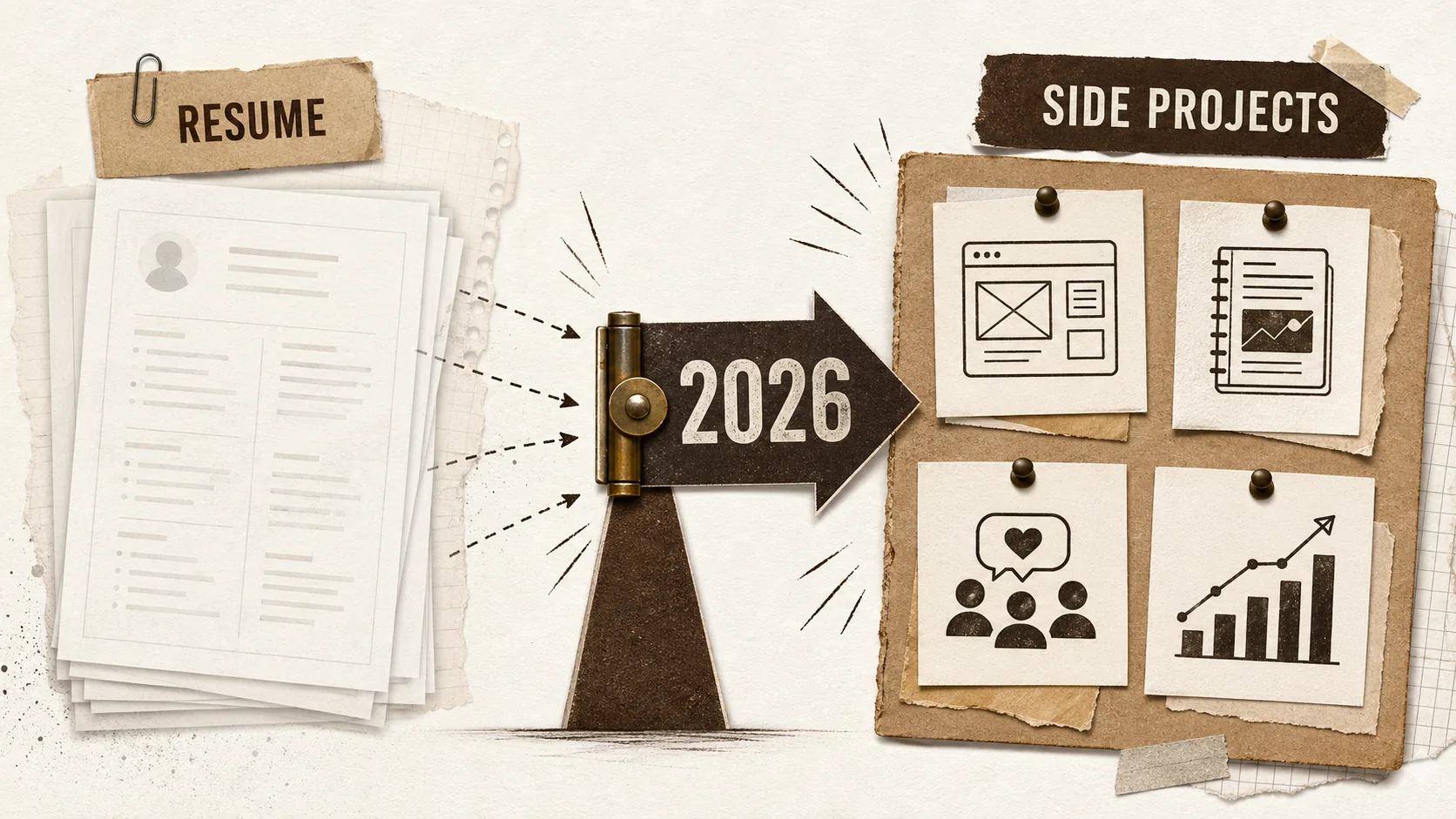
The resume is no longer the star of the show. If you're still leading with a two-page PDF of job titles and dates, you're missing the most important hiring signal of 2026: your demonstrable passion work.
A recent analysis from LinkedIn revealed a 40% year-over-year increase in recruiters using filters to hunt for candidates with "notable side projects" or "portfolio work" Source. On social platforms, the hashtag #PortfolioPivot has exploded, chronicling thousands of career transitions where a personal project—not a previous job title—became the key to a new role. This is a fundamental shift in how professional value is assessed across creative, marketing, and business fields.
Welcome to the era of the Portfolio Pivot. In a market saturated with qualified candidates, your side projects have evolved from casual hobbies to your primary career asset. They are the tangible proof of your skills, initiative, and problem-solving abilities that a bullet point on a resume can never convey. This article will guide you through why this shift is happening, how to strategically position your projects, and the tools you need to make your passion work impossible for recruiters to ignore.
The Death of the "Experience-Only" Resume
The experience-only resume is dying because it cannot prove initiative, practical skill currency, or problem-solving ability — three qualities that side projects inherently demonstrate and that companies like Google, IBM, and EY now prioritize over traditional degree requirements.
For decades, the linear career narrative reigned supreme. Your value was a simple equation: Company Prestige + Job Title + Years of Service. That model is crumbling. The rapid pace of technological change means that formal job descriptions often lag years behind the skills actually needed. A developer hired in 2023 might not have touched the AI-integration tools that are standard in 2026. A marketer might have experience with outdated campaign structures.
Hiring managers, overwhelmed by hundreds of applicants with similar degrees and job histories, are looking for a differentiator. They need proof, not promises. A side project is that proof. It answers critical questions a resume leaves unanswered:
- Initiative: Did you build this because you were told to, or because you saw a problem and were driven to solve it?
- Practical Skill: Can you actually execute on the technologies or strategies listed on your CV?
- Problem-Solving: How do you approach challenges, make decisions, and iterate?
- Passion: What do you genuinely care about? Passionate employees are often more innovative and resilient.
This aligns with the global move towards skills-based hiring. Companies like Google, IBM, and EY have publicly de-emphasized degree requirements in favor of skill assessments and portfolio reviews. Your side project is the ultimate skills assessment—one you designed and completed on your own terms.
What Makes a "Career-Transforming" Side Project?
A career-transforming side project has three attributes: it solves a real problem, it showcases a cluster of complementary skills (design, code, deployment), and it is documented and "show-ready" with a clear narrative that others can evaluate.
Not all side projects are created equal. The weekend you spent tweaking your smart home lights is different from building a full-stack application. A career-transforming project typically has three key attributes:
- Solves a Real (or Interesting) Problem: It addresses a gap, however small, improves a process, or explores a new technology. It has a clear "why."
- Showcases a Cluster of Skills: It's not a one-trick pony. A great project might demonstrate front-end design, backend logic, API integration, and basic DevOps deployment.
- Is "Show-Ready": It is documented, accessible, and presented in a way that others can understand and appreciate its value. A GitHub repo with no README is a closed book.
Examples of High-Impact Portfolio Projects:
- For a Developer: An open-source tool on GitHub that automates a tedious workflow, a mobile app that uses a novel API, or a contribution to a major library/framework. Publishing on npm or PyPI adds discoverability.
- For a Designer: A comprehensive case study on Behance or Dribbble for a reimagined user experience of a common app, a self-initiated branding project for a fictional company, or a set of design system components prototyped in Figma.
- For a Marketer: A niche blog or Substack newsletter that gained a substantial organic following, a detailed analysis of a market trend with original data visualization, or a successful small-scale influencer campaign you ran for your own passion.
- For a Content Creator: A YouTube video series teaching a complex skill, a podcast that interviews industry experts, or a personal blog that demonstrates deep expertise in a subject.
The common thread is ownership and narrative. You conceived it, built it, and can tell the story of its creation—challenges, pivots, and outcomes.
How to Execute Your 2026 Portfolio Pivot: A Step-by-Step Guide
Execute a portfolio pivot in five steps: audit and select 2-4 projects, build a narrative for each using the Problem-Process-Challenge-Outcome structure, choose a showcase platform, optimize for SEO and discoverability, then integrate projects into your resume, cover letter, and interview prep.
Shifting your side projects from the background to the center of your professional identity requires strategy. Follow this actionable framework.
Step 1: Audit and Select Your Projects
Start by listing every side project you've worked on in the last 3-5 years. Then, ruthlessly evaluate them against the "career-transforming" criteria above. Choose 2-4 projects that best represent the skills and direction you want to be hired for. Quality and relevance trump quantity.
Step 2: Build a Compelling Project Narrative
For each selected project, you must craft its story. Use this structure:
- The Problem/Inspiration: What prompted this? What itch were you trying to scratch?
- The Process & Tech Stack: How did you approach it? What tools, languages, or frameworks did you use? (This is where you naturally integrate keywords).
- The Challenges & Solutions: What went wrong? How did you debug, pivot, or overcome obstacles? This shows resilience and critical thinking.
- The Outcome & Impact: What was the final result? If possible, quantify it (e.g., "Improved load time by 40%," "Grew to 500 monthly active users," "Received 50+ GitHub stars"). What did you learn?
Step 3: Choose Your Showcase Platform (It's Not Just GitHub)
Where you host your portfolio is as important as what's in it. Your portfolio needs to be:
- Discoverable: Optimized for search engines so recruiters can find you.
- Accessible: Easy to navigate on any device.
- Integrated: A central hub that connects to your other work (GitHub, Dribbble, LinkedIn, etc.).
While a custom-built website is impressive, it's also a major time sink. Modern portfolio builders like Popout exist specifically to solve this problem. They allow you to create a stunning, SEO-optimized portfolio page in minutes, not weeks, letting you focus on your project content rather than your CSS. For a deeper look at the landscape, explore our analysis of The Ultimate Guide to Portfolio Builder Alternatives in 2026.
Step 4: Optimize for Discoverability
You must make it easy for opportunities to find you.
- SEO Your Portfolio: Use clear page titles (e.g., "John Doe | Full-Stack Developer & AI Projects"), meta descriptions, and header tags that include your target skills and roles. Google Search Console lets you verify which queries your portfolio ranks for.
- Update Every Profile: Your LinkedIn headline and "Featured" section should highlight your key project. Your GitHub bio should link to your live portfolio. Consistency across Dribbble, Behance, and social profiles is key. For more on brand consistency, see our guide on portfolio authenticity and online persona trust.
- Engage in Communities: Share your project journey (not just the launch) on Twitter/X, Dev.to, Hashnode, or relevant subreddits. Teaching others what you learned builds authority.
Step 5: Integrate Projects into Your Job Search
- Resume: Add a "Selected Projects" section above your work experience. For each, include a concise version of your narrative and a link.
- Cover Letter: Use a project as your opening hook. "I built [Project X] to solve [Problem Y], which demonstrates my skills in [Z] that are directly relevant to the challenges your team faces..."
- Interviews: Be prepared to walk through a project in detail. Use the STAR method (Situation, Task, Action, Result) to structure your answers.
For developers specifically, crafting this narrative requires a unique approach. Dive into our specialized guide on How to Create a Developer Portfolio That Gets You Hired.
The Role of a Centralized Portfolio Hub
A centralized portfolio hub solves the fragmentation problem — where code lives on GitHub, designs on Behance, writing on Medium, and credentials on LinkedIn — by providing a single curated entry point that controls your professional narrative.
As you build out multiple projects, a critical challenge emerges: fragmentation. Your code is on GitHub, your designs on Behance, your writing on Medium, and your resume on LinkedIn. Asking a hiring manager to piece together this puzzle is a sure way to lose their attention.
This is where the concept of a centralized portfolio hub becomes non-negotiable. Think of it as your professional "homepage." Its sole purpose is to curate your best work, tell your cohesive story, and direct traffic to your various assets.
A great portfolio hub, like the ones you can build with Popout, does more than just list links. It provides context, presents visuals, and frames you as a polished professional. It's the difference between handing someone a folder of loose papers and presenting a bound, compelling book. Learn more about this essential strategy in our deep dive on building an effective hub portfolio.
Beyond the Job Search: Projects as a Long-Term Career Engine
Side projects serve as a long-term career engine for four audiences: freelancers use them as pitch decks, career changers use them as bridge evidence, employees use them for internal mobility, and personal brand builders use them to attract inbound opportunities organically.
The Portfolio Pivot isn't just for job seekers. It's a sustainable career strategy.
- Freelancers & Consultants: Your portfolio is your pitch deck. It provides social proof and allows clients to immediately see your capabilities. Platforms like Toptal and Upwork increasingly surface candidates with strong portfolio links.
- Career Changers: Side projects are the bridge between your old career and your new one. They provide the concrete evidence needed to overcome a lack of formal job titles in a new field. Our guide on the cold start problem covers how to build from zero.
- Internal Mobility: Want a promotion or to switch teams internally? A side project that solves a company-specific problem is the most powerful argument you can make.
- Building a Personal Brand: Consistently shipping public projects builds your reputation as a doer and an expert, attracting opportunities, speaking engagements, and collaborations organically. See our personal branding hub for a comprehensive strategy.
How Do I Start If I Have No Projects?
You need to build something, but start small. A full-scale app is not the only option. A single, well-executed component can be a powerful project. In my own experience, I built a custom analytics dashboard using Python and Chart.js to track my blog's performance—it was a weekend project that became a talking point in interviews. The goal is to demonstrate applied skill, not complexity. Choose a tiny problem in your daily workflow and solve it. Document the process. That's a project.
What Tools Should I Use in 2026?
The tooling landscape moves fast. For 2026, focus on stacks that signal modern competency. For web projects, consider frameworks like Next.js 15+ or SvelteKit. For design, tools like Figma are standard, but showing proficiency with prototyping tools like Framer can help you stand out. For backend work, Supabase or Firebase demonstrate you can ship end-to-end. According to data from Sprout Social, portfolios that include interactive prototypes see a 70% higher engagement rate from recruiters. The key is to use tools appropriate for the problem, not just the trendiest ones.
Measuring the Impact of Your Portfolio
Portfolio impact goes beyond "got a job" — track traffic sources with Plausible Analytics or Google Analytics 4, monitor link clicks with Bitly, and identify which projects generate recruiter inbound using UTM parameters.
How do you know your portfolio is working? Track metrics beyond just "got a job." Set up simple analytics on your portfolio page to monitor traffic sources. Are recruiters from specific companies viewing your case studies? Use link-tracking on your project links shared on LinkedIn or Twitter/X. I use a combination of Plausible Analytics for my portfolio site and Bitly for social links. This data shows me which projects resonate. For example, my open-source API tool generates 80% of my inbound recruiter traffic, telling me to highlight similar work. For a deeper dive into which numbers actually matter to hiring managers, see our guide on portfolio metrics that matter to recruiters.
Can a Portfolio Hurt Your Chances?
Yes, if it's poorly executed. A portfolio with broken links, outdated tech stacks, or plagiarized work is worse than no portfolio. A 2025 survey by Hired.com found that 34% of hiring managers have rejected candidates based on a low-quality or irrelevant portfolio alone. Your portfolio must be current, honest, and reflective of the work you want to do. If you're transitioning, explain the shift in your project narratives. Don't let an old, misaligned portfolio anchor you to a past career.
FAQ: Your Portfolio Pivot Questions Answered
How many projects should I include in my main portfolio?
Aim for 3-5 high-quality, diverse projects. This is enough to demonstrate range and depth without overwhelming the viewer. Each project should serve a distinct purpose in your narrative (e.g., one shows deep technical skill, another shows user-centric design, another shows business acumen).
What if my side project failed or is unfinished?
This is more common than you think. The key is framing. An "unfinished" project can be a brilliant case study if you document what you built, what you learned, and why you stopped. A "failed" project is an excellent demonstration of problem-solving and resilience. The story of navigating failure is often more valuable than a story of easy success.
I work in a non-technical field (e.g., HR, Finance). Does this apply to me?
Absolutely. The principles are the same: demonstrate skill and initiative. Your "project" could be a process improvement you designed and documented, a comprehensive analysis you conducted outside your core duties, a workshop you organized, or a industry-focused newsletter you started. Think in terms of tangible outputs, not just job responsibilities.
How do I balance time between my day job and building a portfolio?
Start microscopically. Dedicate 2-3 hours per week. A portfolio project doesn't have to be a massive, year-long endeavor. It can start as a small script, a single case study, or a well-researched article. Consistency over time trumps sporadic bursts of effort. Use tools that minimize friction, like portfolio builders that get you online quickly.
Should I only include "solo" projects, or can I include collaborative work?
Include collaborative work, but be crystal clear about your specific contribution. Use "I" statements to describe what you personally owned and built (e.g., "I designed the database schema and built the API endpoints for this group project"). This shows you can work in a team while still highlighting your individual input.
Is it worth buying a custom domain for my portfolio?
Yes, it's a small investment with a high return on professionalism. yourname.com is infinitely more memorable and credible than portfolio-builder-site.com/yourname. It signals that you take your personal brand seriously.
Summary and Action Plan
The 2026 portfolio pivot means treating side projects as primary career assets: curate 3-5 high-quality projects with narrative depth, host them on a centralized hub, optimize for discoverability, and integrate them into every touchpoint of your job search.
The 2026 job market rewards proof over pedigree. Your side projects are no longer just a supplement to your resume; they are the core of your professional identity and your most powerful tool for standing out. The #PortfolioPivot is more than a trend—it's the new standard for career advancement.
Stop hiding your passion work in private repos and local folders. Curate it, narrate it, and put it at the forefront. Your next career opportunity is far more likely to come from someone who saw what you built than from someone who simply read where you worked.
Ready to make your portfolio pivot? Stop spending time coding a website from scratch and start showcasing your actual work. Create Your Popout Page in minutes and build the central hub that turns your side projects into your main career asset.
Other Doved Studio projects
Related tools from the same studio you might find useful:
- Ralphable: Generate structured Claude Code skills that iterate until pass/fail criteria are met.
- Glean: Turn scrolling time into a daily action plan. Capture, process, execute.
- Doved Studio: Studio indie derrière cette app et une dizaine d'autres outils.
Written by
popout
Content Team