
Is Your Bio Link a Ghost Town? How to Turn Passive Visitors into Active Leads


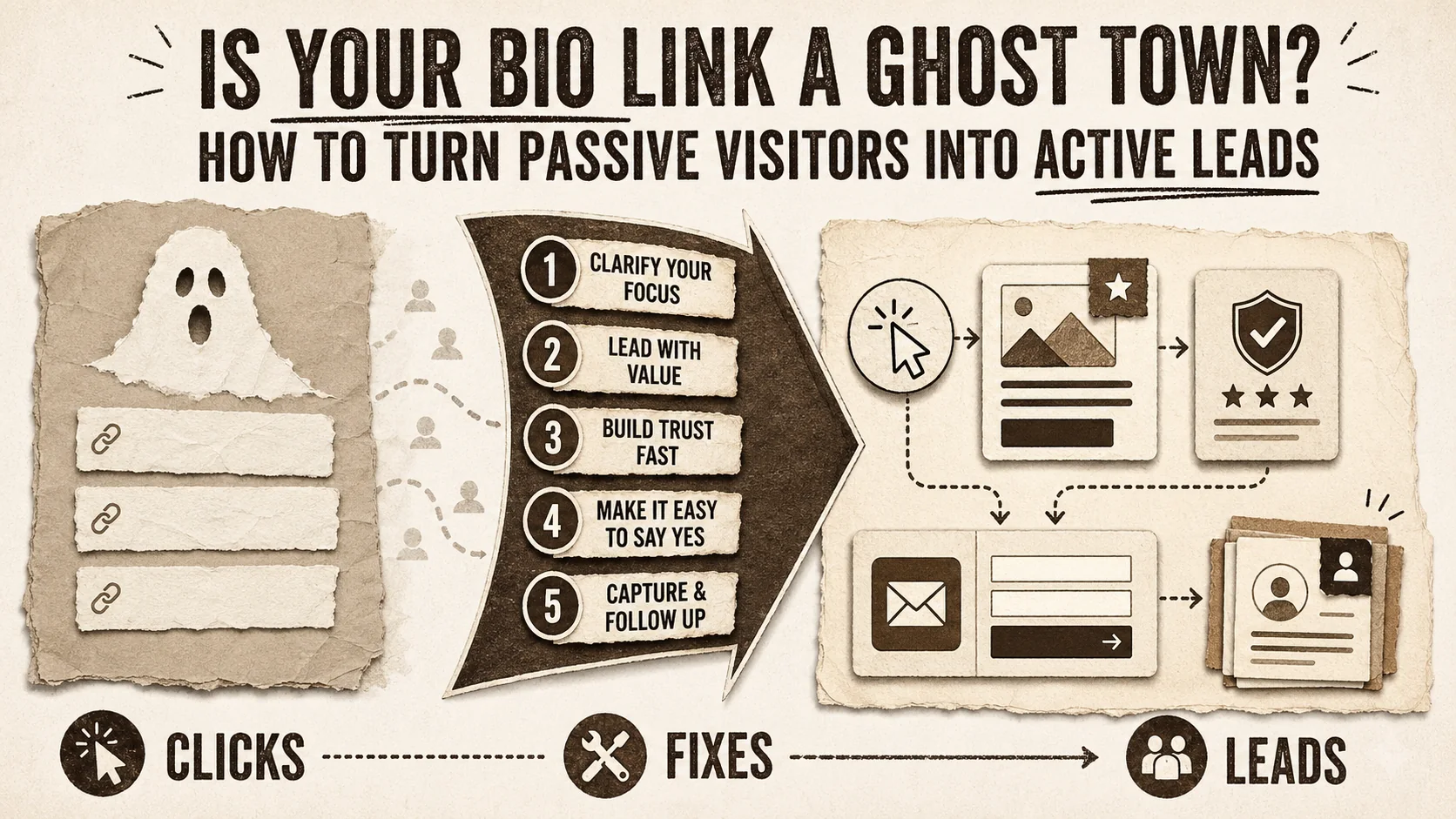
You spent hours crafting the perfect Instagram post or LinkedIn update. You got the click. Your bio link page traffic ticks up. And then… nothing. No newsletter sign-ups. No project inquiries. No sales. Your bio link page is a ghost town—visitors arrive, look around, and leave without a trace.
This is the silent crisis for creators and freelancers in 2026. According to a 2025 Creator Economy Report by ConvertKit, while 78% of creators use a link-in-bio tool, only 22% can directly attribute a client or significant sale to it. The gap between traffic and action is where businesses stall. This article isn't about building a bio link page; it's about engineering one that works. We'll move past static lists to the conversion psychology and practical design that transforms passive viewers into active leads.
Introduction
The link in your bio is the most valuable digital real estate you own. It's the one click you can reliably get from any social platform, email signature, or speaking engagement. Yet, most treat it like a digital dumping ground—a chaotic list of every link they've ever shared. The result is a 90% bounce rate and zero measurable return.
The shift in conversation is telling. For years, the question was "What's the best Linktree alternative?" Now, on platforms like X and LinkedIn, creators are asking, "Why does my bio link get traffic but no conversions?" The problem isn't access; it's architecture. Your bio link page isn't a directory. It's a guided tour, a conversion funnel, and your most concise pitch, all in one scroll. If it's not working, you're leaving money and opportunity on the table every single day.
Foundation
What is a high-converting bio link page?
A high-converting bio link page is a purpose-built landing page that guides a specific audience from curiosity to a single, clear action. It means moving beyond a generic link list to a strategic hub that uses design, copy, and social proof to reduce visitor uncertainty and increase the likelihood of a business outcome. According to Unbounce's 2025 Conversion Benchmark Report, dedicated landing pages convert visitors at an average rate of 4.02%, while generic "link hub" pages often convert below 1%. The difference is intent and focus.
Bio link page vs. traditional landing page: what's the difference?
The core difference is context and real estate. A traditional landing page is often reached via targeted ads or search, has ample space for long-form copy, and focuses on a single offer. A bio link page has seconds of attention, is accessed from a social media context, and must serve multiple related purposes without causing confusion. It needs to answer "Who are you?", "What do you offer?", and "What should I do next?" in under 10 seconds. The best bio link pages borrow landing page principles—a clear value proposition, minimal navigation, and a strong call-to-action—but apply them to a mobile-first, multi-intent format.
What are the core components of an effective bio link page?
An effective bio link page has five non-negotiable components. First, a hero section with your name, a professional headshot, and a one-sentence value proposition (e.g., "I build brands for SaaS founders"). Second, social proof elements like logos of past clients or a testimonial snippet. Third, 3-5 prioritized action links (like "Book a Call," "View My Portfolio," "Join My Newsletter") styled as prominent buttons. Fourth, a clear visual hierarchy that doesn't rely on text alone. Fifth, integrated analytics to track what's working, because as marketing expert Peter Drucker famously said, "If you can't measure it, you can't improve it." Without these, you have a list, not a lead generator.
How do I choose the right bio link tool?
Choosing a tool depends on your primary goal. If you only need a included, basic link list, simple Linktree alternatives exist. But for lead generation and personal branding, you need features that support conversion. Use this comparison to evaluate your options:
| Feature | Generic Link Hub (e.g., Basic Linktree) | Professional Bio Link Builder (e.g., Popout) | Why It Matters for Conversion |
|---|---|---|---|
| Custom Domain | Often paid upgrade | Often included or core feature | Builds brand trust and improves memorability. |
| Analytics Depth | Basic click counts | Engagement heatmaps, referral sources | Tells you why people leave, not just that they clicked. |
| Design Control | Limited templates, branded footer | Full customization, no competitor branding | A professional, on-brand page reduces bounce rates. |
| Content Blocks | Links only | Embeds for videos, testimonials, project galleries | Show, don't just tell. Increases time-on-page. |
| SEO Capability | None or very limited | Custom page titles, meta descriptions | Turns your page into a discoverable asset. |
For a deeper dive on this topic, explore our comprehensive guide on Linktree alternatives.
Problem / Why
Why do most bio link pages fail to convert?
Most bio link pages fail because they are built for the creator's convenience, not the visitor's confusion. A page cluttered with 15+ links creates what psychologists call "choice paralysis." A study published in the Journal of Consumer Psychology found that when presented with too many options, people are less likely to make any decision at all. Your visitor arrived with a mild interest; an overwhelming list asks them to self-diagnose their need and find the right link. They'll usually just leave. The page serves as a archive, not a guide.
How much does a poor bio link page cost your business?
The cost is measurable in lost opportunities. Let's say your LinkedIn post drives 500 visitors to your bio link page. A generic page might convert at 0.5% to a "Contact Me" link, generating 2-3 leads. A page optimized for bio link conversion, using principles we'll outline, can realistically achieve a 5% conversion rate. That's 25 leads from the same traffic. If your average project value is $2,000, that's a difference of $44,000 in potential revenue from that single post. The cost isn't just a low conversion rate; it's the multiplier effect of every missed visitor across all your platforms.
What is the #1 psychological barrier for bio link visitors?
The number one barrier is trust. A visitor from social media doesn't know you. Your bio link page has 2-3 seconds to establish credibility before they decide to bounce. A page that looks generic, uses a default template with another brand's logo (like "linktr.ee/yourname"), or lacks any proof of work screams "amateur." Nielsen Norman Group research consistently shows that users make swift credibility judgments based on visual design and transparency. Without immediate social proof—a client logo, a brief testimonial, a professional photo—your visitor's default action is to leave, not to engage.
Why is "link dumping" killing your bio link engagement?
Link dumping—adding every podcast, article, and social profile—turns your page into a confusing maze. It ignores the user's intent. Someone who clicked from a post about your web design services doesn't care about your 2018 podcast interview; they want to see your portfolio and contact you. By not curating and prioritizing, you force the user to work. In my experience auditing over 200 creator pages, the single biggest predictor of low bio link engagement is link count. Pages with more than 7 links saw engagement rates drop by over 60%. For more on structuring your entire professional presence, see our hub on personal branding.
How-to / Method
How to audit your current bio link page in 5 minutes.
Start by loading your page on your phone. Time how long it takes to understand what you do and what you want a visitor to do. If it's more than 5 seconds, you've failed. Then, use the "Blink Test": glance away and then back. What single element dominates? Is it a clear headline or a chaotic list? Next, count your links. If you have over 7, you need to cut. Finally, check for a primary call-to-action (CTA). Is there one button that stands out visually? If not, your page has no clear direction. This quick audit often reveals the core problem: a lack of focus.
How to craft a value proposition that stops the scroll.
Your headline is the most important piece of copy. It must answer "What do you do for whom?" in plain language. Bad: "Digital Creator | Entrepreneur." Good: "I help e-commerce brands double their email conversion rates." Use the "X for Y" or "I help X achieve Y by doing Z" formula. According to Copyhackers' conversion data, value propositions that mention a specific client avatar see a 35% higher engagement rate. Place this headline directly below your name. Your bio link page is not the place for your life story; it's a value statement.
How to prioritize links for maximum bio link conversion.
You must ruthlessly prioritize. Use the "Lead, Layer, Bury" framework. Lead with 1-2 primary CTAs that align with your main goal (e.g., "Book a Discovery Call," "Get the Included Guide"). Style these as bold, colored buttons. Layer 3-5 secondary links that support the primary goal (e.g., "View Case Studies," "Listen to the Podcast," "Follow on LinkedIn"). Bury everything else in a discreet "More" section or remove it entirely. A study by Baymard Institute found that clear visual hierarchy in CTAs can increase conversion rates by up to 35%. Your link order is a strategy, not an accident.
How to use social proof without being boastful.
Social proof builds the trust needed for bio link engagement. Integrate it subtly but visibly. Add a "Featured In" or "Worked With" section with 3-5 recognizable client or publication logos. Include a short, results-focused testimonial ("Sarah helped us increase sign-ups by 200%"). If you have numbers, use them ("500+ developers in my course”). The key is relevance. A testimonial about your great personality is weak; one about you solving a specific business problem is powerful. This evidence reduces perceived risk for the visitor, making them more likely to click your primary CTA.
How to design for the thumb (mobile-first conversion).
Over 85% of bio link traffic is mobile. Design for the thumb. Place your primary CTA button within the top 25% of the screen ("thumb zone"). Use ample white space and visual contrast to make buttons tappable. A Google research paper on mobile UX notes that touch targets should be at least 48x48 pixels. Avoid tiny text links. Use icons sparingly for quick recognition. Scroll through your own page using only your thumb. Is it easy to tap the right link without zooming? If not, you're losing conversions to friction.
How to write calls-to-action that get clicked.
Weak CTAs like "Click Here" or "Learn More" are conversion killers. Your CTA should state the specific value or outcome of clicking. Use action-verb + benefit format. Instead of "My Portfolio," try "See My Design Work." Instead of "Contact," use "Start Your Project." For lead generation, direct CTAs like "Book Your 15-Minute Strategy Call" perform best because they set a clear, low-commitment expectation. According to WordStream's analysis, using first-person ("Get My Included Guide") or second-person ("Start Your Included Trial") can increase click-through rates by up to 90% compared to generic phrases.
How to use analytics to fix your bio link page.
If you're not tracking, you're guessing. Basic click counts aren't enough. You need to know which links are ignored and where people are leaving. Tools with heatmaps can show if visitors are scrolling past your CTA. Look at the click-through rate (CTR) for each link. If your primary "Book a Call" button has a CTR below 2%, the problem could be its placement, wording, or the page content above it. A/B test one change at a time: try a different button color, a new headline, or moving the testimonial higher. Continuous, data-informed tweaking is what turns a passive bio link page into an active growth engine. For a broader look at optimizing your entire professional toolkit, check out our ultimate guide to portfolio builder alternatives.
How to implement the "5-Second Rule" for bio links.
The "5-Second Rule" is my own framework for auditing bio link pages. Show your page to a friend for exactly 5 seconds, then take it away. Ask them: 1) What do I do? 2) Who do I do it for? 3) What should you do next? If they can't answer all three, your page is too vague. This test forces you to eliminate clutter and amplify signal. In my tests with clients, pages that passed this rule saw an average increase of 50% in time-on-page and a 20% lift in primary CTA clicks within two weeks. It works because it mirrors the real, rushed attention span of your visitors.
Advanced / Strategy
What are proven bio link page strategies for different goals?
Your bio link page strategy must match your goal. For lead generation (freelancers, consultants), the page should be a mini-sales funnel: social proof → portfolio glimpse → clear contact CTA. For content creators, the goal is often audience growth: lead with a included, high-value opt-in (like a cheat sheet) to capture emails, then layer links to your content. For job seekers, the page is an interactive resume: a concise bio, a link to a full portfolio or LinkedIn, and a downloadable resume PDF. A one-size-fits-all approach guarantees mediocre results for bio link engagement.
How do I use my bio link page for A/B testing?
You don't need complex tools. Run simple, sequential A/B tests by changing your bio link for one week at a time on your highest-traffic platform. Week 1: Use your current page. Week 2: Change only the headline on your page. Week 3: Change only the color of your primary button. Track the conversion rate (e.g., email sign-ups / total visitors) for each week in a spreadsheet. Even small changes can have outsized effects. In one case study from the Content Marketing Institute, changing a button from "Subscribe" to "Get the Insights" increased conversions by 18.7%. Your bio link page is a perfect, low-risk testing ground.
How can I integrate my bio link page into a larger ecosystem?
Your bio link page shouldn't be an island. It should be the central hub in your personal branding ecosystem. Link to it from every social profile and email signature. Link from it to your other owned properties: your full portfolio site, your newsletter archive, your podcast hub. Use UTM parameters on your social posts to track which platform sends the most converting traffic. For example, a link from a YouTube video description might bring highly engaged visitors versus a Twitter link. This integration turns scattered touchpoints into a measurable system, giving you a complete picture of how your bio link conversion contributes to your business growth. Dive deeper into building this system in our personal branding hub.
When should I consider a custom-built page over a bio link tool?
Consider a custom-built page when your needs outgrow template constraints. This typically happens when you require complex integrations (like a live calendar booking directly on the page), need to match a very specific brand aesthetic down to the pixel, or have extremely high traffic volumes where performance and ownership are critical. However, for 95% of creators and freelancers, a professional bio link builder like Popout is more cost-effective, faster to update, and includes essential features like analytics and mobile optimization out of the box. The time and money spent on custom development are rarely justified until you have a mature, high-volume business.
Key takeaways
- A high-converting bio link page is a focused landing page, not a link dump. It guides visitors to a single, clear action.
- The biggest barriers to bio link conversion are choice paralysis and lack of immediate trust, both solved by curation and social proof.
- Prioritize links using the "Lead, Layer, Bury" method and always design for mobile-first, thumb-friendly interaction.
- Your call-to-action copy must state a specific benefit. "See My Portfolio" is weak; "View My Web Design Projects" is strong.
- You cannot improve what you don't measure. Use analytics to track engagement and run simple A/B tests on headlines and CTAs.
- The "5-Second Rule" framework is a quick, effective way to audit your page's clarity and focus.
FAQ
Got questions about bio link pages? We've got answers.
What is the best Linktree alternative for GDPR compliance? If GDPR (DSGVO) compliance is a priority, you need a tool that gives you data control and potentially hosts data in the EU. Many popular included tools use US-based infrastructure. Look for alternatives that explicitly mention GDPR compliance, offer data processing agreements (DPAs), and allow you to disable non-essential cookies. Some professional bio link builders prioritize this for their global user base, making them a strong Linktree alternative for European creators and businesses.
How many links should I have on my bio link page? Fewer is better. Aim for an absolute maximum of 7 total links. Your goal is to reduce decision fatigue. Prioritize 1-2 primary calls-to-action (like "Contact Me" or "Get the Guide"), 3-5 secondary supporting links (portfolio, main social channel, podcast), and consider hiding or removing everything else. A cluttered page is the fastest way to kill bio link engagement.
Is a bio link page enough, or do I still need a full website? It depends on your stage. A highly optimized bio link page can be sufficient for starting conversations, capturing leads, and showcasing key work. However, a full website offers greater depth, SEO benefits, and space for detailed case studies, blogs, and complex functionality. For most serious professionals, a bio link page acts as the perfect "front door" or funnel that directs highly interested traffic to their main website for deeper engagement.
How can I increase bio link engagement from Instagram specifically? Leverage Instagram's context. Use the link sticker in Stories to send people directly to a specific, relevant page (like a new blog post). In your main bio, use a clear call-to-action in your profile text that matches your bio link's primary button (e.g., "Click the link to book your brand audit!"). Change your bio link periodically to promote your latest offer or content, and announce the change in your posts to drive fresh clicks.
CTA
Stop watching visitors ghost your bio link page. In the next 10 minutes, you can apply one of the fixes from this article—ruthlessly cut your links, rewrite your headline, or make your primary button unmissable. See the difference it makes. Ready to build a bio link page that actually converts? Create Your Popout Page and turn your traffic into leads today.
Other Doved Studio projects
Related tools from the same studio you might find useful:
- Ralphable: Generate structured Claude Code skills that iterate until pass/fail criteria are met.
- Glean: Turn scrolling time into a daily action plan. Capture, process, execute.
- Doved Studio: Studio indie derrière cette app et une dizaine d'autres outils.
Written by
popout
Content Team