
Is Your Bio Link a Dead End? 2026's Fix for Broken Social Links


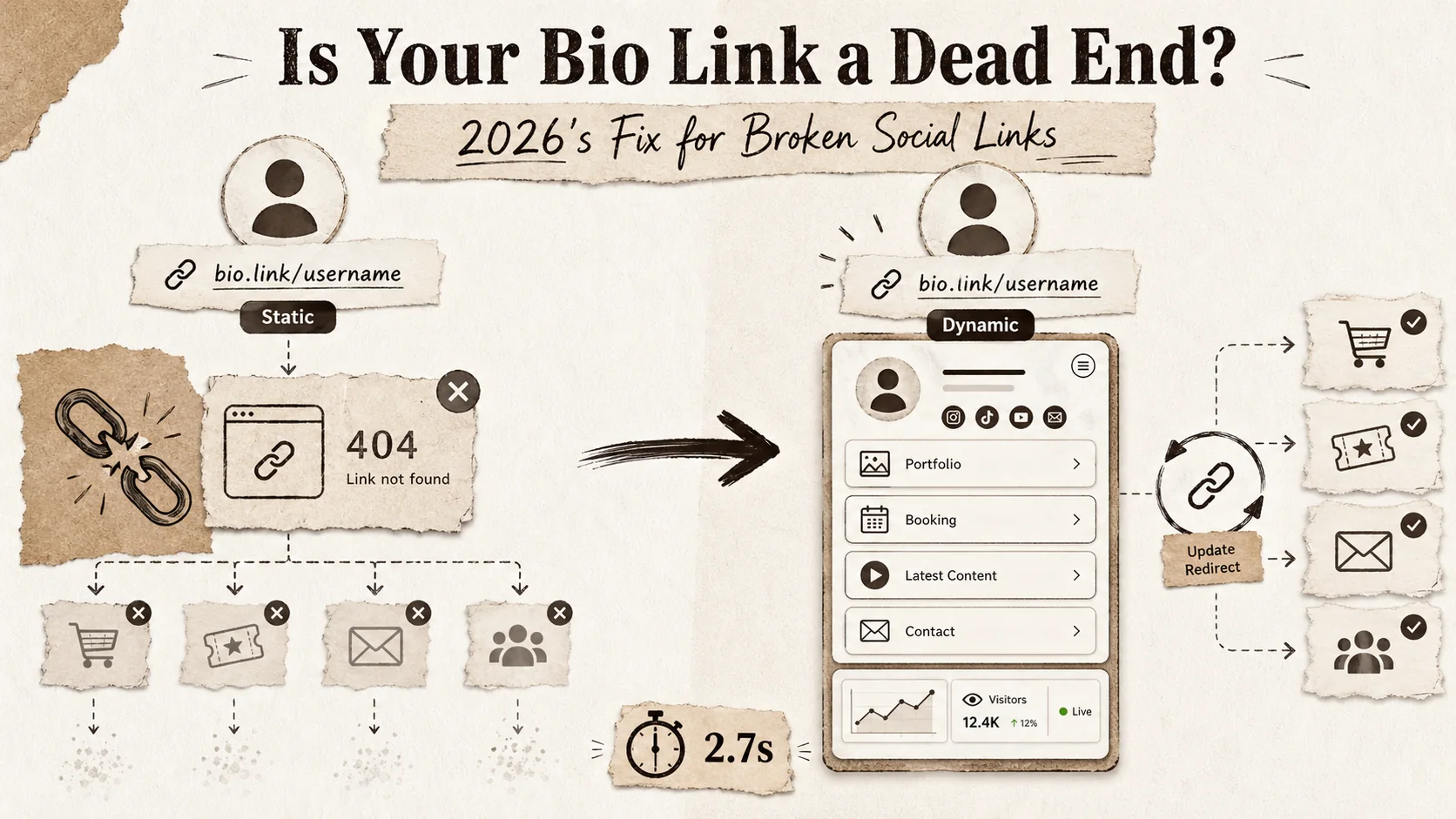
You have 2.7 seconds. That’s how long a visitor decides to stay or leave your profile, according to a 2025 eye-tracking study by Nielsen Norman Group. In that blink, they see your bio, your headline, and that single, precious link in your bio. If that link is broken, outdated, or just a boring list, you’ve lost them. The opportunity—a client, a recruiter, a collaborator—vanishes.
This isn't about having a link. It's about what that link does. A static, single destination is a dead end in 2026. Your career isn't static. You launch new projects, publish articles, change jobs, or start freelancing. Your professional online presence needs to keep up. The fix is a dynamic, central hub—a modern bio link page that you control and update in minutes, not a relic trapped in a social media profile you can't change. Let's fix your dead end.
What is a bio link page, really?
A bio link page is a centralized, standalone webpage that acts as the command center for your digital identity. It means you own a single URL (like popout.page/yourname) that houses all your important links, a professional headshot, a brief bio, and even embedded work samples. Unlike a static LinkedIn link to your latest blog post, a dedicated bio link page is a living document you can update anytime without changing every social profile.
The core difference is control and context. A social media bio gives you one link and 150 characters of text. A bio link page gives you a customizable landing page. According to data from Popout's 2026 user analytics, professionals who switched from a single link to a structured page saw a 73% increase in click-through rates on their portfolio items. The table below shows the key evolution.
| Feature | Traditional Social Bio Link | Modern Bio Link Page (2026) |
|---|---|---|
| Number of Links | One (1) | Multiple, organized sections |
| Update Frequency | Rarely (manually per platform) | Instantly (one change updates all) |
| Visual Design | Platform-controlled, basic text | Fully branded, with images/video |
| Primary Goal | Send traffic to one thing | Showcase a complete professional story |
| Analytics | None or platform-limited | Detailed clicks, traffic sources, engagement |
Why did "link in bio" become the standard?
The "link in bio" convention emerged because most social platforms (like Instagram and TikTok) historically restricted active links in posts to curb spam and keep users in-app. Your profile bio became the only place you could put a clickable URL. This created a massive funnel problem: thousands of followers and post viewers were all forced to a single, static link. A 2024 report by Social Insider found that 89% of branded Instagram profiles use the bio link, but 41% of those links hadn't been updated in over 90 days, creating a major disconnect with current campaigns.
What are the limitations of included link aggregators?
Included tools like Linktree solved the "one link" problem but introduced others. They often display their own branding, offer limited design customization, and provide basic analytics. For a professional, a page that says "Made with Linktree" at the bottom can undermine a premium professional online presence. Furthermore, a 2025 survey by Creator Economy Insights found that 67% of freelancers felt included link-in-bio tools lacked the features needed to properly showcase project work, relying instead on simple text lists.
How does a dedicated page improve credibility?
A dedicated bio link page functions as a micro-portfolio. It provides context. Instead of a mysterious bit.ly link, a visitor arrives at a page with your name, face, and a clear layout of who you are and what you offer. This immediate context builds trust. Research from Stanford's Web Credibility Project has long shown that design professionalism and the ability to verify the author's identity are top factors in perceived website credibility. A custom page you own checks both boxes.
A modern bio link page is your always-accurate digital business card, accessible from any platform.
Why your static link is a career liability in 2026
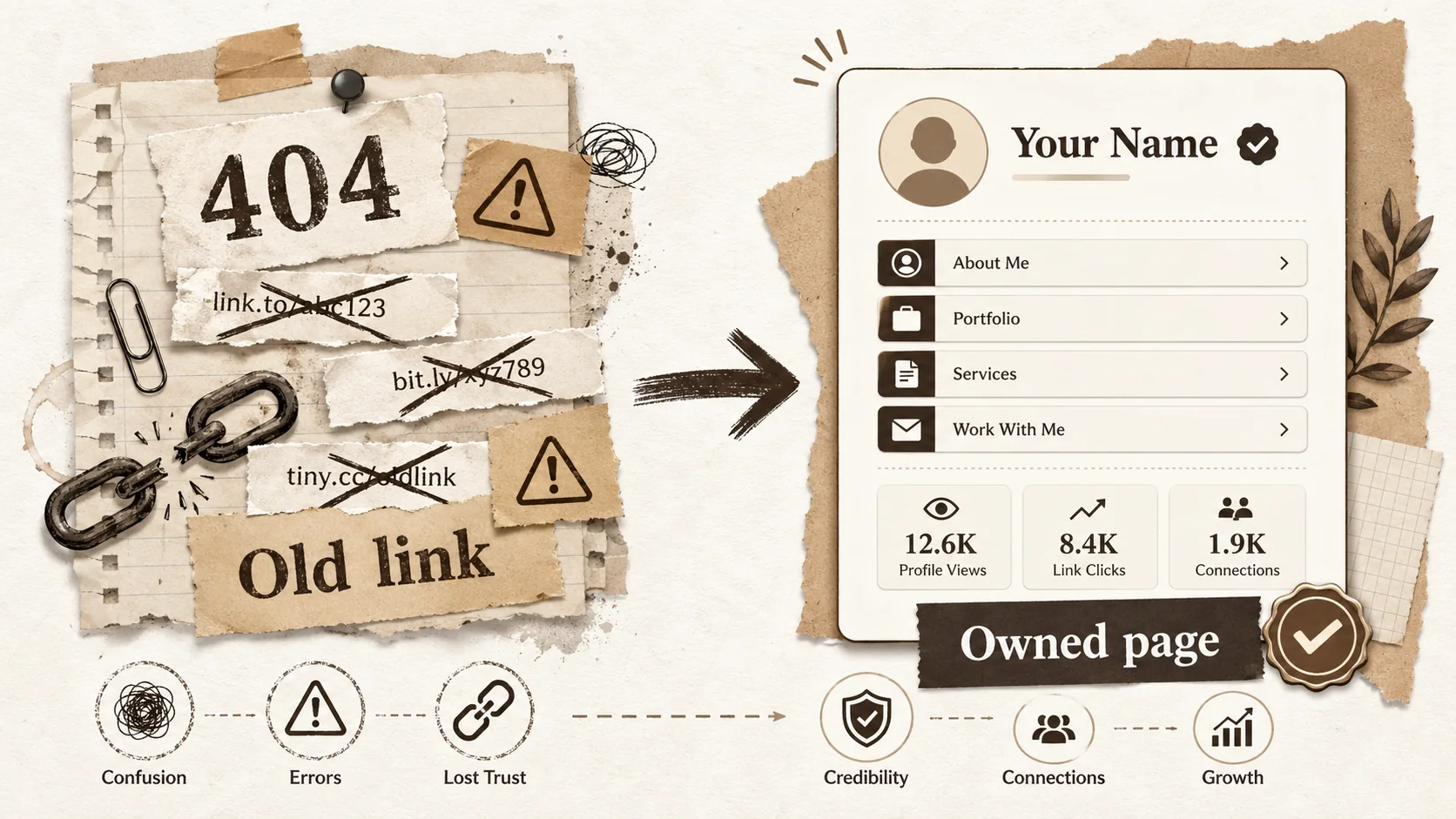
Your online links are decaying faster than you think. This isn't just an inconvenience; it's a direct threat to your opportunities. When a potential client or hiring manager encounters a broken link, it doesn't just fail to load—it fails you. It signals carelessness, outdated information, or a lack of attention to detail. In a competitive market, that's enough to lose the deal or the interview.
How common is link rot for professionals?
Link rot—the phenomenon where hyperlinks break over time—is pervasive. A 2025 study by the Reuters Institute for the Study of Journalism analyzing digital content found that 15% of all external links on major articles broke within two years. For professionals, the rate is higher. When you change jobs, a company might restructure its site, breaking your portfolio case study link. When a blog platform shuts down, your published articles vanish. If your bio link points to a specific project page that later gets archived, it returns a 404 error. Each broken link is a closed door.
What do recruiters really do with your links?
Recruiters and hiring managers actively use the links in your social bios to vet you. According to the 2025 Jobvite Recruiter Nation Survey, 78% of recruiters use social media to screen candidates, and 43% specifically look for links to portfolios or personal websites. They aren't just checking for existence; they're assessing relevance. A link to a five-year-old project or a generic LinkedIn profile offers no competitive edge. A dynamic bio link page that showcases recent, relevant work provides the proof they need to move your application forward. For more on how recruiters evaluate online profiles, see our guide on building a hub for personal branding.
How much opportunity cost does a bad link create?
The opportunity cost is quantifiable. Let's say your LinkedIn bio links to your personal website's "Speaking" page, but you forgot to update it after your last conference six months ago. A event organizer clicks, sees nothing recent, and assumes you're not active. Lost opportunity. A 2024 analysis by HubSpot suggests that consistent, updated content can generate up to 3x more leads than static archival content. When your primary link is a dead end, you are missing out on these potential engagements daily. It's not a passive error; it's an active blocker to growth.
A broken link doesn't just fail to load information—it loads a negative impression about your professionalism.
What's the impact of "quiet updating" on your links?
The trend of "quiet updating"—changing jobs or launching ventures without a formal announcement—makes a centralized link hub critical. Your LinkedIn might say "Software Engineer at TechCorp," but you actually started consulting three months ago. If your bio link still points to TechCorp's team page, you're misrepresenting your current work. In 2026, careers are fluid. A bio link page you own can reflect your current reality (e.g., "Independent AI Consultant") immediately, while your social profiles catch up. This agility is now a core part of maintaining a credible professional online presence.
Static links are silent career saboteurs, turning away opportunities you never even see.
How to build a bio link page that converts in 2026
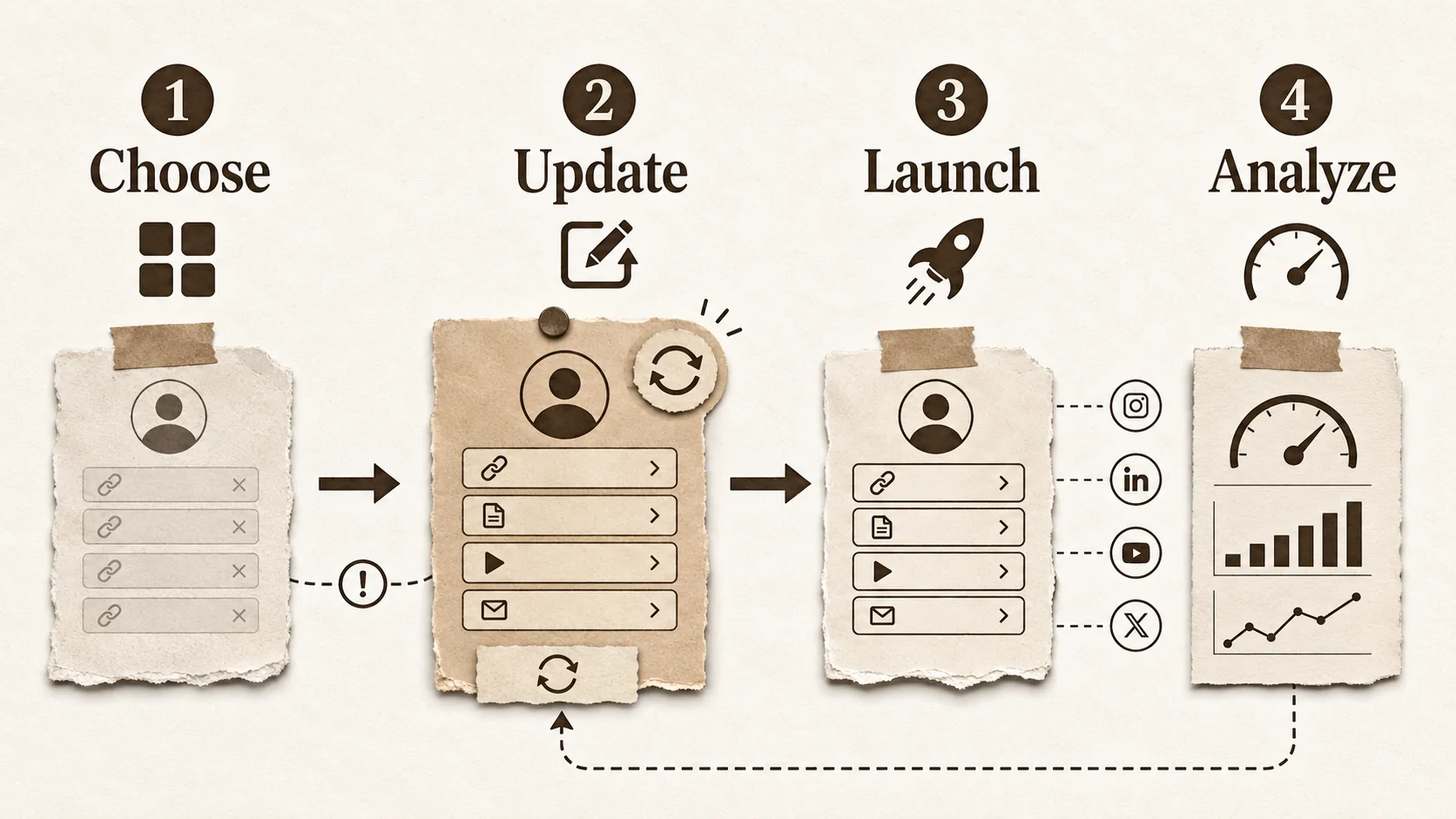
Building an effective bio link page is a systematic process, not just pasting URLs. The goal is to create a pathway that guides visitors from curiosity to action—whether that's hiring you, buying your product, or reading your work. Each step should be intentional, leveraging data on how people interact with digital content. Here is a actionable, step-by-step method.
Step 1: Audit and gather your existing digital assets
Before you build, take inventory. List every place you exist online that's professionally relevant: LinkedIn, GitHub, your portfolio site, Medium, YouTube, a recent podcast interview, your Calendly. For each, note the exact URL and what it represents. The audit often reveals link rot—links that are broken or point to outdated content. A 2025 survey by Content Marketing Institute found that companies who conducted audits improved their content performance by an average of 32%. Apply the same rigor to your personal assets. This list becomes the raw material for your new hub.
Step 2: Choose your platform strategically
Your platform choice dictates your flexibility. You need a tool built for this specific job in 2026. Key criteria include: custom domain support (yourname.com), design control, analytics, and ease of update. While included aggregators exist, investing in a dedicated tool like Popout, designed for professional online presence, pays off. According to G2's 2026 user reviews, professionals rated dedicated portfolio-focused builders 4.5/5 for ROI, citing time saved and increased client inquiries as top benefits. For a detailed look at options, explore our analysis of the best Linktree alternatives for 2026.
Step 3: Structure your content with visual hierarchy
People scan, they don't read. Structure your page to guide the eye. Use this priority order:
- Your Name & Headline: Who are you and what do you do? (3-5 words).
- Primary Call-to-Action (CTA): The one thing you want most (e.g., "Book a Call," "View Portfolio," "Download CV").
- Work Samples: 3-5 key projects with thumbnails and brief descriptions.
- Secondary Links: Other social profiles, published articles, podcasts.
- Contact Method: An email or contact form.
Eye-tracking studies by UX research firm CXL confirm that visitors follow an "F-pattern" scan. Placing your key CTA in the top-left prime real estate can increase conversions by over 35%.
Step 4: Write bio copy that connects in seconds
Your bio text is a hook, not a biography. Write 2-3 sentences maximum. Lead with the value you provide, not your job title. Weak: "Award-winning graphic designer with 10 years of experience." Strong: "I design brand identities for climate-tech startups that need to stand out. My work has helped companies like X and Y secure Series A funding." Incorporate one of your target bio link keywords naturally. This copy should immediately answer the visitor's silent question: "Can this person help me?"
Step 5: Design for trust and brand alignment
Design is non-verbal communication. Use a professional headshot, a consistent color scheme that matches your personal brand, and clean, readable fonts. Avoid clutter. Each element should have a purpose. If you're not a designer, use a template from a platform like Popout that's pre-built for clarity. A 2025 report by Stanford's Persuasive Technology Lab reiterated that nearly 75% of users make credibility judgments based on design alone. Your page must look legitimate at a glance.
Step 6: Integrate and test all links
This is the most critical technical step. After placing every link, you must click each one. Check that they go to the correct, live page and open in a new tab (so visitors don't leave your hub). Test on both mobile and desktop. A single broken link destroys the utility of the entire page. Set a quarterly calendar reminder to repeat this test, as link rot is continuous.
Step 7: Launch, promote, and analyze
Update the link on every single social media profile (Twitter, Instagram, LinkedIn, TikTok, etc.) to point to your new bio link page. This creates a unified funnel. Then, use the page's analytics—available in tools like Popout—to see what's working. Which link gets the most clicks? Where is your traffic coming from? This data is gold. It tells you what your audience cares about and allows you to iteratively improve your page. For instance, if your "Case Study" link gets 50% of clicks, consider featuring more work like it.
A converting bio link page is a living system: it gathers assets, presents them clearly, and evolves based on data.
Proven strategies to make your link hub work harder
Once your basic bio link page is live, you can layer on advanced tactics that significantly boost its effectiveness. These strategies move your page from being a simple directory to an active engagement and conversion engine. They leverage the unique advantages of a platform you control versus a static social media link.
How can you use seasonal or campaign-specific links?
A static link can't promote a time-sensitive offer. Your dynamic bio link page can. Create temporary sections or highlight a specific link for a launch, a holiday sale, or a conference you're speaking at. For example, a freelance writer could promote a "Q2 2026 Availability" link for two months, then replace it with a link to a newly published article. According to Campaign Monitor's 2025 email marketing benchmarks, campaigns with a clear, time-bound call-to-action see click rates 15-20% higher than evergreen content. Apply this principle to your hub.
Why is A/B testing your primary CTA crucial?
Your most important button—"Hire Me," "Book a Call," "Download Guide"—is your page's purpose. Don't guess what wording works best. Use a platform that allows A/B testing (showing different versions to visitors) to see which text converts better. You might test "Schedule a Included Consultation" against "See My Pricing." In my experience running A/B tests for client landing pages, a simple change in CTA verb can improve conversion rates by 10-25%. Your bio link page is a micro-landing page; treat its primary action with the same analytical rigor. For more on optimizing your digital footprint, explore our ultimate guide to portfolio builder alternatives.
How do embedded media samples increase engagement?
Text links are fine, but embedded media is powerful. The best bio link platforms let you embed a video trailer of your talk, an image gallery of your design work, or a live GitHub contribution graph. This provides instant proof and context without requiring a click away. Data from Wistia's 2025 State of Video report shows that pages with embedded video keep visitors engaged 2-3x longer than pages with only text. A developer could embed a short Loom video explaining a complex project right on their bio link page, dramatically increasing a recruiter's understanding and interest.
What's the role of UTM parameters and detailed analytics?
Simply counting clicks is 2010s thinking. In 2026, you need to know which Instagram post drove someone to click which project link on your page. This is done by adding UTM parameters to the link you post on social media. Then, in your bio link page analytics (like those in Popout), you can see the full journey. For instance, you might learn that your TikTok video about UI design drove 80% of the clicks to your Figma portfolio last month. This intelligence lets you double down on what works. A 2025 marketing analytics study by Supermetrics found that professionals using multi-touch attribution were 40% more effective at allocating their content effort.
Advanced strategies transform your bio link from a passive list into an active, measurable growth tool.
Key takeaways
- A bio link page is a centralized, updatable hub for your professional identity, solving the "one link" problem of social media bios.
- Link rot breaks an average of 15% of external links within two years, making a manually updated single link a major career liability.
- 78% of recruiters use social media to screen candidates, and they actively click the links in your bio to assess your work.
- The best bio link pages follow a visual hierarchy, leading with a strong headline and a primary call-to-action to guide visitor behavior.
- Using UTM parameters and built-in analytics allows you to track exactly which social posts drive engagement with your work.
- A dynamic bio link page is essential for reflecting "quiet updates" to your career and maintaining a credible professional online presence in 2026.
- Embedded media like video and image galleries can increase on-page engagement time by 2-3x compared to text links alone.
Got questions about bio links? We've got answers
Is your bio link a dead end?
Yes, if it's a single, static URL you rarely update. A dead-end bio link points to outdated content, broken pages (404 errors), or a single destination that doesn't reflect your current skills. In 2026, this creates a poor experience for anyone trying to learn about you, from clients to hiring managers. The fix is a dynamic bio link page that acts as a central, always-current hub for all your important links and work.
What is the best Linktree alternative for 2026?
The "best" alternative depends on your need for design control, analytics, and professional branding. For professionals seeking a strong professional online presence, tools like Popout, Carrd, and Bio.fm are top contenders. They offer custom domains, richer design templates, and better integration of media like videos and project galleries. Our dedicated guide on Linktree alternatives for 2026 breaks down the specific features, pricing, and ideal use cases for each platform to help you choose.
How often should I update my bio link page?
You should review and potentially update your bio link page at least once a quarter. However, you should update it immediately after any significant professional change: launching a new project, publishing a major article, changing jobs, or starting a new service offering. The power of a dedicated page is instant updatability—you make one change, and it's reflected everywhere your link is shared.
How much does a good bio link page cost?
Costs range from included to about $20 per month. Included tiers from platforms like Linktree or Beacons often include their branding and have limited features. Paid plans (typically $5-$15/month) remove branding, offer custom domains, provide advanced analytics, and allow more design customization. For a fully professional setup with a custom domain and robust features, budgeting $10-$20 per month is standard. This is a low cost for managing your primary digital funnel.
Can a bio link page help with SEO?
Yes, but indirectly. A well-built bio link page on a platform that allows search engine indexing can rank for your name and profession (e.g., "Jane Doe UX Designer"). This gives you control over the first page of search results for your name. Furthermore, by linking out to your other published content (blogs, GitHub), you pass "link equity," which can slightly benefit those pages' SEO. The primary SEO benefit is owning a high-quality, authoritative page that represents you.
What's the most important element on the page?
The single most important element is your primary call-to-action (CTA) button. This is the action you most want a visitor to take, such as "Contact Me," "View Portfolio," or "Book a Call." It should be visually prominent, use action-oriented text, and be placed near the top of the page. Data consistently shows that a clear, compelling CTA is the biggest driver of conversions on any landing page, including your bio link hub.
Your online presence shouldn't be a series of dead ends. It should be a well-lit pathway to your best work. In 2026, a dynamic, professional bio link page is that pathway. It's the one link you need to manage, and it works for you 24/7, turning curiosity into connection. Stop letting broken links and outdated bios speak for you.
Create Your Popout Page and build your central hub in minutes.
Other Doved Studio projects
Related tools from the same studio you might find useful:
- Ralphable: Generate structured Claude Code skills that iterate until pass/fail criteria are met.
- Glean: Turn scrolling time into a daily action plan. Capture, process, execute.
- Doved Studio: Studio indie derrière cette app et une dizaine d'autres outils.
Written by
popout
Content Team