Portfolio Website vs LinkedIn in 2026: Which One Actually Gets You Remembered?

Short answer: LinkedIn helps people find you. A portfolio website helps them understand you. The strongest career setup uses LinkedIn for discovery and a personal page for proof, taste, and a clear next click.
Most people frame the choice incorrectly. They ask, "Do I need a website if I already have LinkedIn?" The better question is, "What can LinkedIn not show quickly enough?" If the answer is nothing, you may not need a full site yet. If the answer is projects, case studies, writing, demos, screenshots, offers, or personality, then a portfolio page earns its keep.
Sources checked
- LinkedIn profile help
- Notion Web Clipper help
- Readwise Reader
- Nielsen Norman Group, how users read on the web
What LinkedIn does well
LinkedIn is a search surface, a social graph, and a credibility baseline. Recruiters already know how to scan it. People can see your job history, mutual connections, posts, recommendations, and current role. If your profile is empty or confusing, a personal website will not fully fix the trust gap.
The best LinkedIn profile answers three questions fast: what do you do, who have you done it for, and what proof is visible? It should point outward to your strongest work, not trap everything inside the platform.
What a portfolio website does better
A website gives you sequencing. You decide what comes first. You can show one project deeply instead of ten roles shallowly. You can write in your own voice. You can use a custom domain. You can make a single page that says, "Here is who I am, here is my best work, here is how to contact me."
That control matters most for developers, designers, writers, consultants, students, creators, and freelancers. Anyone whose value depends on examples benefits from a page that turns scattered proof into a clean story.
The decision table
| Situation | LinkedIn only | Portfolio page |
|---|---|---|
| Traditional job search | Good baseline | Useful if you have strong proof |
| Developer portfolio | Not enough for demos | Essential for projects and GitHub context |
| Design work | Too constrained | Essential for case studies |
| Freelance services | Weak offer control | Strong service and contact flow |
| Creator profile | Good distribution | Strong home base |
| Student profile | Acceptable starting point | Great if projects are real |
The website does not need to be huge. It needs to be clear.
What belongs where
Put your employment history, network activity, and recruiter keywords on LinkedIn. Put your best projects, case studies, demos, writing, media, pricing signal, newsletter, booking link, or custom contact flow on your site.
Do not duplicate everything. Duplication creates maintenance debt. Instead, use LinkedIn as the door and the website as the room.
The Popout structure
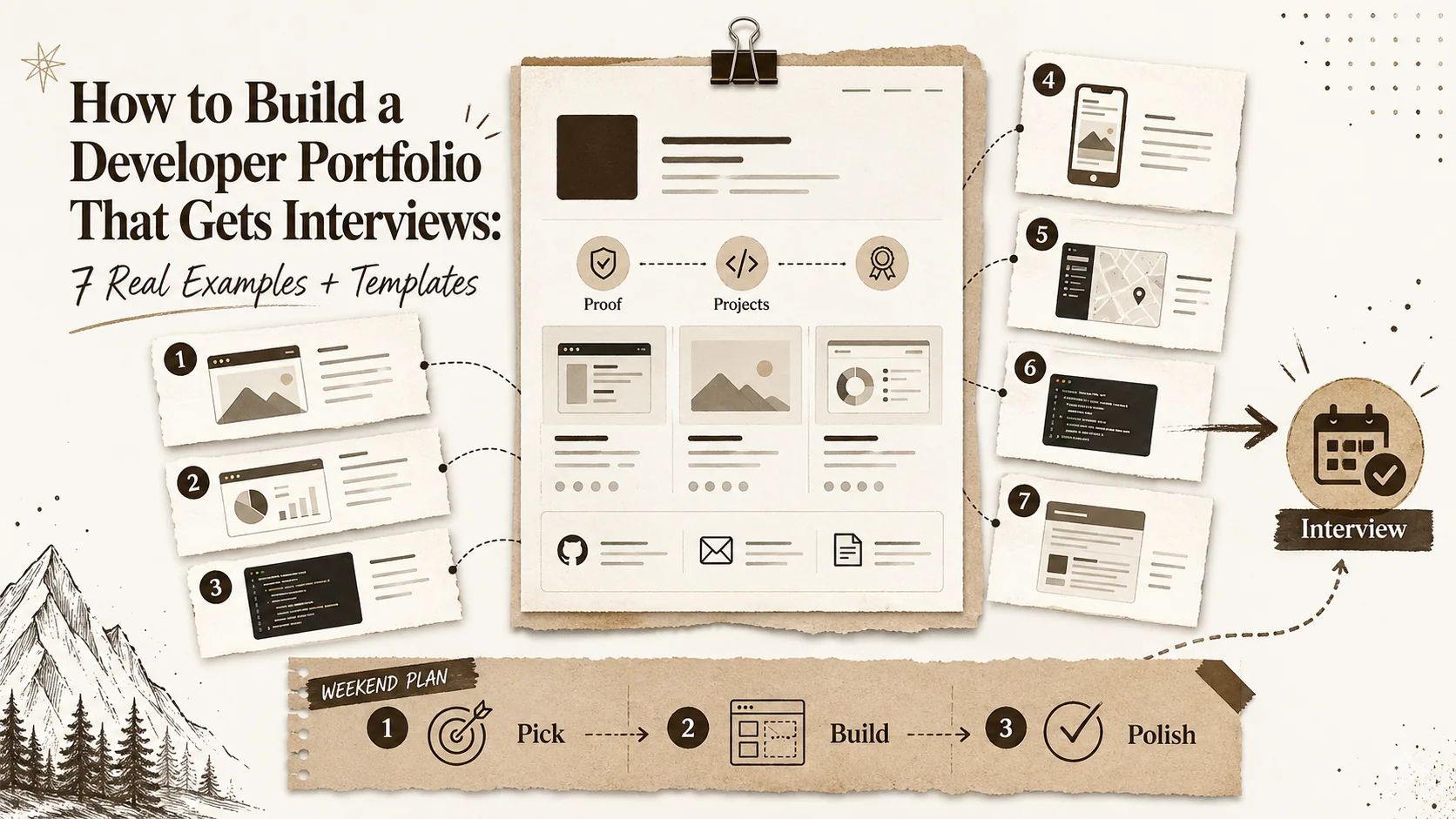
Popout works best when the page has five blocks:
- Identity: name, role, location or availability, one sentence.
- Proof: strongest project, screenshot, metric, client result, or demo.
- Links: three to five meaningful destinations.
- Trust: testimonials, logos, GitHub, press, or credentials.
- Contact: one obvious way to reach you.
This structure beats a wall of buttons because it respects how strangers scan. They do not want your entire internet. They want the quickest path to confidence.
Common mistakes
The first mistake is a beautiful page with no proof. The second is a link page with twenty choices and no priority. The third is a "coming soon" portfolio that makes you look less ready than a complete LinkedIn profile. The fourth is hiding contact behind clever copy.
If the visitor cannot tell what you do within five seconds, rewrite the top. If the strongest project is below the fold, move it up. If every link has equal weight, choose.
The best setup for 2026
Use LinkedIn to be found, then use your portfolio page to be remembered. Pin the portfolio link on LinkedIn. Put LinkedIn on the portfolio for verification. Keep both updated quarterly. When a project ships, decide whether it belongs as a LinkedIn post, a portfolio proof block, or both.
Read next: /blog/about-me-alternatives-portfolio-page-2026, /blog/personal-website-checklist, and /blog/link-in-bio-vs-portfolio.
FAQ
Is LinkedIn enough?
For some roles, yes. If your work needs demos, visuals, case studies, or a distinct offer, add a portfolio page.
Should my website copy my resume?
No. It should highlight proof and guide the next click.
Do freelancers need a website?
Usually yes, because the site can frame services, proof, and contact better than a profile.
How long should the page be?
Long enough to prove one clear identity. Shorter is usually better than broader.
Written by
Popout Team
Content Team