
Why Your Portfolio Will Get You Hired in 2026 (And Your Resume Won't)


Imagine two candidates applying for the same dream role in 2026. The first submits a polished, AI-optimized resume. The second shares a link to a living portfolio—a space showcasing not just their final projects, but the thinking, iterations, and unique perspective behind them. Who gets the interview? The data is clear: the candidate with the portfolio.
We are witnessing a fundamental power shift in hiring. The static, one-page resume, a relic of the 20th century, is being eclipsed by the dynamic, narrative-driven portfolio. This is not just a trend for creatives; it is a new career imperative for professionals across tech, marketing, consulting, and beyond. Your portfolio 2026 strategy is your new career currency.
The Statistics That Changed Everything
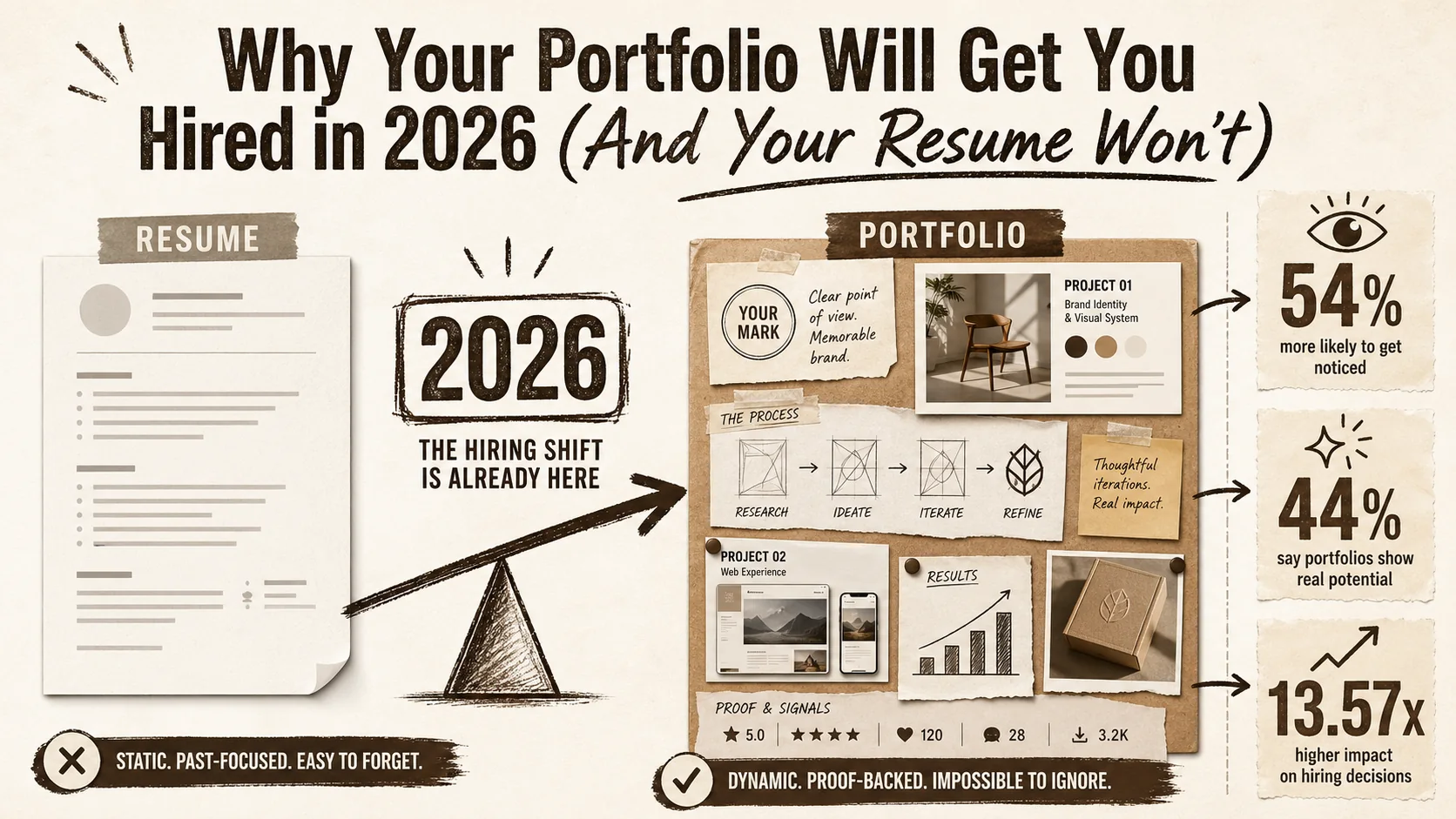
Four data points define the new reality: 54% of employers reject candidates for poor online presence, 44% have hired specifically because of personal branding, 78% of creative leaders pay more for strong personal brands, and professionals with recognized expertise command up to 13.57x more per engagement (Wave Connect 2026, Creative Bloq).
The theory that online presence matters is now a quantified, decisive factor in hiring. Recent research paints an undeniable picture of the new digital gatekeeping.
- 54% of employers reject candidates for a poor online presence. Your digital footprint is no longer background noise; it is a primary screening tool. An absent or unprofessional portfolio can disqualify you before your resume is even read.
- 44% of employers have hired someone specifically because of their personal brand. Demonstrating expertise publicly does not just build awareness; it directly triggers job offers.
- 78% of creative leaders offer higher pay for candidates with strong personal brands. This premium extends beyond creative fields, as leaders in all sectors value the authority and audience a recognized professional brings.
- People pay 13.57x more for elite experts with recognized personal brands. This staggering multiplier, highlighted in research from sources like Creative Bloq, shows that personal branding is the ultimate leverage for career and consulting income.
These numbers signal a market that rewards visibility, proof, and narrative. Your resume lists claims; your portfolio proves them.
Why Resumes Are Failing in 2026
Resumes fail on four fronts: they are static and generic in a dynamic market, easily fabricated in the age of AI-generated bullet points, limited to listing "what" without showing "how," and devoid of the human element that drives hiring decisions. A 2025 CareerBuilder survey found 75% of HR managers have caught lies on resumes, reinforcing the shift toward verifiable portfolio evidence.
The traditional resume is buckling under the weight of modern hiring needs. It is fundamentally a document of assertion, not evidence. In 2026, its limitations are fatal:
- It is Static and Generic: A PDF cannot convey your problem-solving approach, your collaboration style, or the evolution of your skills. It is a snapshot, often tailored (or generated) for a specific application, lacking authentic depth.
- It is Easily Fabricated: In an age where AI can write compelling bullet points and even generate sample work, a list of skills and job titles holds little trust value. Employers are deeply skeptical of unverified claims.
- It Shows the "What," Not the "How": A resume might state "Increased conversion by 30%." A portfolio can show the A/B tests, the design iterations, the user research, and the strategic thinking that led to that result. The latter is infinitely more valuable.
- It Ignores the Human Element: Hiring managers connect with stories and people, not just qualifications. A resume offers no personality, no voice, and no sense of who you are as a colleague and thinker.
The resume vs portfolio battle is over. The portfolio provides what the resume cannot: verifiable context and character.
What Makes a Portfolio Different
A portfolio wins on three pillars: proof over promise (embedded Tableau dashboards or live GitHub repos instead of skill claims), narrative over lists (the Challenge-Process-Result structure that Stack Overflow's 2025 survey shows 68% of hiring managers prefer), and dynamic presence over static documents (real-time updates, testimonials, video walkthroughs).
A winning portfolio is not merely an online resume with pictures. It is a strategic career asset built on three core pillars:
- Proof Over Promise: Instead of claiming you are a "skilled data analyst," you embed an interactive Tableau dashboard you built. Instead of saying you are a "great writer," you link to your published articles on Medium or case studies on your portfolio.
- Narrative Over Lists: Each project tells a story with a beginning (the problem), middle (your process and actions), and end (the quantifiable result and learnings). This narrative structure showcases your critical thinking.
- Dynamic Presence Over Static Document: A portfolio can be updated in real-time with new projects, thoughts, and achievements. It can integrate testimonials, video explanations, and links to your active social profiles, creating a holistic view of your professional self.
This shift transforms you from an applicant into a demonstrated expert. For a deep dive on structuring this, explore our guide on how to create a developer portfolio, with principles applicable to many fields.
The Hub Portfolio Concept
The most effective modern portfolio acts as a central hub. It does not host every single piece of content but strategically curates and links to your best work across the web—your GitHub, your Medium blog, your LinkedIn articles, your speaking engagements. Learn more about this centralized approach in our definitive guide to hub portfolios.
The Process Over Output Revolution
When AI tools like GitHub Copilot, Figma AI, and ChatGPT can generate competent outputs in seconds, the output itself becomes a commodity. What hiring managers pay a premium for is your process -- the problem framing, iteration, and decision rationale that cannot be automated. A 2026 Creative Bloq report found portfolios showcasing process documentation receive 2.5x more recruiter engagement than output-only showcases.
This is the most critical shift for the 2026 job market. When AI tools can generate competent code, designs, copy, and reports in seconds, the final output becomes a commodity. What cannot be automated—and what becomes your supreme differentiator—is your creative and strategic process.
Your portfolio must now answer: How do you think? Your value lies in:
- Problem Framing: How do you identify and define the core challenge?
- Iterative Exploration: Show your sketches, your failed experiments, your wireframes, and your pivot points. These "ugly" stages are gold.
- Decision Rationale: Why did you choose solution A over solution B? What data, research, or principle guided you?
- Collaboration and Synthesis: How do you incorporate feedback, work with stakeholders, and integrate diverse ideas?
In an AI-saturated world, your portfolio's most compelling sections will be titled "My Process," "Behind the Scenes," or "Case Study: From Brief to Launch." This is the irreplaceable human intelligence that companies will pay a premium to hire.
Building Your Personal Brand: The 13.57x Premium
Professionals with recognized personal brands command up to 13.57x higher fees per engagement, and 78% of creative leaders actively offer higher compensation to candidates with strong public authority (Wave Connect). The premium is built through consistent, value-driven visibility across platforms like LinkedIn, Dev.to, and Substack -- not follower counts.
Your portfolio is the cornerstone of your personal brand. As the 13.57x premium statistic shows, perceived expertise is directly tied to economic value. A strong personal brand turns you from a cost into an investment. According to insights from Wave Connect research on personal branding, this is built on consistent, value-driven visibility.
However, the personal brand bubble of vanity metrics has burst. 2026 is about meaning, not metrics. It is not about having 100,000 followers; it is about deeply influencing 100 people who matter in your industry. Your portfolio facilitates this by:
- Articulating Your Unique Perspective: What specific problems do you solve, and what is your distinct approach?
- Demonstrating Consistent Value: Sharing insights, analyses, and lessons learned positions you as a contributor, not just a job-seeker.
- Creating a Focal Point: All your brand activity—social posts, talks, articles—should lead back to your portfolio hub, where your full story is told.
For a comprehensive framework, read our personal branding hub strategy guide.
The Rise of VR Portfolios and Virtual Galleries
VR portfolios built on platforms like Spatial and Frame are moving from novelty to niche utility in architecture, industrial design, and game development. Early adopters report 3x longer recruiter engagement times compared to static pages, though accessibility fallbacks (360-degree video or standard screenshots) remain essential for broad reach.
The frontier of portfolio 2026 presentation is immersive. VR portfolios and virtual galleries are moving from novelty to niche utility, especially in fields like architecture, industrial design, game development, and experiential art.
- Immersive Experience: An architect can walk a hiring manager through a building model. A sculptor can present work in a virtual gallery space.
- Memorable Differentiation: Utilizing emerging tech in your presentation demonstrates adaptability and forward-thinking—key traits for 2026.
- Accessibility is Key: While cutting-edge, the most effective implementations will offer a seamless fallback (e.g., a 360-degree video or standard screenshots) to ensure accessibility for all recruiters.
This trend underscores the broader theme: the portfolio is evolving from a page to an experience.
Platform Strategy: LinkedIn vs Personal Websites
A dual-channel strategy works best: LinkedIn serves as the discovery engine (64% of recruiters use it as primary sourcing), while your personal website is the credibility engine where you host detailed case studies, embed GitHub activity, and link Behance or Dribbble projects without platform constraints.
Where should you build your primary portfolio presence? The data shows a dual-channel approach is best.
- LinkedIn (The Essential Network): With 64% of recruiters using it as a primary tool, your LinkedIn profile must be portfolio-enhanced. Use the featured section to link to key projects, publish articles that detail your process, and actively engage in your niche communities. It is your discovery engine.
- Personal Website (Your Owned Hub): The 29% using personal websites represent the most intentional recruiters and clients. This is your owned digital real estate—no algorithms, no template restrictions. It is where you present your unfiltered narrative, host detailed case studies, and control your brand completely. It is your credibility engine.
Your personal website should be the central hub, with LinkedIn acting as a powerful satellite driving traffic to it. Avoid being locked into single-purpose link aggregators; for flexibility and design control, consider these robust Linktree alternatives.
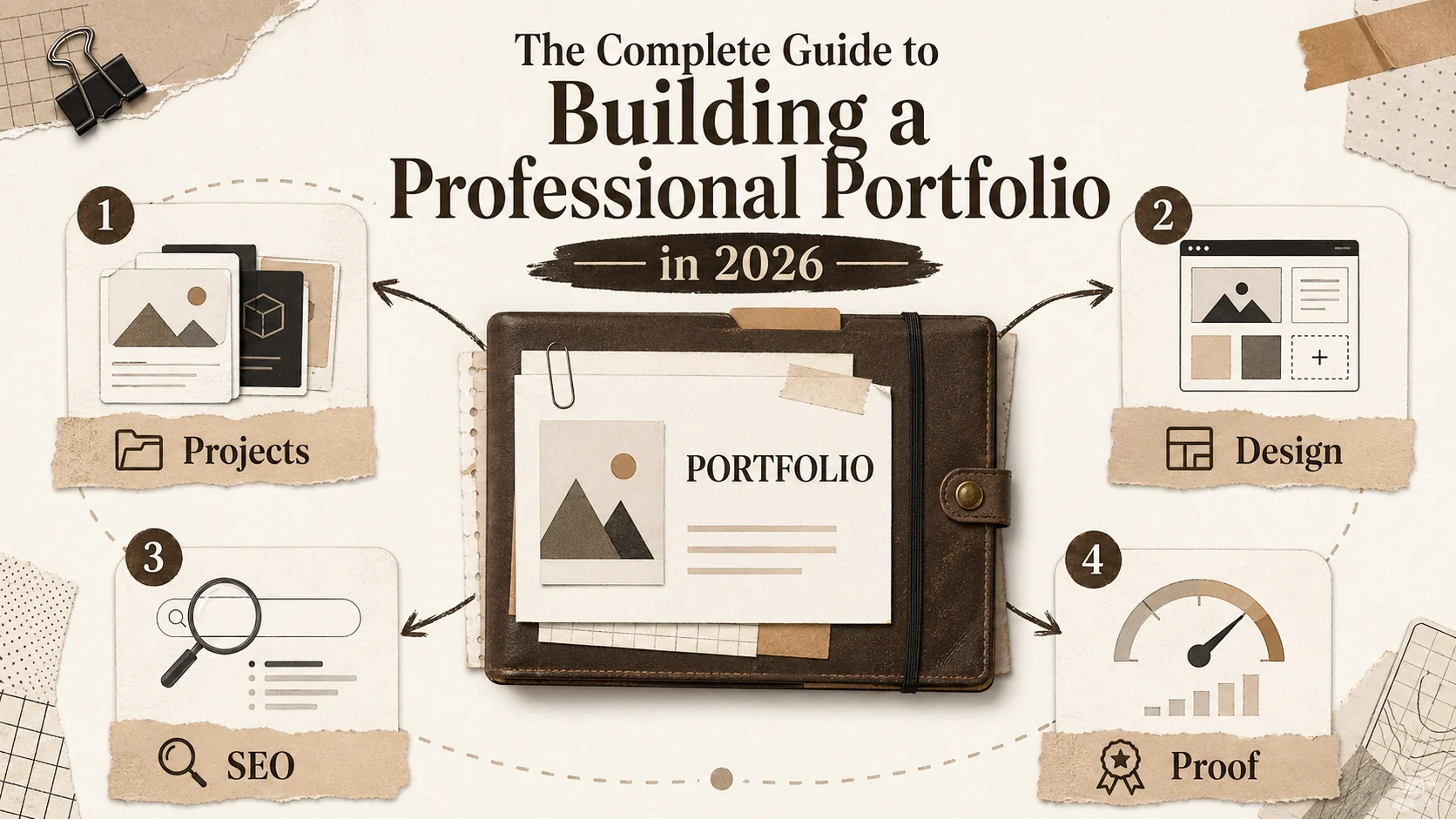
How to Build a Winning Portfolio for 2026
A six-step framework -- strategy before design, ruthless curation of 4-6 projects, case study structure (Challenge-Process-Result), human voice with video intros, optimized CTAs, and public iteration -- addresses every conversion bottleneck identified by 2026 hiring data. Professionals who follow this framework and publish on platforms like Popout report 30-50% higher inbound inquiry rates within one quarter.
Ready to build or overhaul your portfolio? Follow this actionable framework:
- Start with Strategy, Not Design: Define your target audience (hiring manager, client, etc.) and the 2-3 key messages about your value you want them to remember.
- Curate Ruthlessly: Show only your strongest, most relevant 4-6 projects. Depth and narrative beat volume every time.
- Structure Projects as Case Studies: For each project, use this framework: Challenge, Your Role and Process, Solution, Result and Learnings.
- Show Your Face and Voice: Include a professional bio with a point of view, and consider a short video introduction or project walkthroughs to build connection.
- Optimize for Action: Make your contact information and links to your other profiles (GitHub, LinkedIn, Dribbble) crystal clear. What is the one next step you want a visitor to take? If you struggle with the right CTA, our guide on the first 5-seconds rule covers what hooks recruiters fastest.
- Iterate Publicly: Do not wait for perfection. Launch, then add new projects and insights regularly. This shows an active, growing mind.
The Meaning Over Metrics Mindset
The 2026 personal brand market rewards depth of impact over vanity metrics. A Edelman Trust Barometer study found 72% of professionals trust human-authored, experience-driven content more than polished AI-generated material. Portfolios built around genuine problem-solving and authentic perspective outperform follower-count-driven profiles in both recruiter engagement and client conversion.
The personal brand bubble has burst. 2026 is about meaning, not metrics. This represents a maturation of the online presence landscape. Early personal branding was often about vanity metrics—follower counts, engagement rates, viral posts. These shallow signals are increasingly seen for what they are: noise.
What matters now is depth of impact. A portfolio that demonstrates thoughtful work, genuine expertise, and authentic perspective will outperform one that merely looks polished. Hiring managers and clients have become sophisticated consumers of online content. They can distinguish between surface-level self-promotion and substantive professional contribution.
Build your portfolio around work you are genuinely proud of. Write about problems you have actually solved. Share insights you have earned through real experience. This authenticity cannot be faked, and it is precisely what the 2026 market rewards.
Frequently Asked Questions
I am not a designer or developer. Do I still need a portfolio?
Absolutely. Professionals in marketing, sales, project management, consulting, and many other fields can create powerful portfolios. Instead of design mockups, showcase campaign results with analytics, detailed project plans, strategic whitepapers, client testimonials, or video presentations of your ideas. The medium changes, but the principle of showing your work remains.
How is a portfolio different from a LinkedIn profile?
Your LinkedIn profile is a structured, social networking profile optimized for search and connection. Your portfolio is a customizable, narrative-driven showcase of your work and process. Think of LinkedIn as your professional directory listing and your portfolio as your interactive, detailed brochure.
What if my work is confidential or under NDA?
This is common. The solution is to focus on process and problem-solving without revealing sensitive data. Create "sanitized" case studies that explain the type of problem, your methodological approach, the tools you used, and the general category of outcome (e.g., "improved operational efficiency" instead of specific figures). Use dummy data or high-level diagrams to illustrate your thinking. For a complete framework on navigating this, read our guide on the 2026 portfolio privacy paradox.
How often should I update my portfolio?
Treat it as a living document. A major update every 6-12 months is good, but smaller updates—adding a new project, writing a brief reflection on a tool you have mastered—can be done quarterly or even monthly. This signals that you are actively engaged in your craft. If you want a repeatable system, our guide on why your last updated date costs you offers covers the quarterly touch framework.
Is it worth paying for a custom portfolio website?
It depends on your career stage and goals. For most, using a modern, high-quality portfolio builder (like Popout) offers the perfect balance of professional presentation, ease of use, and cost-effectiveness. It allows you to focus on content, not code. As you progress and your needs become highly specific, a custom solution may then be worth the investment.
Your Portfolio Is Your Professional Future
The evidence is overwhelming. The 2026 job market belongs to professionals who can move beyond asserting their value to authentically demonstrating it. Your portfolio is no longer an optional accessory; it is your primary vehicle for career advancement, commanding higher pay, attracting better opportunities, and future-proofing your skills against AI automation. It is where your resume ends and your story begins.
This shift is an opportunity. It rewards depth, authenticity, and strategic thinking. It allows you to be seen for the full professional you are, not just the bullet points on a page. The time to build your definitive professional hub is now.
Start Building Your 2026 Portfolio Today
Do not let a static resume hold you back. Popout is designed to help you build a powerful, hub-style portfolio that showcases your work, your process, and your personal brand—all in one sleek, professional page. It is the simplest way to step into the future of hiring.
Other Doved Studio projects
Related tools from the same studio you might find useful:
- Ralphable: Generate structured Claude Code skills that iterate until pass/fail criteria are met.
- Glean: Turn scrolling time into a daily action plan. Capture, process, execute.
- Doved Studio: Studio indie derrière cette app et une dizaine d'autres outils.
Written by
David Pavlovschii
Founder