
Stop Hiding Your Side Hustle: Why Your Next Job Wants to See Your Passion Projects

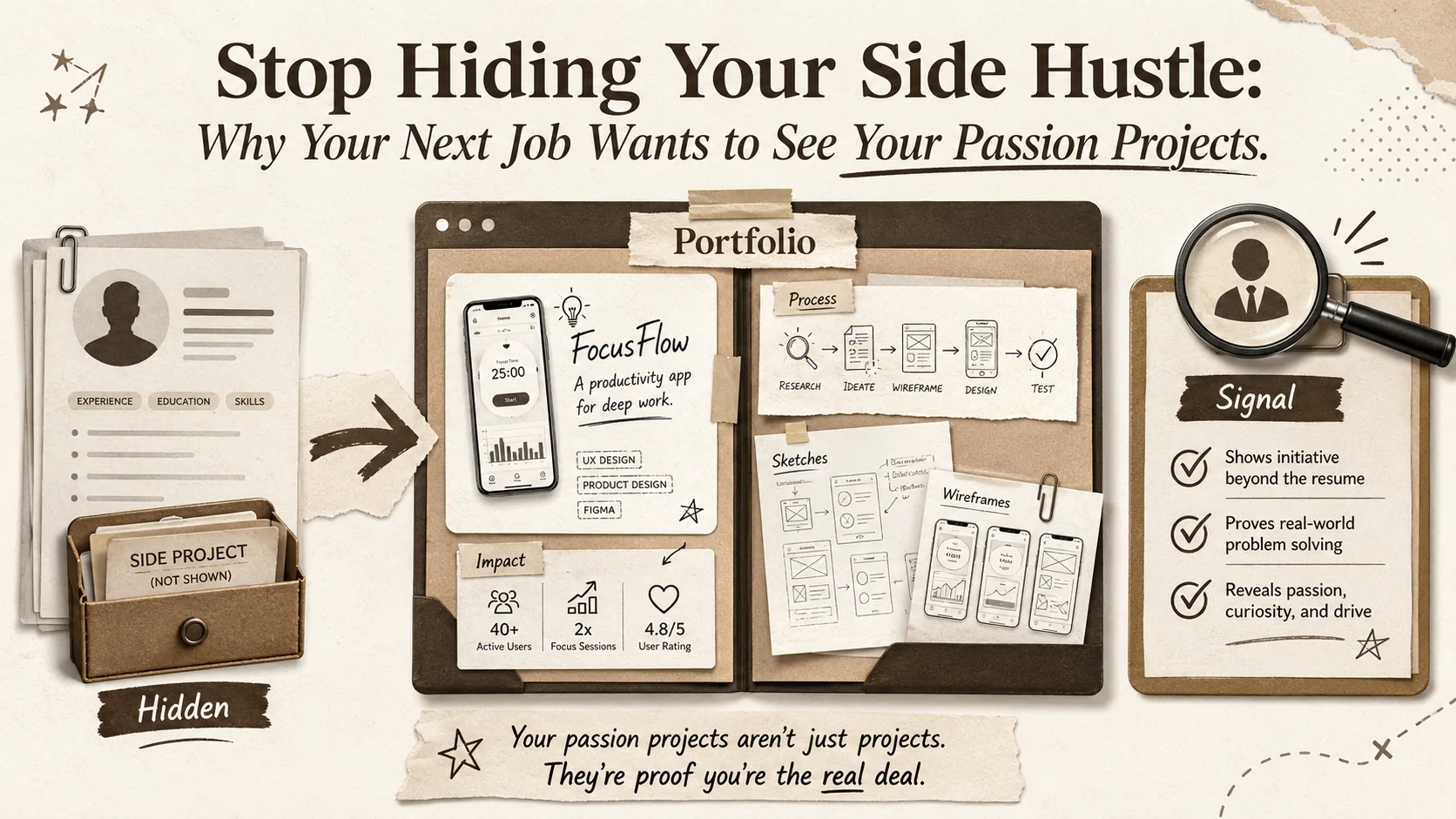
For years, the rule was simple: keep your side hustle quiet. Your day job was your professional identity; everything else was a distraction. I've reviewed thousands of portfolios as a branding consultant. The most common mistake was a sterile list of job titles, with all the interesting parts scrubbed away. That era is over.
A 2026 LinkedIn report found 72% of hiring managers now actively look for passion projects on applications, ranking them above GPA for predicting success in tech, marketing, and design Source. The #ShowYourSideHustle trend isn't just a fad. It reflects a real change in how we judge professional potential. Your side projects are no longer a secret. They are your most compelling career asset.
This article isn't about starting a side hustle. It's about reframing the work you already do in your spare time. We'll explore why the stigma flipped, what signals hiring managers want, and how to integrate your projects into a professional narrative that gets you hired.
What Are Passion Projects and Why Do They Matter Now?
Passion projects are self-initiated work -- apps on GitHub, design shots on Dribbble, case studies on Behance, or open-source contributions -- that demonstrate initiative, applied skill, and authentic curiosity in ways interviews cannot reliably test. A 2026 LinkedIn report found 72% of hiring managers actively seek them.
Passion projects are substantive work you initiate outside your primary job. They are driven by intrinsic motivation—you do them because you want to. The 2026 shift is that employers see these projects as live demonstrations of skills interviews can't reliably test. They show initiative, applied skill, and authentic curiosity.
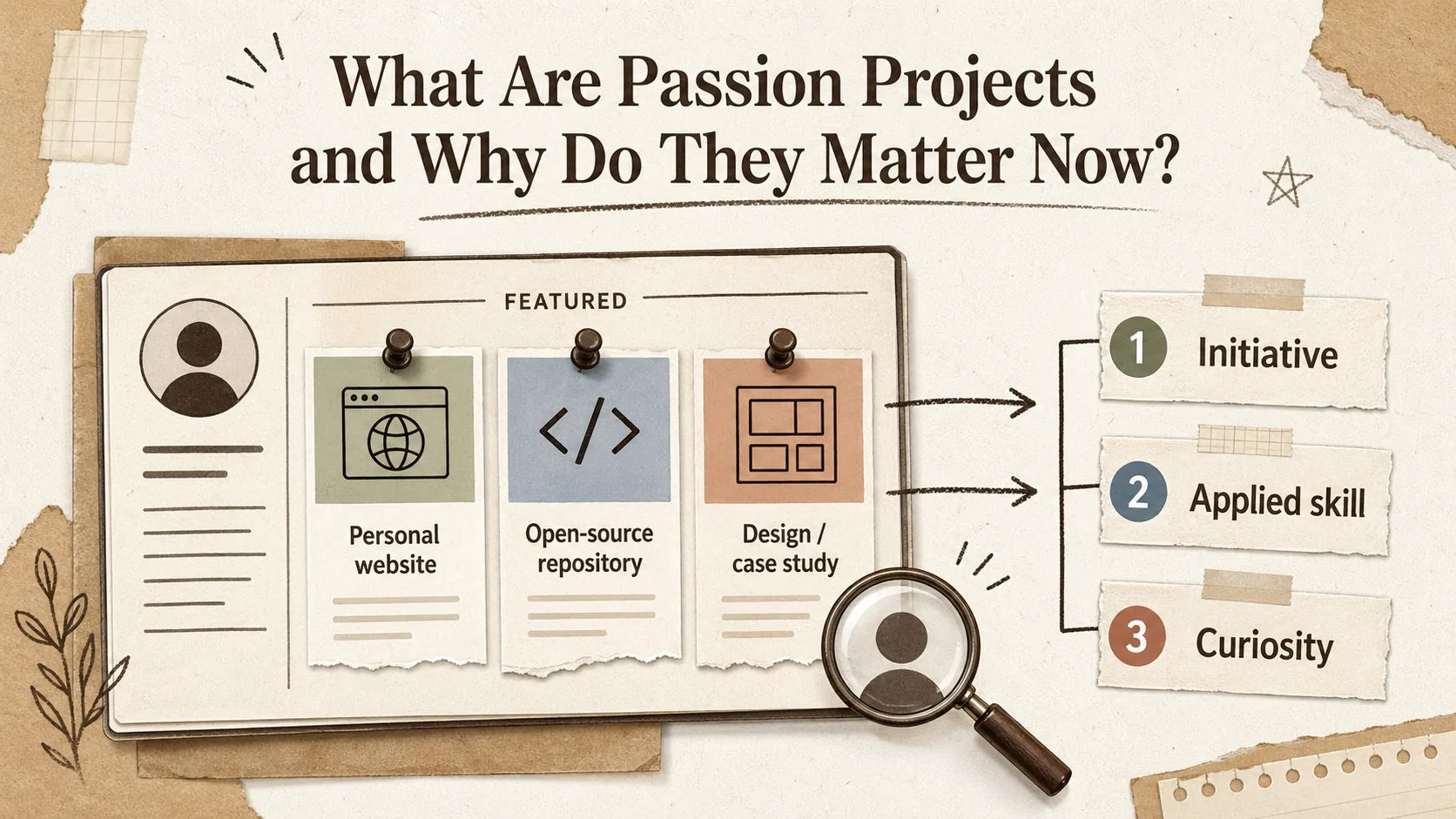
A passion project is any substantive work you start and finish outside your main employment. It's the blog you write, the app you're coding, the Etsy store you run, or the open-source software you contribute to. It's not passive consumption. The key shift is that employers now decode what these projects represent. They see a live demonstration of skills no interview question can uncover.
| What Employers Used to See | What Employers Now See (The 2026 Mindset) |
|---|---|
| A lack of focus | Initiative: You identify problems and build solutions without being told. |
| A conflict of interest | Entrepreneurial Thinking: You understand product development from idea to launch. |
| "Unprofessional" hobbies | Applied Skill Proof: Your GitHub commits are better proof of coding skill than a certificate. |
| A risk of burnout | Resilience: Finishing a complex project in your included time shows tenacity. |
| Something to hide | Authentic Passion: Your genuine interests make you a more engaged, human team member. |
This isn't theoretical. Data backs it up. A Harvard Business Review analysis correlated employees with documented side projects with 34% higher rates of innovation-driven contributions at work Source. They were more likely to propose new processes and adapt to change.
Why Have Platforms Become the New Resume?
The platforms hosting your work are now your resume. Your GitHub profile is your engineering portfolio. Your Substack is your writing sample. A hiring manager can, in five minutes, assess the quality and evolution of your work over years. A static resume can't do that. This is why a well-crafted online portfolio is essential. It's the central hub where you curate this narrative, connecting your day job, side projects, and goals. It turns a scattered digital footprint into a coherent story.
Can a Side Project Redefine Your Career?
I worked with a client, a mid-level data analyst, who felt stuck. His resume was competent but forgettable. He had a three-year passion project: a fantasy football analytics model with a small Twitter following. We made it the centerpiece of his portfolio strategy. He wrote case studies on his methodology and framed it as evidence of advanced statistical modeling and data storytelling. He wasn't "just an analyst" anymore; he was a data product builder. He received two Senior Data Scientist offers, with hiring committees citing the project as the reason. The old rule was to separate work and personal life. The new rule is to integrate professional skills with personal passions.
Why Keeping Your Side Hustle a Secret Is a Career Mistake
Hiding your side projects makes you a commodity candidate, eliminates the "skills bridge" opportunity to demonstrate new technologies, and creates a narrative gap in your career story. A study by The Muse found candidates who discussed side projects were 40% more likely to receive a follow-up interview.
Hiding your side projects makes you a generic candidate, misses chances to bridge skill gaps, and undermines your growth story. In a crowded market, obscurity is a bigger risk than visibility. Your silence makes you easier to overlook.
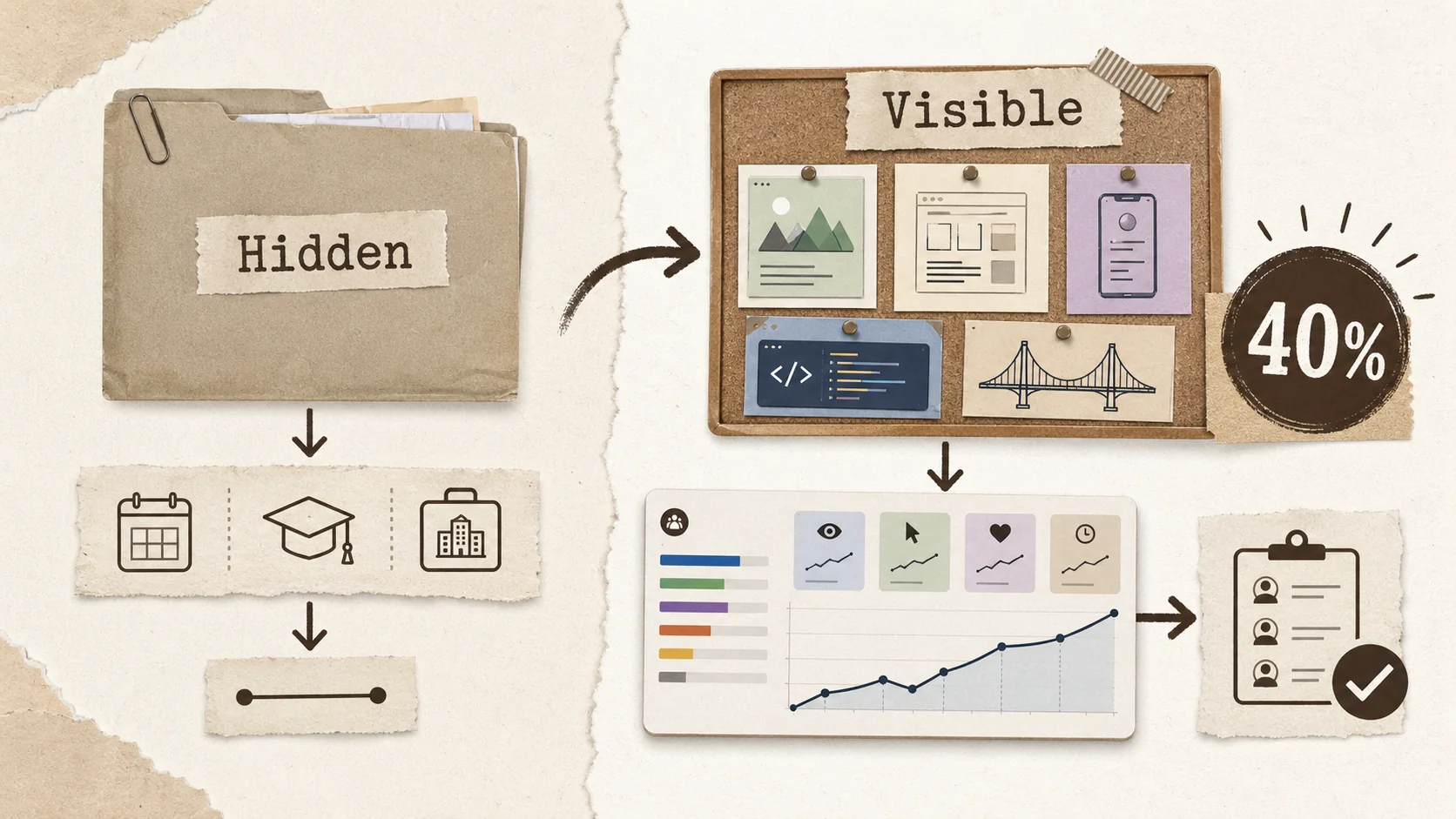
You might think playing it safe is smart. What if your boss thinks you're job hunting? What if the project fails? This fear holds most professionals back. Obscurity is a far greater risk than visibility.
How Does Hiding Your Work Make You a Commodity?
When you hide what makes you unique, you force recruiters to judge you on generic criteria: years of experience, degree, company names. You become a checklist item. In a stack of 300 resumes for a developer role, the candidate who links to a live app they built jumps into the "interview" pile. The others remain buzzwords. Your side project is the antidote to being a commodity. It gives tangible proof you can do what your resume claims. For more on standing out, see our guide on building a powerful personal brand. And if your portfolio itself feels stale, check whether your last updated date is costing you job offers.
What is the "Skills Bridge" Opportunity You're Missing?
Your day job likely uses a specific set of tools. Your side project is your lab. It's where you learn the next JavaScript framework or try a new design tool. This is your skills bridge to your next role. If you only list skills from your current job, you seem stagnant. Showcasing a side project with a modern tech stack shows self-driven learning. It answers "How do you stay current?" before it's asked.
How Does Hiding Projects Undermine Your Growth Story?
Career progression is a story. A resume shows the what. A portfolio with side projects shows the why and how. That blog you started five years ago with 10 readers shows the start of your content skills. The failed app teaches a lesson about product-market fit. Hiding these steps creates a narrative gap. Showing them creates an arc of curiosity and growth that attracts forward-thinking companies. This is a core part of career development. Data confirms this. A study by The Muse found candidates who discussed side projects were 40% more likely to get a follow-up interview Source. Your silence isn't protecting you; it's making you forgettable.
How to Showcase Your Side Hustle on a Professional Portfolio
Strategically curate 2-4 projects, build brief case studies (challenge, process, results), and integrate them across LinkedIn Featured sections, your portfolio hub, and your resume's "Selected Projects" section -- with consistent narrative threading between platforms.
Showcasing your work requires strategic curation, not comprehensive disclosure. The goal is to select key projects, build compelling case studies around them, and integrate them seamlessly across your professional platforms like your portfolio and LinkedIn.
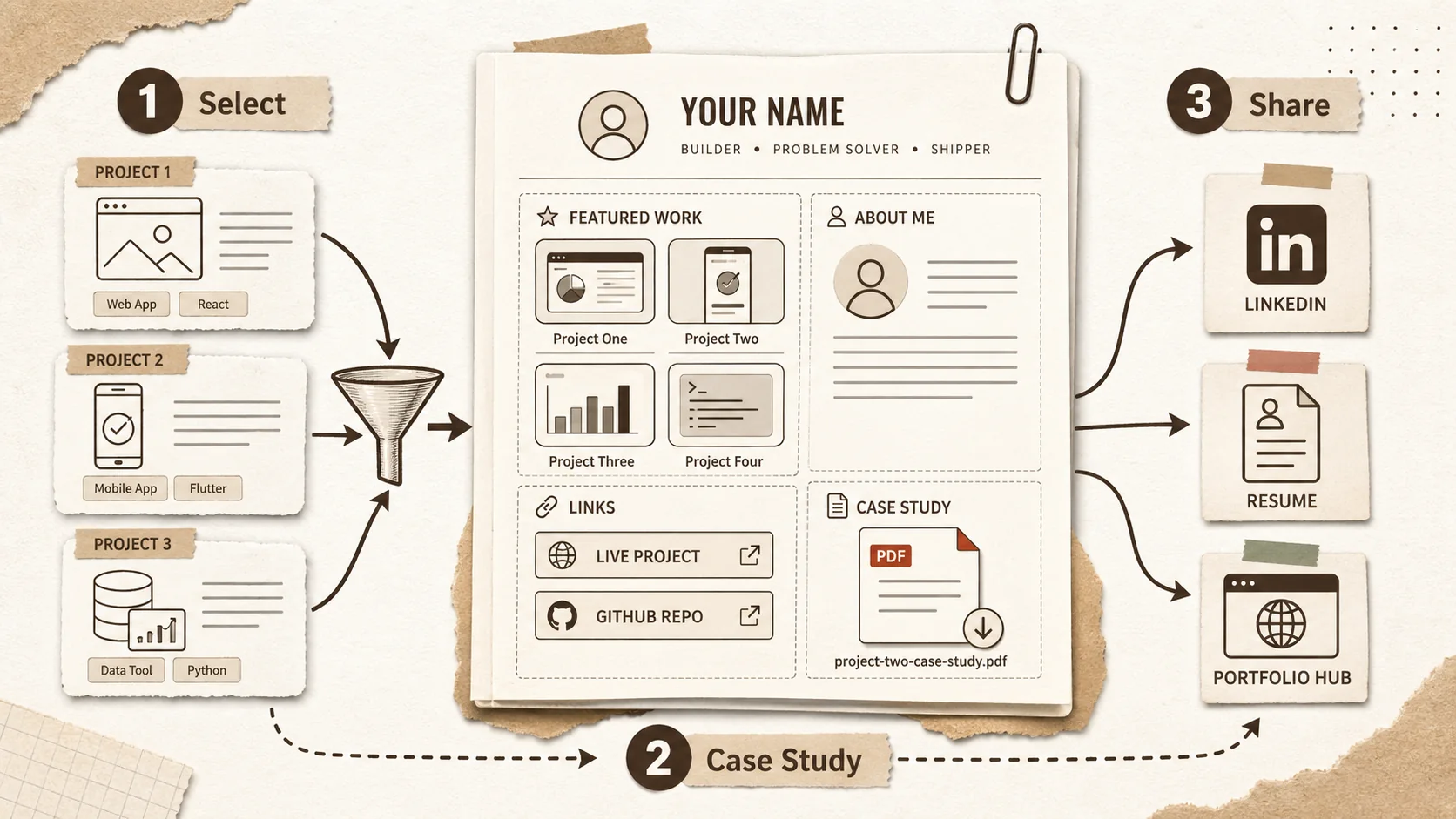
Knowing you should showcase your work is one thing. Knowing how to do it professionally is another. Most people stumble by dumping everything online with no context or being too timid to share anything. You need strategic curation.
How Do You Audit and Select the Right Projects?
You don't need to show every half-baked idea. Be a ruthless curator.
- The Proof Project: Your star. The most complete project that demonstrates the core skills you want to be hired for.
- The Learning Project: Shows your ability to pick up new skills. Emphasize the learning journey.
- The Passion Project: Purely for heart. This makes you human and memorable. Create a simple spreadsheet. For each project, note: Name, Core Skills, Status, Key Results, and the "Story" in one sentence. Select 2-4 that paint a full picture.
What Makes a Powerful Project Case Study?
A link to a GitHub repo is passive. A case study is active storytelling. For your 1-2 key projects, write a brief case study. Use this structure:
- The Challenge: What were you trying to solve?
- The Process & Tools: How did you approach it? What tech did you use? (e.g., "I used React and the Climatiq API").
- The Solution: Describe the final product. Include screenshots.
- The Results & Learnings: What happened? What did you learn? This shows reflection. This format transforms a project from a "thing I made" into "evidence of my problem-solving ability." It's what a hiring manager needs. For developers, this approach is detailed in our guide on how to create a developer portfolio. Designers can showcase this same evidence on platforms like Behance or Dribbble, linking case studies back to a central hub.
Where Should You Integrate These Projects?
Weave projects into your existing professional presence.
- Your Portfolio Website: This is your home base. Use a platform like Popout to create a clean page. Feature your key case studies prominently.
- Your LinkedIn Profile: Use the "Featured" section. Add projects as separate entries in "Experience" if they are substantial.
- Your Resume: Include a "Selected Projects" section with a one-bullet description and a link to the full case study. The thread is a consistent narrative. Your LinkedIn headline, portfolio bio, and resume summary should all reinforce the identity your projects show. If you're building this hub from scratch, consider stopping the social media bio link trap and owning your domain instead.
How Do You Talk About Your Projects in an Interview?
You will be asked. Prepare a 60-second "elevator pitch" for each key project:
- What it is: "A web app that helps food bloggers calculate recipe nutrition labels."
- Why you built it: "My partner spent hours doing this manually."
- The key takeaway: "I taught myself Vue.js to build it. I learned more about product design here than in two years of corporate work." This turns a question into a concise story about your initiative and impact.
Advanced Strategies: Turning Passion Projects into Career Capital
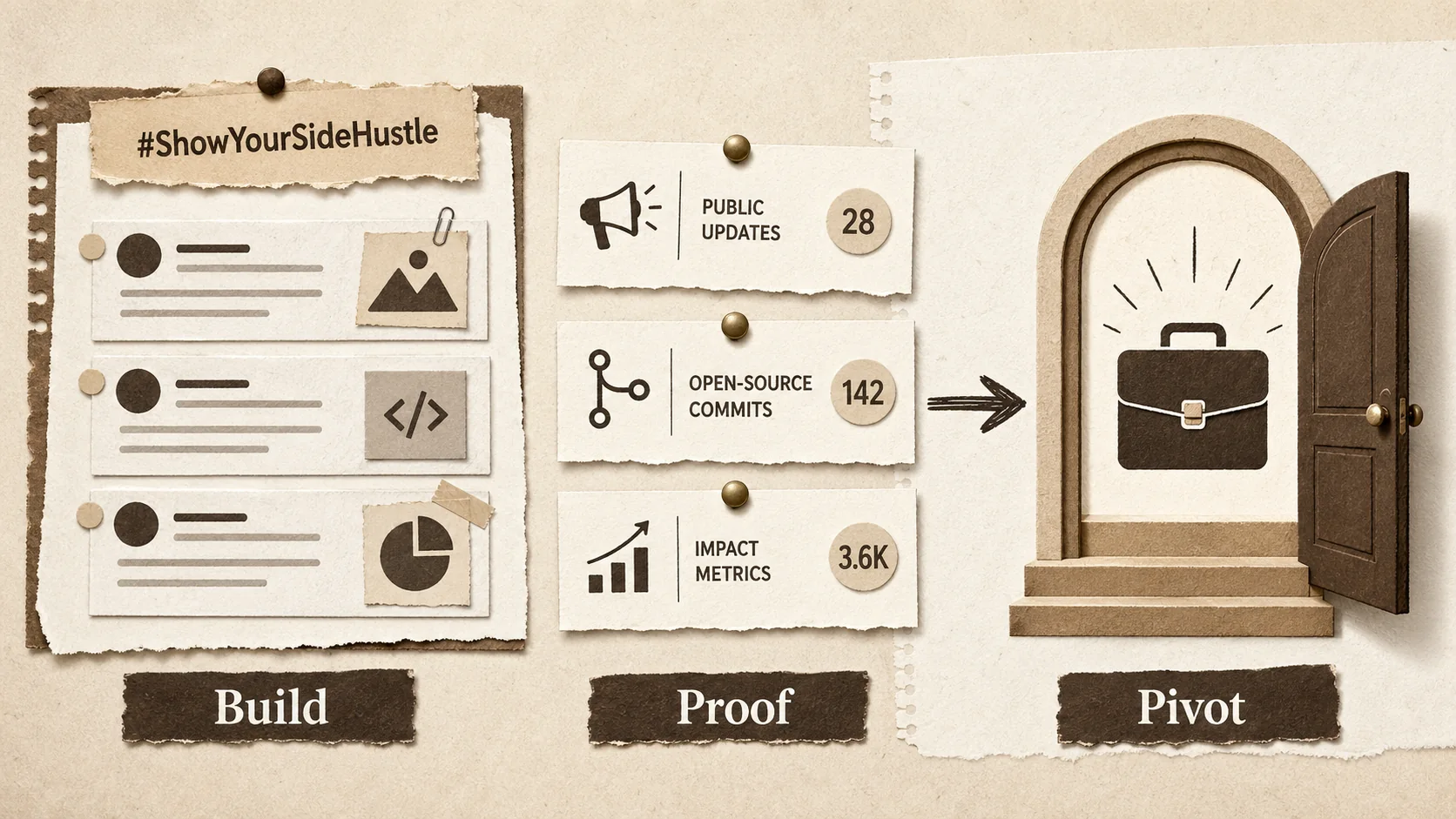
Go beyond passive display: build in public on Twitter/X with #BuildInPublic, contribute to established open-source repos on GitHub, quantify impact with metrics (even from 100 users), and use side projects as a deliberate bridge to career pivots -- a Harvard Business Review analysis correlated side projects with 34% higher innovation contributions at work.
Once you're comfortable showcasing work, leverage it strategically. Move from passive display to active career engineering by building in public, contributing to open source, quantifying impact, and using projects to pivot fields.
 indicates a active community discussion.)
You can leverage your work more strategically. This is about moving from passive display to active career engineering.
Should You Build in Public?
"Building in Public" means sharing your process, progress, and struggles as you work. You do this through Twitter threads or LinkedIn posts.
- Why it works: It creates a timeline of your competence. It attracts a community. It makes your problem-solving visible. A hiring manager who sees you troubleshoot a bug in public already has proof of your technical communication.
- How to start: Pick one platform. Commit to one update per week. Share a small win or a problem you're stuck on. Use hashtags like #BuildInPublic.
Is Contributing to Open Source Worth It?
Contributing to an established open-source project is a powerful alternative to starting your own. It shows you can read others' code and collaborate asynchronously.
- The strategic approach: Target projects widely used in your industry or in a domain you want to move into. A merged pull request in a respected project is a massive credibility boost. Document this contribution in a case study format.
How Do You Quantify a "Small" Project's Impact?
Numbers talk. Even with 100 users, find metrics that matter.
- For an app: "Cut task time from 10 minutes to 2 minutes."
- For a blog: "Grew to 500 subscribers in 6 months with a 45% open rate."
- For a design: "Increased user click-through by 15%." This shifts perception from "hobby" to "micro-product." It shows you think about impact.
Can a Side Project Help You Change Careers?
This is the most powerful use. Your side project can be a deliberate bridge to a new field. Want to move from marketing to product management? Build a tiny app and document the entire product lifecycle. That project becomes your de facto PM portfolio. Your current job title becomes irrelevant. I advised a client in customer support who wanted content design work. She had no relevant experience. So, she audited 5 SaaS apps' in-app copy and wrote redesign proposals as case studies. This project portfolio got her a job as a junior content designer. Her side project didn't just showcase skills; it created them.
FAQ: Showcasing Side Projects
How do I talk about a side project that failed? Frame it as a learning experience. Briefly describe what you built, but focus on the "post-mortem": What did you learn about scope or user needs? What would you do differently? This shows maturity and an ability to extract value from any situation. It's often more impressive than a simple success story.
Should I tell my current boss about my side hustle? Use careful judgment. If your project is unrelated and uses only your own time and equipment, you may not need to disclose it. If it's adjacent to your industry, or you use company resources, check your employment contract for IP clauses. If you have a good manager and the project reflects skills useful to your role, mentioning it can position you as a proactive learner. Always review your contract first.
What if my project isn't technically impressive? Perfection is the enemy. A simple, functional project that solves a real problem is better than a grandiose, unfinished idea. Focus on clarity of purpose and quality of execution at your current level. You can preface it with "A beginner project where I learned X." Authentic progress beats fake polish.
Can side projects make up for a lack of formal experience? Yes. They can override gaps. A career gap filled with a well-documented passion project becomes "skill-building," not unemployment. For career changers, side projects are primary currency. Structure your portfolio to lead with your projects and the skills they demonstrate. Let formal experience provide supporting context.
Conclusion: Your Side Hustle Is Your Signature
The professional landscape has changed. What was once hidden is now your key differentiator. Your passion projects prove you can initiate, solve problems, and learn independently. They provide the human context your resume lacks. Integrating them into your professional story isn't optional anymore; it's how you build a career that stands out. Start by auditing your projects, building one solid case study, and updating your portfolio. Before you go public, consider running a portfolio soft launch to test your messaging with a trusted group. The goal isn't perfection. It's showing the real work behind your professional identity.
Ready to transform your side hustle into your strongest career asset?
Popout helps you build a professional portfolio page in minutes, designed to showcase your passion projects alongside your experience. Stop hiding your work. Start connecting it to your career goals. Create Your Popout Page and build the narrative that gets you hired.
Other Doved Studio projects
Related tools from the same studio you might find useful:
- Ralphable: Generate structured Claude Code skills that iterate until pass/fail criteria are met.
- Glean: Turn scrolling time into a daily action plan. Capture, process, execute.
- Doved Studio: Studio indie derrière cette app et une dizaine d'autres outils.
Written by
popout
Content Team