

Stop Letting Your Portfolio Collect Dust: The 30-Minute Weekly Refresh That Actually Works


Introduction
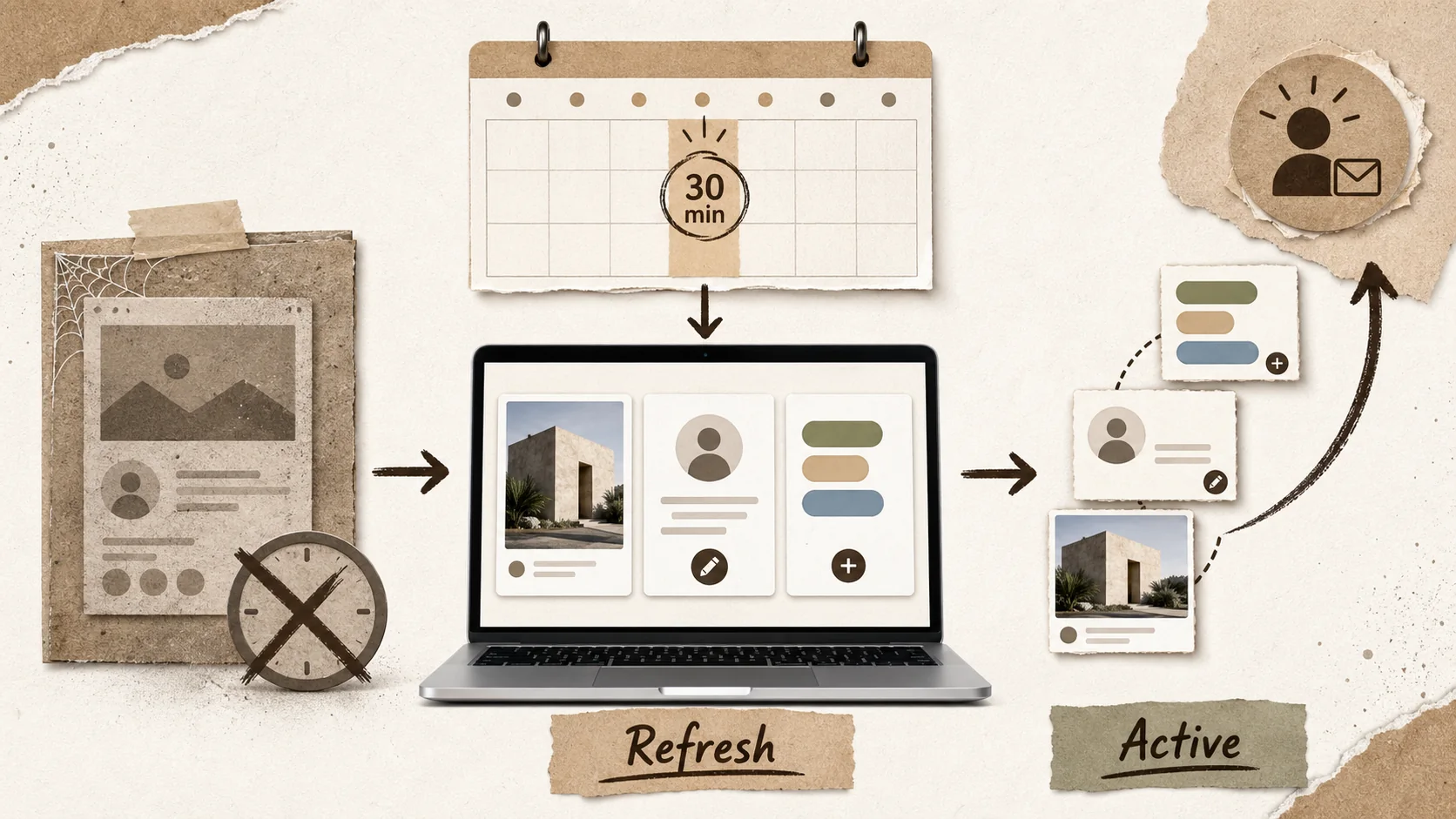
A static portfolio actively works against you in 2026 -- recruiter tools flag profiles with no recent activity, and a Greenhouse 2025 report found that candidates with updates within 90 days are 70% more likely to be contacted. A 30-minute weekly refresh replaces painful annual overhauls with sustainable, compounding micro-improvements.
You spent a weekend, maybe two, pouring your heart into it. You chose the perfect template, agonized over project descriptions, and finally hit publish. Your portfolio was live. For a few weeks, you checked the analytics, maybe even sent the link to a few potential clients. Then life happened. A new project, a busy quarter, a job search that went quiet. You haven't touched it in months. Maybe a year.
That portfolio isn't just sitting there. It's actively working against you. In March 2026, a static portfolio is a digital liability. Your LinkedIn profile, GitHub repos, Behance projects, and Dribbble shots all contribute to the same story -- and when any of them go stale, the whole narrative suffers. It signals disengagement, outdated skills, and a lack of professional momentum. Recruiters and clients now use tools that flag profiles with no recent activity. Your beautifully crafted "About Me" page from 2024 whispers that you haven't learned anything new since then.
This isn't about another daunting, soul-crushing overhaul. The idea of spending another full weekend rebuilding your site is exactly why you avoid it. The solution is smaller, smarter, and sustainable. It's about shifting from a monolithic "project" mindset to an agile "practice" mindset. You don't need a new portfolio; you need a system to keep your current one breathing, relevant, and working while you sleep. This is that system. A focused, 30-minute weekly ritual that turns your portfolio from a museum of past work into a dynamic engine for future opportunity.
Understanding Portfolio Decay and the Active Portfolio
Portfolio decay is the gradual erosion of your page's value as content goes stale -- measured by recency (last update > 6 months = red flag) and momentum (skill representation, content freshness). An active portfolio runs on two engines: content updates (project swaps, bio rewrites) and signal updates (SEO freshness, LinkedIn algorithm boosts, human credibility cues).
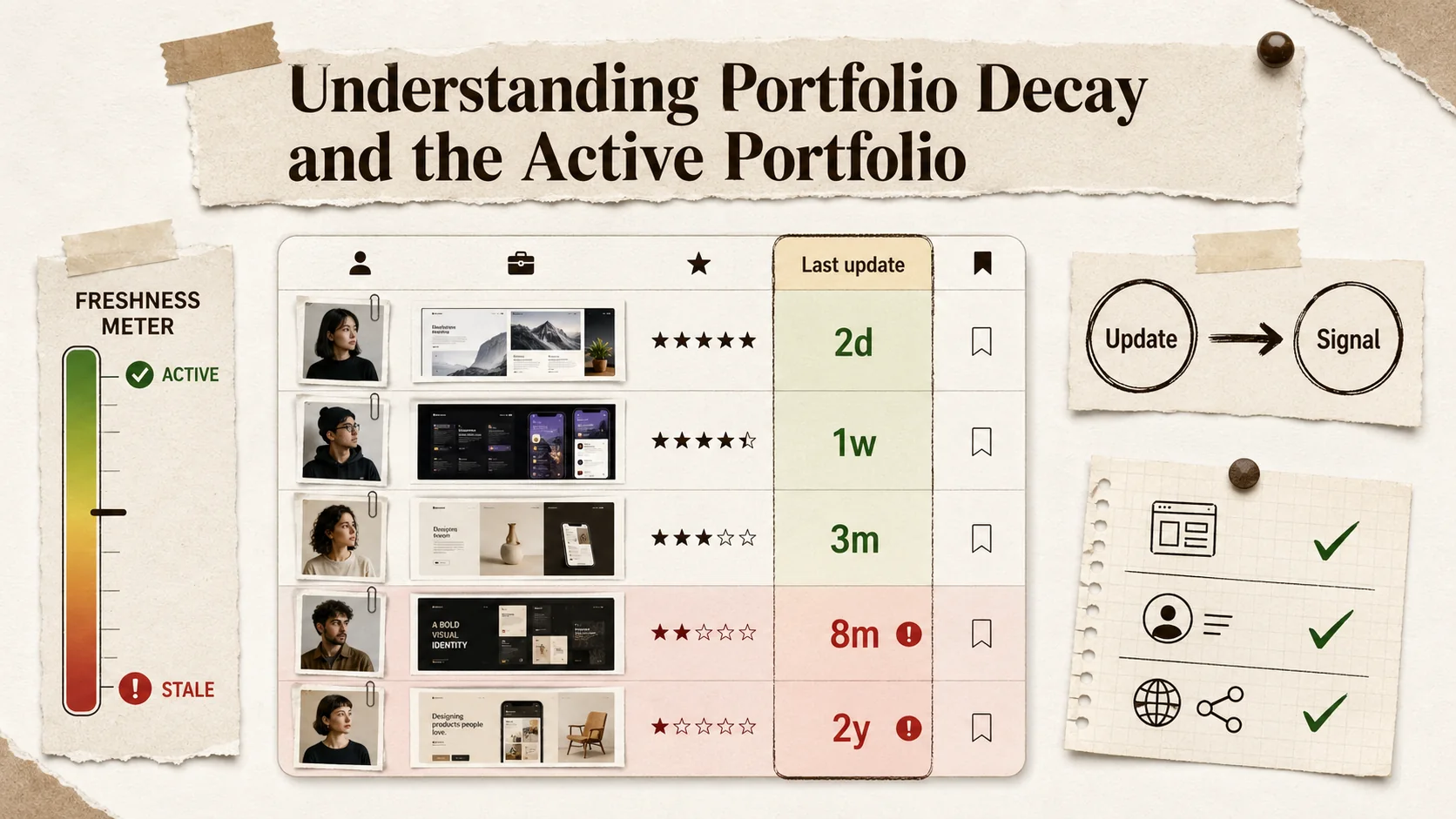
Let's define the problem precisely. Portfolio decay isn't about your site breaking. It's the gradual erosion of its value and relevance because the information it presents becomes stale. Think of it like a grocery store. A store with fresh produce, new products on the shelves, and clean floors attracts customers. A store with dusty cans, wilted lettuce, and last year's promotions does not. Your portfolio is your professional storefront.
An active portfolio, in contrast, is managed with continuous, incremental updates. It's treated as a living document of your professional journey, not a time capsule. The goal isn't perfection with each change, but consistent motion. This concept has moved from a "nice-to-have" to a non-negotiable. A 2025 report by the hiring platform Greenhouse found that recruiters are 70% more likely to contact a candidate whose online profile shows activity within the last 90 days. Stagnation is interpreted as career stagnation.
The difference between a static and an active portfolio often comes down to two metrics: recency and momentum.
| Metric | Static Portfolio | Active Portfolio |
|---|---|---|
| Last Updated | 6+ months ago | Within the last 30 days |
| Content Freshness | Showcases completed projects from a distinct past period (e.g., "2023 Projects") | Integrates recent work, learnings, or thoughts (e.g., "Latest: Q1 2026 UI Exploration") |
| Skill Representation | Lists skills acquired at the time of publishing | Reflects current proficiency and trending tools (e.g., mentions a new AI dev tool learned last month) |
| Visitor Signal | "This person's story ended here." | "This person is currently engaged and evolving." |
The Two Engines of an Active Portfolio
An active portfolio runs on two engines: content updates and signal updates.
Content updates are the tangible changes: swapping a project image, adding a new case study, rewriting a bio sentence. These are what you see. Signal updates are the meta-data and behavioral cues that platforms and people pick up on. When you regularly update your site, several positive signals are sent:
- SEO Signals: Search engines like Google prioritize fresh content. A page updated last week is seen as more relevant than one updated three years ago, all else being equal. This is a core principle behind Google's crawling algorithms.
- Platform Algorithms: Sites like LinkedIn or GitHub often boost profiles in internal searches and suggestions when they detect recent activity. The same applies to Behance and Dribbble, which surface recently-updated portfolios in their "Discover" feeds. Posting a new project or even updating your headline can re-engage these algorithms.
- Human Psychology: A visitor who sees a "Recent Thoughts" section dated yesterday subconsciously assigns more credibility and immediacy to your entire profile. It feels current, and by extension, so do you.
Why "Set and Forget" Is a Career Strategy from a Bygone Era
The "set and forget" model made sense when a portfolio was a digital business card—a static PDF you emailed. Today, your portfolio is a dynamic node in a network. It's indexed by search engines, scraped by applicant tracking systems, and shared across social platforms. In this environment, inactivity has a cost. As one tech recruiter told me last month, "If I see a fantastic portfolio but the copyright date says 2023, my first question is, 'What have they been doing for two years? And why didn't they care enough to update this?' It creates doubt where there shouldn't be any."
This shift demands a new approach to personal branding, one that embraces continuous, low-friction improvement. For a deeper dive into building a foundation that supports this kind of agility, exploring the principles of a modern portfolio builder is essential. If you haven't audited the broader digital trail surrounding your portfolio, our guide on digital exhaust and recruiter perception explains how forgotten artifacts across platforms actively undermine your candidacy.
Why Your Stale Portfolio Is Actively Costing You Opportunities
A stale portfolio costs you in three ways: invisibility (profiles updated in the past week get 3x more recruiter views on LinkedIn Talent Solutions), credibility damage during the decisive hiring-manager review, and lost compound growth -- 52 weekly micro-updates per year outperform a single January overhaul that decays by February.
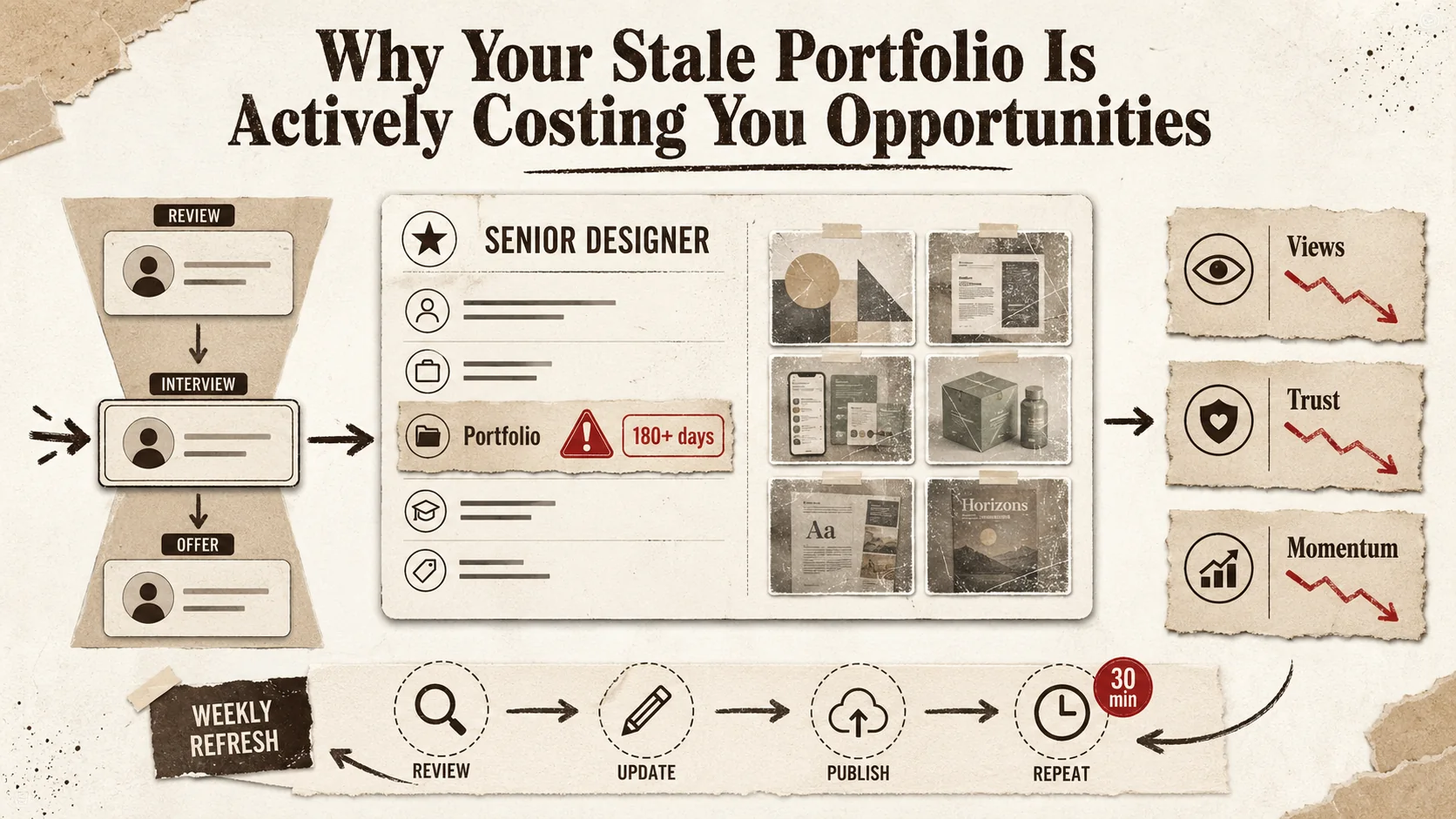
It's easy to think of an outdated portfolio as a neutral object—just a page that's not as good as it could be. That's dangerously optimistic. In the current professional climate, a stale portfolio functions as an active drag on your career momentum. Let's break down the specific, often hidden, costs.
Problem 1: You're Invisible to Modern Hiring Tools
The hiring process is increasingly automated in its early stages. Beyond human recruiters, Applicant Tracking Systems (ATS) and dedicated sourcing tools now incorporate simple but devastating filters. A common one is "profile freshness." Sourcers can filter out candidates whose LinkedIn or personal website hasn't been updated in the last X months. You might have the perfect experience, but if your portfolio's last update timestamp is from 2024, you never even make it to a human's screen.
This isn't speculation. Data from a 2025 LinkedIn Talent Solutions report indicated that profiles updated in the past week receive up to 3x more profile views from recruiters than those untouched for over a month. The algorithm literally surfaces active candidates. By not updating, you're opting out of this visibility game.
Problem 2: You Sabotage Your Own Credibility During the Decisive Moment
Let's say you beat the algorithms. Your resume lands on a hiring manager's desk, and they're interested. Their next step? Almost invariably, they visit your online presence. This is the decisive moment. They arrive at your portfolio.
If they see a copyright date of 2023, a "Latest Projects" section featuring work from 2022, and a blog with its last post over a year old, a narrative forms instantly. It doesn't matter if you've been doing groundbreaking work at your current job. The visible evidence suggests otherwise. The unspoken questions arise: Are their skills current? Are they passionate about their craft? Do they pay attention to details? You're forced to explain the gap instead of letting your work speak for itself. This is a profound disadvantage, especially when competing against candidates whose portfolios demonstrate obvious, ongoing engagement. For developers, this gap can be particularly damaging, as the pace of change in tools and frameworks is so rapid. Knowing how to create a developer portfolio that stays current is a key competitive skill.
Problem 3: You Miss the Compound Interest of Small, Consistent Actions
Career growth isn't usually about one massive breakthrough. It's about the compound interest of small, smart actions taken consistently. A portfolio refresh is a perfect example of this principle.
One 30-minute update seems insignificant. But 52 of them a year is transformative. Over a year, you might:
- Incrementally improve the copy on every project description.
- Add 12 small, new pieces of content (thoughts, mini-case studies, skill summaries).
- Test and optimize 12 different calls-to-action based on analytics.
- Keep every skill and tool listing meticulously current.
The person who does this has a portfolio that is objectively, measurably better and more effective by the end of the year than the person who does one giant, stressful overhaul in January and then ignores it. The "overhaul" person's portfolio is already decaying by February. The "weekly refresh" person's portfolio is always within 7 days of its peak relevance. This consistent practice builds not just a better portfolio, but a professional habit of curation and self-presentation that pays dividends everywhere.
The cost of inaction, therefore, isn't zero. It's the sum of missed recruiter views, eroded first impressions, and forgone compound growth in your most important career asset. The data is stark: 54% of recruiters reject candidates based on poor online presence alone, before ever reading a resume.
The 30-Minute Weekly Portfolio Refresh System
The system has four timed phases: a 5-minute analytics audit (traffic sources, top pages, behavior flow), a 15-minute content pulse (refresh one project, add a micro-case study, or prune skills), a 7-minute signal boost (update metadata and craft one LinkedIn or Twitter share), and a 3-minute hygiene check (test your CTA link, mobile glance, spell-check).
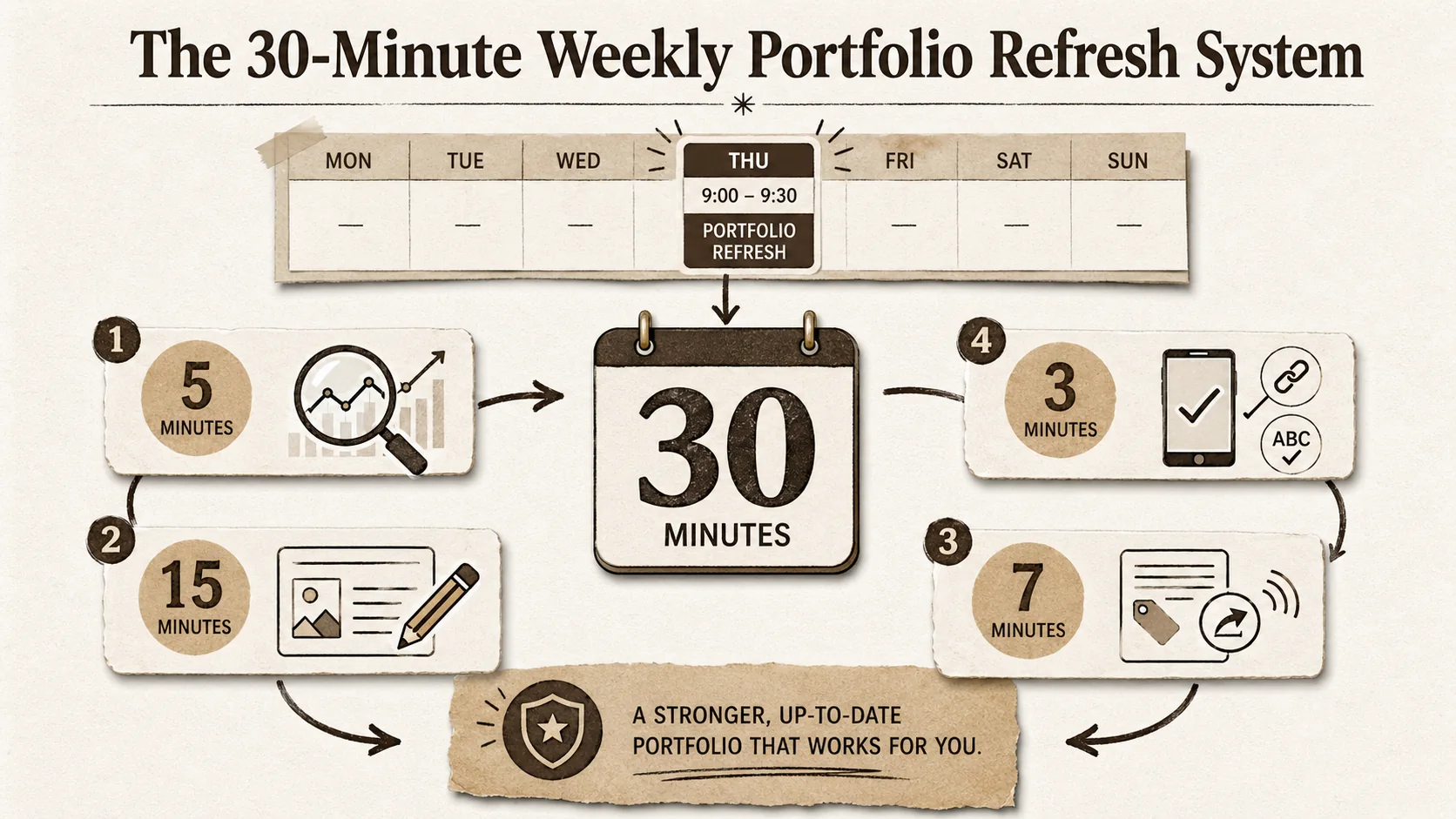
This system is built on one non-negotiable rule: You have 30 minutes. Use a timer. The constraint is the catalyst. It forces prioritization, prevents perfectionism, and makes the task feel manageable, not monumental. You're not rebuilding; you're refining. Schedule this block like a critical meeting—every week, same time. Protect it.
Here is your step-by-step framework. Each week, you will move through these phases. Some weeks you'll spend more time on one; other weeks, another. The goal is to always leave your portfolio in a slightly better state than you found it 30 minutes ago.
Step 1: The 5-Minute Audit (Minutes 0-5)
Start every session with data, not guesswork. Open your portfolio's analytics. If you don't have analytics set up, that's your only task for this week—get them installed. For most modern portfolio builders, including Popout, this is built-in.
Look at three things:
- Traffic Sources (1 min): Where did visitors come from last week? LinkedIn? A specific forum? A Google search for a particular skill? This tells you what's working.
- Top Pages (2 mins): Which project page or blog post got the most views? Is there an unexpected favorite?
- Behavior Flow (2 mins): Where did people land, and where did they go next? Did they click your "Contact" link? Did they bounce immediately from your homepage?
Actionable Insight: If you see traffic coming from a LinkedIn post about "AI prototyping tools," and your Framer project page is getting hits, that's a signal. Maybe next week you add a line to that project page like, "Built using Framer's latest AI components (March 2026)." You're aligning your content with active interest.
Step 2: The 15-Minute Content Pulse (Minutes 5-20)
This is the core work. Choose ONE of the following actions to execute. Do not try to do more than one in a single session.
- Option A: Refresh One Existing Project. Pick the project that aligns with the career direction you want. Don't just look at it—edit it.
- Update the Hero Image (3 mins): Can you create a sharper mockup or a short GIF showing interaction?
- Rewrite the First Paragraph (5 mins): Start with the outcome, not the process. Change "I was tasked with designing a dashboard" to "This dashboard reduced user time-to-insight by 40% for Acme Corp."
- Add a "What I'd Do Differently Now" Note (7 mins): This is a power move. Add a 2-3 sentence box at the end: "Looking back in 2026, I'd leverage [New Tool X] to automate the data pipeline shown here." It shows critical thinking and growth.
- Option B: Add a "Micro-Case Study." Not every project deserves a full page. Did you solve a tricky bug last week? Design a slick component? Push a fix to a GitHub repo? Write a short process thread on Twitter?
- Create a new section on your homepage or a "Log" page.
- Title: "Fixed [Problem] with [Solution]."
- Content: 3-4 sentences on the challenge, your approach, and the result. Add a single screenshot or code snippet.
- This builds a timeline of competence. Over a year, you'll have 50+ examples of you being good at your job.
- Option C: Prune and Update Your Skills/Tools List. Open your "Skills" or "Tools" section.
- Remove (2 mins): Take out anything you're not genuinely comfortable discussing in an interview today. "Familiar with" is often code for "used once three years ago."
- Update (8 mins): Add one tool or library you've used meaningfully in the last month. Be specific with versions or contexts (e.g., "React 18 + Next.js 15", "Figma Dev Mode", "Python for data scripting").
- Re-order (5 mins): Move the 3-5 skills most relevant to your target role to the very top.
Step 3: The 7-Minute Signal Boost (Minutes 20-27)
Now, make sure the world knows something changed. This is about amplifying the work you just did.
- Update Your "Last Updated" Meta (1 min): If your platform allows it, ensure the site's meta description or a visible timestamp reflects the current date. Some site generators do this automatically on publish.
- Craft One Social Share (6 mins): Don't just say "Updated my portfolio." That's noise. Share the specific update as a tiny piece of value.
- Bad Post: "Just updated my portfolio site!"
- Good Post: "Was revisiting my [Project Name] case study and wrote a short note on how I'd approach the data viz differently today using [New Tool]. Always learning! [Link to the specific project page]" This drives targeted traffic back to the refreshed content and signals deep engagement.
Step 4: The 3-Minute Hygiene Check (Minutes 27-30)
Do a blazing-fast functional review.
- Check One Critical Link: Click your primary call-to-action (e.g., "Schedule a call," "View my resume"). Does it work?
- Mobile Glance: Open your homepage on your phone. Does it load quickly? Is the text readable?
- Spell Check One Page: Run a quick spell-check on the page you just edited.
Timer goes off. Stop. You're done.
This system works because it's atomic and cyclical. You're not doing "portfolio work"—you're conducting a weekly review and adjustment of your professional front door. The key is using a platform that makes these small updates frictionless. A clunky, hard-to-update website is the biggest enemy of this habit. This is why evaluating portfolio builder alternatives is so important; the right tool should disappear, letting you focus on the content, not the mechanics.
Pro Strategies to Make Your Portfolio a Lead Generation Engine
Layer three advanced tactics on top of the weekly refresh: a "project gateway" funnel that turns each case study into a conversion path, strategic content upgrades (PDF checklists, annotated code) that capture email leads, and thematic pruning that aligns every project with your target niche using keyword-informed LinkedIn and GitHub language.
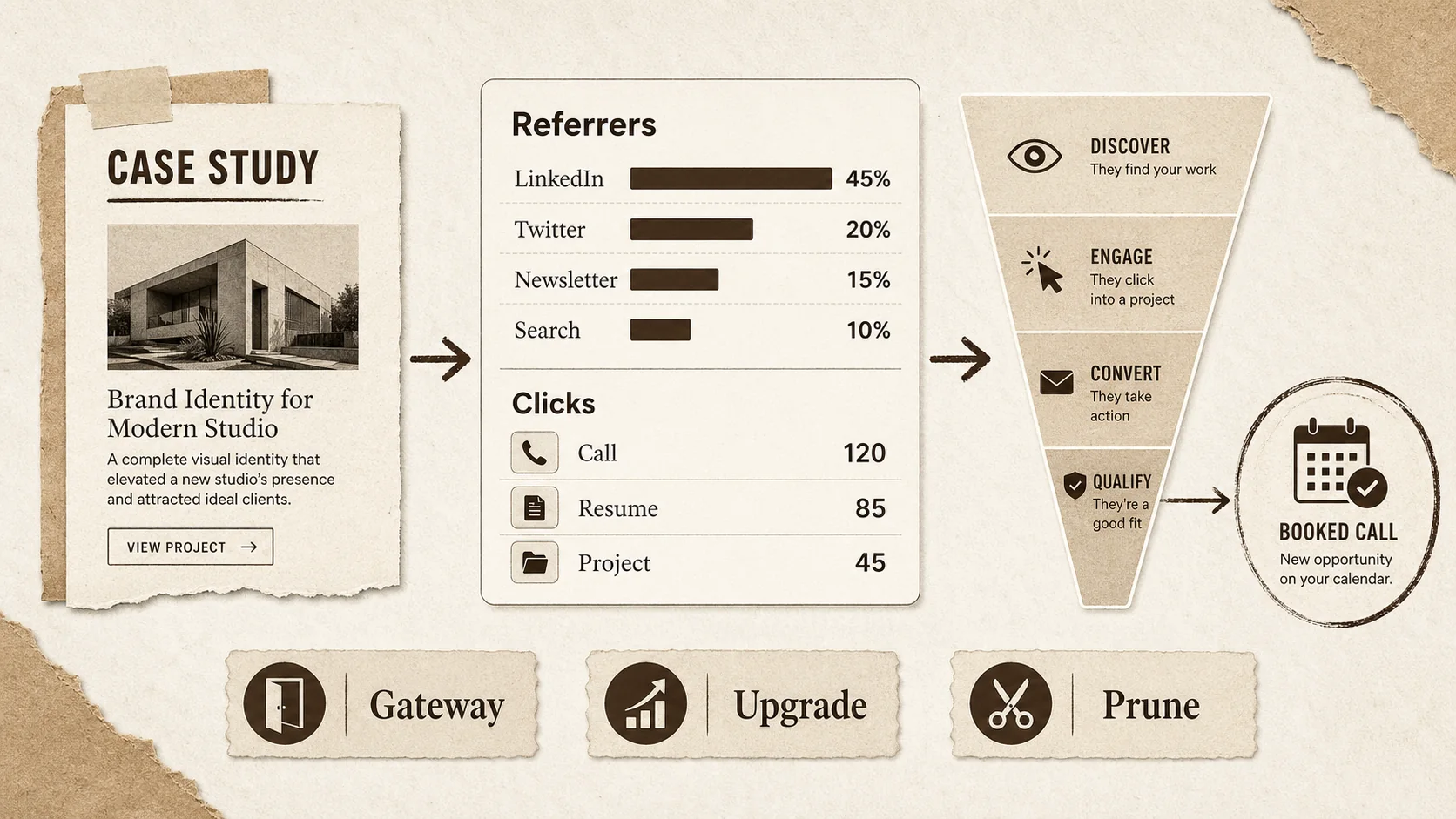
Once the weekly refresh habit is locked in, you can layer on strategic moves that transform your portfolio from a passive showcase into an active business development tool. These tactics leverage the freshness you're maintaining to capture and convert interest.
Strategy 1: Implement the "Project Gateway" Funnel
Don't let project pages be dead ends. Each project page should be a gateway to deeper engagement. Structure them with a clear narrative and a deliberate next step.
- The Hook: Start with the most impressive visual or the most compelling result (the 40% improvement stat).
- The Story: Walk through the challenge, your unique approach, and the solution. Use "I" statements. This is your thinking, not just a product description.
- The Proof: Show deliverables—images, videos, snippets.
- The Gateway: End with a context-specific call-to-action.
- For freelance designers/devs: "This approach to solving [specific problem] is what I bring to every project. If you're facing something similar, let's talk." (Link to contact form).
- For job seekers: "I detailed my process for [specific skill] here. You can see more examples of my [skill] work in the [Other Project Name] case study." (Internal link to another relevant project).
- For creators: "I built this using [Tool]. I wrote a short thread about the key lessons here." (Link to your Twitter thread).
This turns a viewer into a lead by offering a logical next step that matches their intent.
Strategy 2: Deploy Strategic "Content Upgrades"
A content upgrade is a specific, valuable piece of content you offer in exchange for an email address. On a portfolio, it should be hyper-relevant to your work.
- On a UX Case Study Page: Offer a "PDF Checklist: 5 Questions to Ask Before Your Next UX Audit."
- On a Developer Project Page: Offer "The Annotated Source Code: Comments explaining key functions in this project."
- On a Writer's Portfolio: Offer "The Editable Outline: How I structured this white paper."
Create these once, link to them from relevant project pages, and use a simple tool like Carrd or a form builder connected to your email service (like ConvertKit or Mailchimp) to capture emails. Now your portfolio isn't just getting views; it's building a mailing list of warm, interested contacts. You now have a permission-based channel to share future updates, new projects, or availability.
Strategy 3: Master the "Strategic Omission" and Theming
Your portfolio shouldn't be a comprehensive archive of everything you've ever done. It's a curated argument for a specific future role. Use your weekly refresh to sharpen this argument.
- Thematic Consistency: Are all your projects pointing toward a niche? "Fintech UX," "Developer Experience Tools," "E-commerce Content Strategy"? If you want to move into a niche, gradually increase the weight of relevant projects and refine the language in your bio and headlines to match.
- Strategic Omission: That random one-off project from 5 years ago that has nothing to do with your current direction? Consider removing it or demoting it to a simple text link in an "Other Work" section. It's creating noise. Use analytics: if a project page gets no traffic and doesn't serve your goal, it's a candidate for removal.
- Keyword Alignment: Think about the terms your ideal client or hiring manager searches for. Is it "SaaS product designer" or "B2B UX specialist"? Weave these terms naturally into your project titles, descriptions, and bio. This isn't stuffing; it's aligning your language with the market's language. This is a core part of building a personal brand that stands out, which is the entire philosophy behind a platform like Popout. If you're structuring your portfolio for global reach, our guide on building a skills passport portfolio provides the strategic framework. And if privacy compliance is on your radar, see Is Your Bio Link a Privacy Liability? for the 2026 GDPR/CCPA rules.
The advanced game is about intentionality. Every element, from the project you choose to update to the words you change, should be a small move on the chessboard toward your defined career objective. Your weekly 30 minutes is the time you step back, look at the board, and make that deliberate move.
Got Questions About Portfolio Maintenance? We've Got Answers
The most common concern is "I don't have new projects every week" -- but the system doesn't require them. Iterate on existing case studies, update skills lists, add micro-learnings, and tweak copy. Consistent small progress compounds into a portfolio that's always within 7 days of peak relevance.
How often should I really do a full portfolio overhaul?
Almost never. The concept of a "full overhaul" is the problem. It's a massive, painful project that creates resistance. The weekly refresh system is designed to make overhauls obsolete. By continuously making small improvements, your portfolio is in a perpetual state of being "current enough." If you feel you need an overhaul, it means you've let the decay go too far. Start the weekly system now, and in 3 months, you'll have effectively overhauled it through dozens of tiny, painless changes.
What if I don't have new projects to add every week?
This is the most common misconception. You don't need new finished projects. The weekly refresh is about iterating on what you already have and documenting the process in between big projects. Update an old project with new insights. Add a micro-case study about a problem you solved at work. Tweak the copy on your services page. Update your skills list with something you learned on a tutorial. Your professional growth is constant; your portfolio should reflect that journey, not just the destination milestones.
Can this system work if I'm using a simple PDF portfolio or a LinkedIn profile?
The principles transfer, but the execution is limited. A PDF is inherently static—it's a snapshot. You could have a "Master PDF" that you update monthly, but you lose all the SEO and signal benefits of a live website. LinkedIn is better; you can update your Featured section, projects, and headline weekly. However, you're confined to their template and you don't own the platform. For a true active portfolio that you control and can optimize for conversion, a dedicated site is superior. The weekly refresh is most powerful when applied to a flexible, ownable platform.
What's the biggest mistake people make when trying to keep their portfolio updated?
They aim for perfection in a single session. They sit down thinking, "I need to rewrite my entire bio, redesign two project pages, and add a blog post." An hour in, they're exhausted, frustrated, and have barely scratched the surface. They quit. The mistake is scope. The 30-minute timebox is the antidote. The goal is not perfection; it's progress. One better sentence, one updated link, one new screenshot. Consistent, small progress always wins over sporadic, overwhelming effort.
Ready to build a portfolio that works as hard as you do?
Popout is built for the era of the active portfolio. It turns the weekly refresh from a chore into a quick, satisfying habit. Update a project, tweak your bio, or add a new link in minutes—no code, no fuss. Stop letting your best work hide in the past. Start your 30-minute ritual today.
Other Doved Studio projects
Related tools from the same studio you might find useful:
- Ralphable: Generate structured Claude Code skills that iterate until pass/fail criteria are met.
- Glean: Turn scrolling time into a daily action plan. Capture, process, execute.
- Doved Studio: Studio indie derrière cette app et une dizaine d'autres outils.
Written by
popout
Content Team