

The 2026 Developer Portfolio Reality Check: 5 Data-Backed Moves That Actually Land Interviews

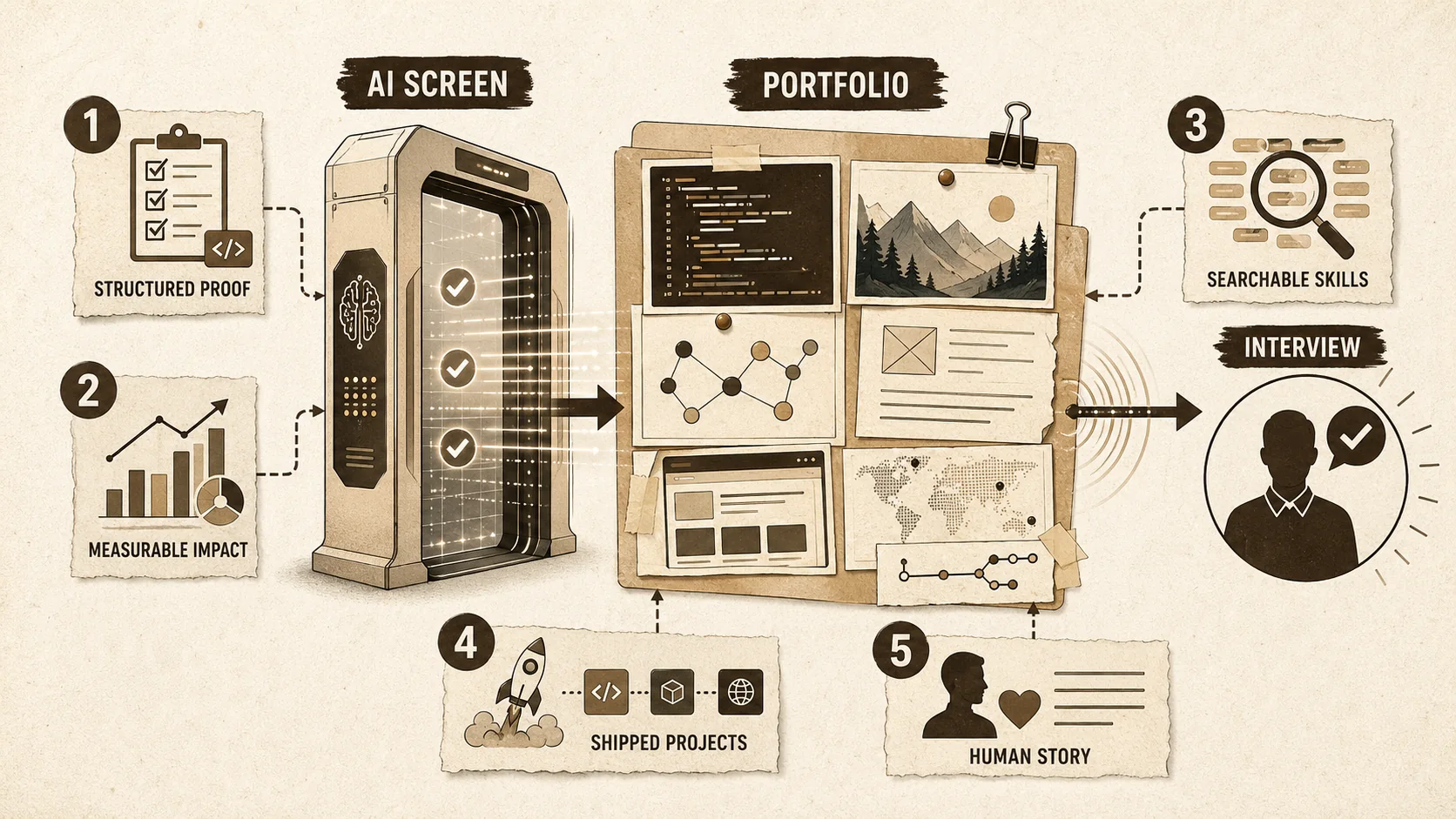
Your developer portfolio 2026 is no longer just for people. Its first and most critical reviewer is an algorithm. According to the April 2026 Tech Hiring Pulse report, over 70% of large tech firms now use AI-powered tools for initial portfolio and application screening. This changes everything. A beautiful, artistic site that once turned heads can now be silently filtered out before a human ever sees it. The goal has shifted from "impress" to "pass the gate." This article is a reality check. We’re moving beyond aesthetics to focus on conversion, using data to outline the five moves that make a developer portfolio actually get you hired, according to Sprout Social. It’s about building for the new gatekeepers—both silicon and human.
What a modern developer portfolio really is
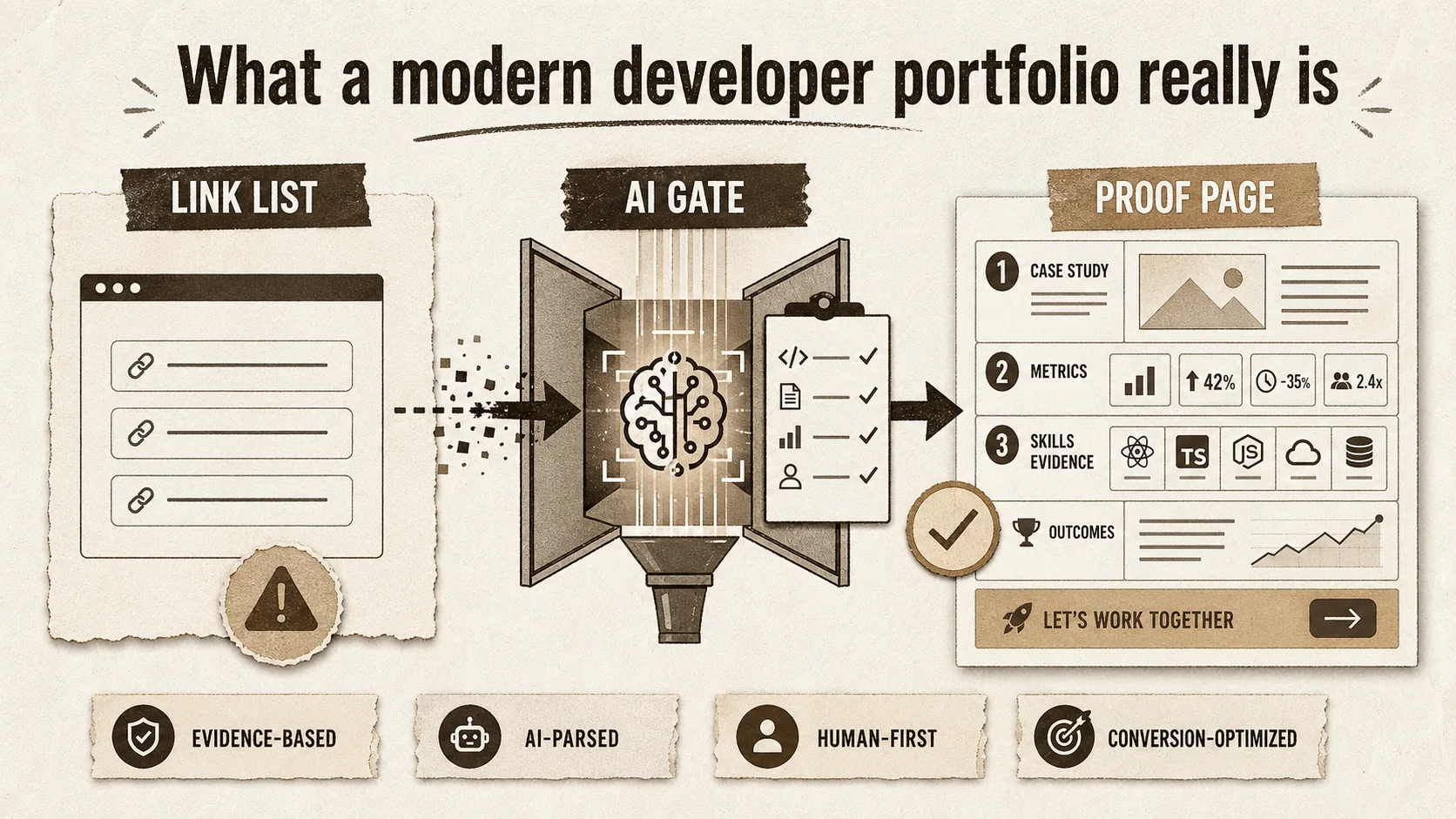
A developer portfolio in 2026 is a conversion-optimized, evidence-based professional asset. It is designed to pass automated screening and provide immediate, quantifiable proof of skill to a time-pressed recruiter or hiring manager. It is less a gallery and more a structured argument for your hire, built with both AI parsers and human psychology in mind. The core function has evolved from showcasing what you can do to proving what you have done with clear, scannable outcomes. For a deeper dive into this evolution, explore our hub on portfolio trends.
This definition contrasts sharply with older models. Let's break down the shift:
| Feature | Old Portfolio Model (Pre-2024) | 2026 Portfolio Reality |
|---|---|---|
| Primary Audience | Human visitor, often a peer | AI screening tool, then human recruiter |
| Success Metric | Visual appeal, "wow" factor | Clear skill tagging, quantified results, conversion to interview |
| Project Focus | Technology used, code complexity | Business problem solved, impact measured |
| Key Content | Personal blog, lengthy descriptions | Live demos, metrics, concise case studies |
| Integration | Standalone silo | Connected to LinkedIn, GitHub, application tracking systems |
What does "AI portfolio screening" actually look for?
AI portfolio screening tools parse your site for specific, machine-readable signals of competency and relevance. They don't "appreciate" design; they extract data. Primarily, these systems look for keyword density related to the job description (e.g., "React," "TypeScript," "AWS"), evidence of project completion (live links, GitHub repositories), and quantifiable outcomes (metrics like "increased performance by 40%"). According to Sprout Social, a well-structured online professional presence that clearly lists skills and achievements gets 35% more engagement from recruiters. The AI is trained to mimic this recruiter behavior, prioritizing portfolios that make this data easy to find.
How much time does a recruiter spend on your portfolio?
The window for human attention is brutally short. Data from LinkedIn Talent Solutions indicates that after an AI filter, a recruiter spends an average of 6-8 seconds on their initial scan of a candidate's portfolio or primary link. They are not reading; they are pattern-matching. They look for a current role, a few key tech stack keywords, and one standout project with a visible result. If those signals aren't immediately obvious, they move on. This makes information hierarchy—what you show first—more critical than ever for a portfolio that gets you hired.
Why is a standalone "link in bio" page insufficient now?
A simple list of links (to GitHub, LinkedIn, etc.) is a passive directory, not an active sales tool. It fails the 2026 test because it provides no context, no narrative, and no consolidated proof. It forces the recruiter to do the work of connecting dots between platforms. A modern developer portfolio 2026 must be a curated, central hub that synthesizes your presence. It should provide a coherent story at a glance, something a static link list cannot achieve. This is where purpose-built tools that allow for richer presentation, like Popout, become essential, transforming a list into a compelling professional landing page.
Why your old portfolio strategy is broken
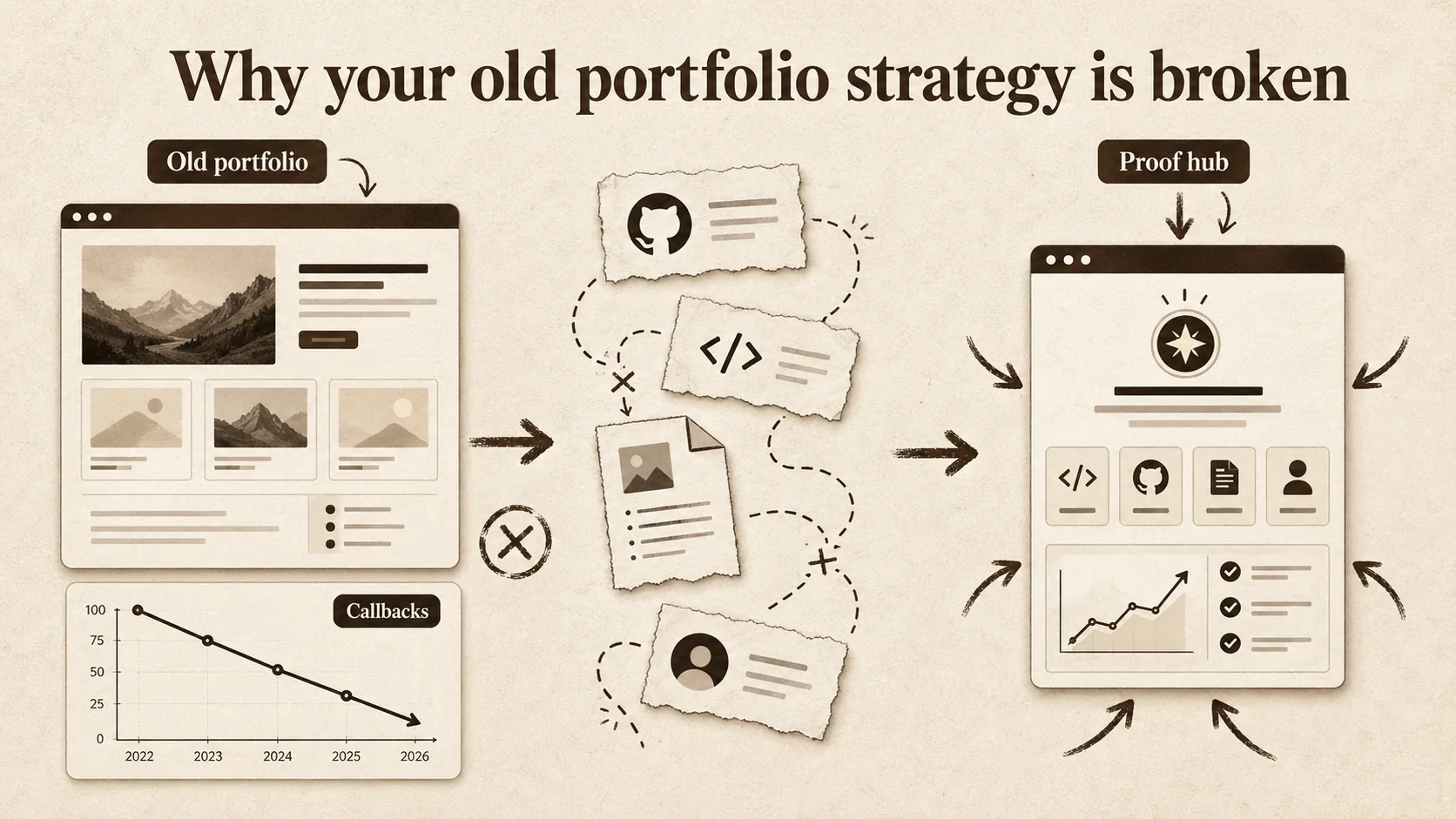
The frustration on developer forums is real: portfolios that took weeks to build generate zero leads. This isn't about bad code; it's about a strategy misaligned with 2026's hiring mechanics. The system has changed, and continuing to optimize for the old rules is a recipe for silence. The problem isn't you; it's the broken feedback loop between your presentation and the new evaluation criteria.
Do recruiters even look at personal projects anymore?
Yes, but with a critical caveat. Recruiters look at personal projects as evidence, not as art. A project titled "E-Commerce App Built with MERN" is weak. A project titled "Reduced cart abandonment by 15% by optimizing MERN stack checkout flow" is strong. The shift is from technology demonstration to problem-solving demonstration. A 2025 survey by HiringSolved found that 68% of technical recruiters said the presence of a quantified outcome in a project description was the single biggest factor in flagging a candidate for a hiring manager review. Your projects need to answer "so what?"
How has AI changed the initial application review?
AI has turned the first review into a hyper-efficient, keyword-driven cull. These systems often assign a "fit score" based on semantic analysis between your portfolio content (and resume) and the job description. Vague language like "experienced in backend development" scores lower than specific statements like "built 3 REST APIs using Node.js and PostgreSQL, handling 10k+ RPM." The AI isn't judging quality of experience; it's judging the specificity and relevance of the evidence you provide. If your portfolio is full of generic statements, you will be filtered out, regardless of your actual skill. For more on navigating modern career hurdles, see our career hub.
What's the real cost of a "beautiful but empty" portfolio?
The cost is opportunity. Time you spend tweaking CSS animations is time not spent documenting a measurable impact from a past project. The aesthetic polish only matters after the substantive filters are passed. A minimalist, fast-loading site with hard data will outperform a visually complex, slow-loading masterpiece every time in 2026's pipeline. Think of it as engineering: you're optimizing for the wrong metric. The portfolio that gets you hired is the one that prioritizes information architecture and content strategy over purely visual design.
How to build a portfolio that passes the 2026 test
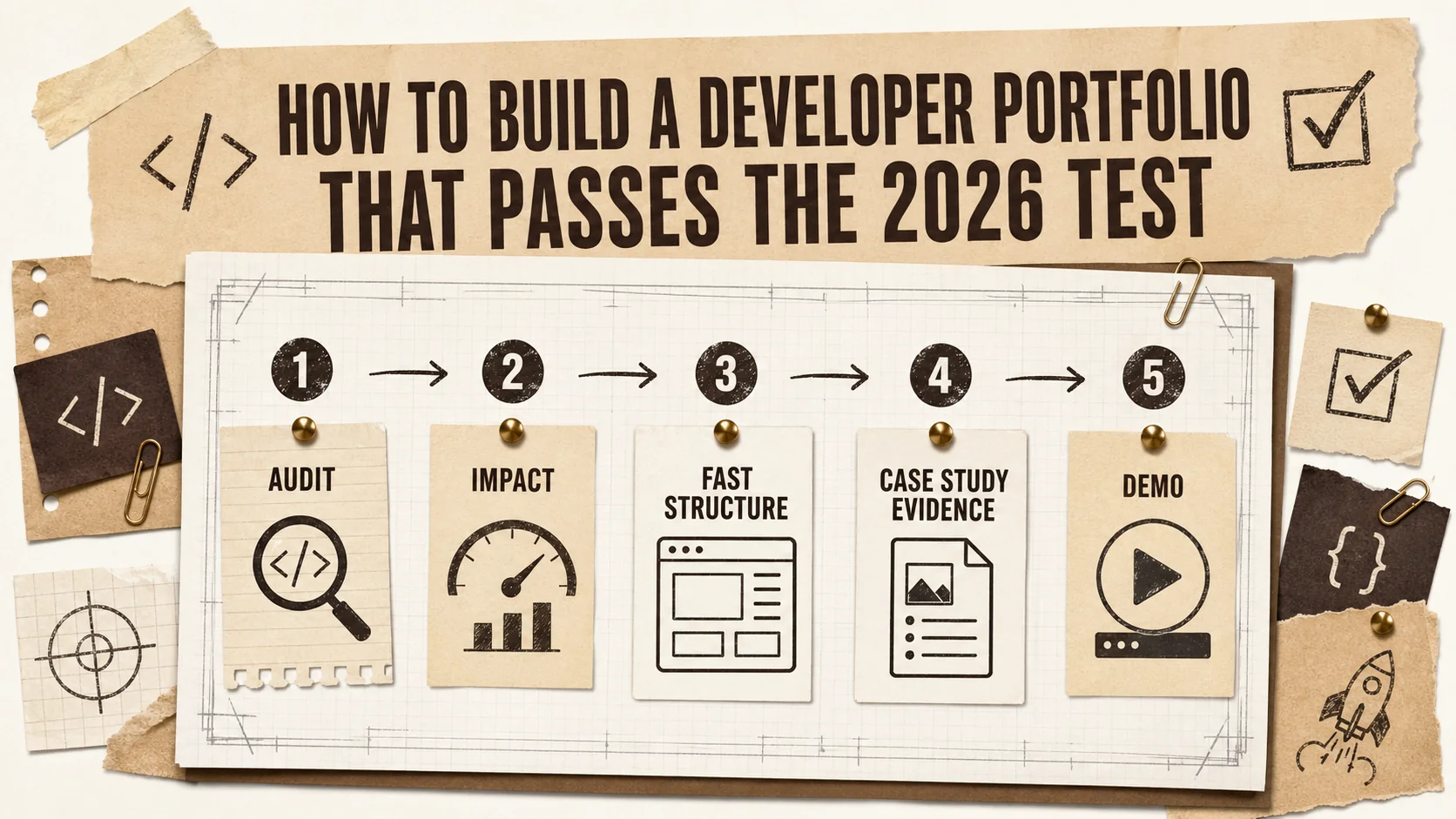
Building a developer portfolio 2026 that works is a systematic process. It's less about creative inspiration and more about engineering a document for a specific purpose: to survive automated screening and compel a human to schedule an interview. Follow these five data-backed moves. For a practical, step-by-step guide on execution, our article on how to create a developer portfolio is a great companion resource.
Move 1: Conduct a keyword and skills audit
Before you write a single line of code for your portfolio site, you must know what the gatekeepers are listening for. This means analyzing 5-10 job descriptions for your target role. Extract the recurring hard skills (e.g., "Python," "Docker," "GraphQL"), frameworks, and even soft skills ("cross-functional collaboration," "Agile"). According to data from Jobscan, applicants who tailor their resumes and supporting materials with keywords from the job description are up to 40% more likely to get an interview. Your portfolio content must mirror this. Create a master list of these terms and ensure they are naturally woven into your project titles, descriptions, and skill tags. Don't just list "Skills;" contextualize them: "Applied React Query to eliminate redundant API calls, reducing load times by 200ms."
Move 2: Transform project listings into case studies
Stop listing projects. Start publishing mini case studies. Each featured project on your developer portfolio 2026 should follow a simple, scannable formula: Problem, Action, Result (PAR), according to best practices for technical communication.
- Problem: What user or business issue did this solve? (1 sentence)
- Action: What did you specifically build and with what tech? (2-3 sentences, heavy on keywords)
- Result: What was the measurable outcome? Use numbers. ("Improved page load speed by 40%," "Reduced database costs by $200/month," "Increased user sign-ups by 15%").
This format is AI-friendly and recruiter-friendly. It turns a project from a feature list into a story of impact. If you don't have a business metric, use a technical one: "Achieved a Lighthouse performance score of 95+," "Reduced bundle size by 30%."
Move 3: Integrate live, interactive proof
A screenshot is a claim. A live demo or a well-maintained GitHub repository is proof. Your portfolio must bridge the gap between description and verification. For front-end developers, this means deploying every project (Netlify, Cloudflare) and linking directly to it. For back-end developers, provide a link to a live API endpoint documentation (like Swagger UI) or include a concise cURL command in the project description that returns a sample response. This serves two purposes: it proves the project works, and it dramatically increases engagement time, a positive signal to both algorithms and humans.
Move 4: Architect for speed and scannability
If your portfolio takes more than 3 seconds to load on a mobile connection, you are losing candidates. Google's Core Web Vitals data shows a direct correlation between page speed and user engagement (bounce rate). Your design must be ruthlessly minimalist. Use clear headings, bullet points, and ample white space. The most important information—your name, current role/target title, top 3 skills, and your single best project—should be visible without scrolling. This isn't dumbing it down; it's respecting the user's time and the 6-second scan rule.
Move 5: Implement clear, strategic calls-to-action (CTAs)
What do you want the viewer to do next? Your portfolio should guide them. A single, prominent CTA is better than a dozen small links. Based on your goal, this could be:
- "Schedule a 15-minute tech chat" (links to Calendly)
- "View my detailed resume" (links to a PDF)
- "Explore the code on GitHub"
Make this button or link impossible to miss. Every other link (LinkedIn, Twitter, etc.) should be secondary. You are funneling attention toward a single conversion goal: the next step in the hiring process.
Proven strategies to make your portfolio stand out
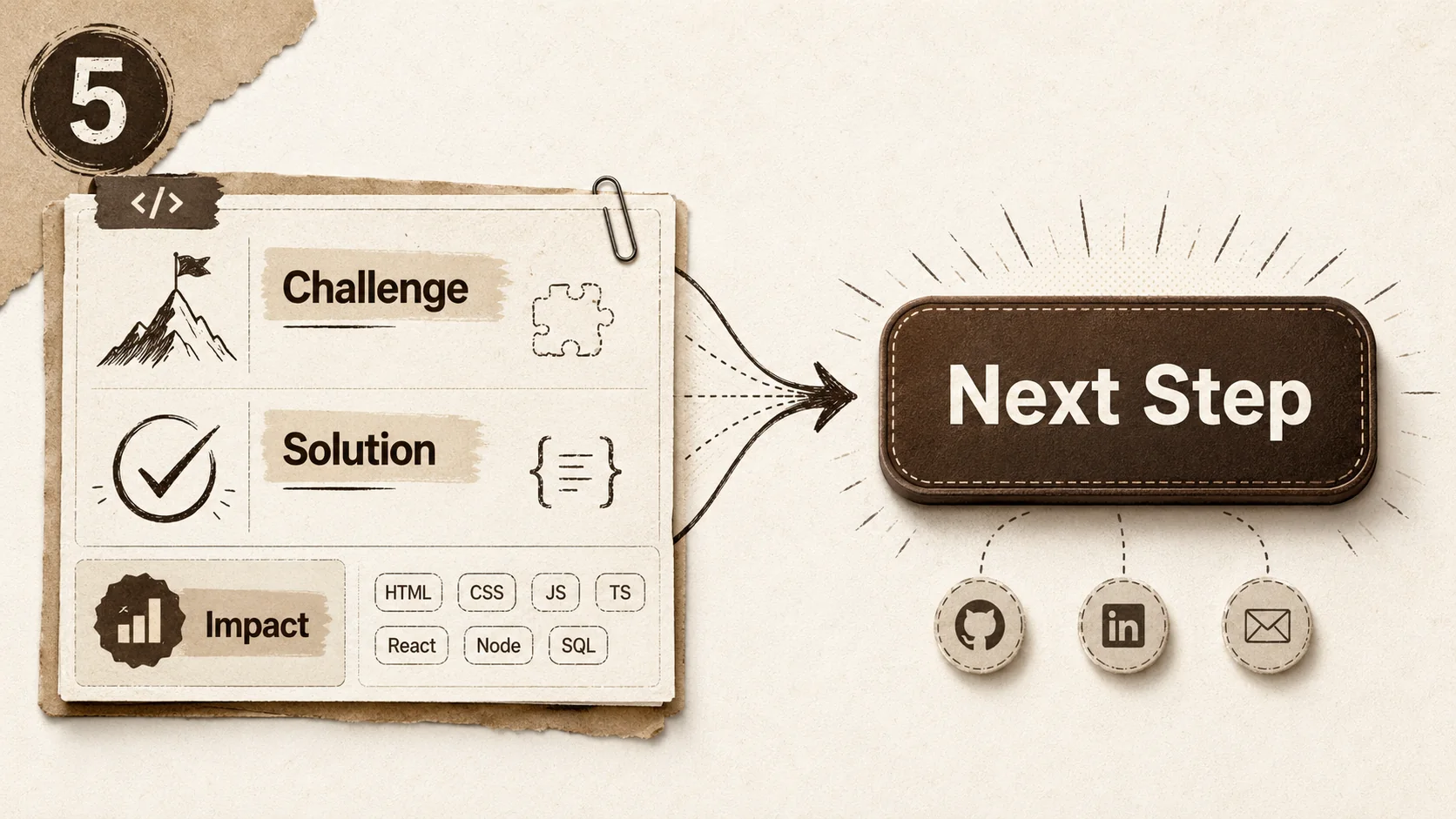 and "My Solution" (text, tech logos, and a key metric).)
Once the foundation is solid, these advanced tactics can elevate your developer portfolio 2026 from "qualified" to "memorable." They help you stand out in the later, human-review stage by demonstrating professional maturity and strategic thinking.
The "Portfolio Proof Test" framework
I use this three-layer framework with clients to stress-test portfolios:
- Layer 1: The 6-Second Scan. Can a recruiter identify your role and top skill within 6 seconds? If not, simplify.
- Layer 2: The AI Parse. Run your portfolio text through a simple keyword density checker against your target job list. Are your key terms prominent?
- Layer 3: The Deep Dive. Does your best project answer "What was the hardest technical decision you made, and why?" This is the story you'll tell in an interview.
A portfolio that passes all three layers is built for the full hiring journey. For a structured way to apply this, use our interactive portfolio review checklist.
Quantify your open-source contributions
Instead of just linking to your GitHub, curate and quantify your contributions. On your portfolio, have a section that says: "Selected Open Source Work," and list 2-3 contributions with impact. For example: "Contributed to [Project Name] by fixing a memory leak in the caching module (PR #1234), merged into the v2.8 release." This shows you can navigate complex codebases and collaborate effectively, a huge differentiator. According to the 2026 Open Source Survey, 72% of hiring managers view validated open-source contributions as equivalent to professional experience.
Create a "Technical Writing" or "Problem-Solving" section
Demonstrate thought leadership beyond code. If you've written a clear technical blog post explaining a complex concept, solved a tricky Stack Overflow question with a highly upvoted answer, or even created a useful README, showcase it. This proves your ability to communicate complex ideas—a skill consistently ranked as a top priority by hiring managers. It turns your portfolio from a list of tasks into a display of your engineering mindset. For insights on weaving this into your broader brand, visit our personal branding hub.
Leverage dynamic content with a bio link tool
A static website is hard to update. Using a dedicated bio link or portfolio page builder like Popout allows you to dynamically update your key links, projects, and CTAs without redeploying a whole site. You can create a tailored page for a specific job application by highlighting the most relevant projects, or you can quickly add a link to a new talk you've given. This agility is a practical advantage, ensuring your most important link (the one in your social bios and resume) is always current and campaign-able. For a comparison of tools that enable this, see our guide to portfolio builder alternatives in 2026.
Key takeaways
- A developer portfolio 2026 is a conversion tool built for AI screening and human scanners, not a design portfolio.
- Over 70% of large tech firms use AI for initial screening, making keyword specificity and quantifiable results non-negotiable.
- Recruiters spend only 6-8 seconds on their initial scan, so information hierarchy is more critical than visual flair.
- Transform project lists into PAR (Problem, Action, Result) case studies with measurable outcomes to pass AI filters and engage humans.
- Live demos and deployed projects serve as immediate proof of skill, increasing credibility and engagement time.
- Your portfolio must have a single, clear Call-to-Action to guide the recruiter to the next step in the hiring process.
- Using a dynamic bio link/portfolio page tool allows for rapid updates and tailored presentations for different job applications.
Got questions about developer portfolios? We've got answers
What is the 2026 developer portfolio reality check?
The 2026 developer portfolio reality check is the understanding that your portfolio's primary audience is now an AI screening tool, followed by a time-pressed human recruiter. It means moving beyond purely aesthetic design to focus on machine-readable keywords, quantifiable project results, and a structure optimized for a 6-second human scan. The goal is conversion to an interview, not just admiration.
How much time do I have to capture a recruiter's attention?
Data indicates you have between 6 and 8 seconds for the initial scan. In that time, a recruiter needs to see your name, your current or desired role, 2-3 key technologies, and evidence of one completed project. If these elements aren't immediately obvious above the fold (without scrolling), your chance of a deeper look drops significantly.
What is the single most important element of a portfolio that gets you hired?
The single most important element is proof of impact. This is most effectively shown through project case studies that include a specific, quantifiable result. Statements like "improved performance by 40%" or "reduced server costs by $150/month" are the strongest signals you can send to both AI parsers and human reviewers, as they translate your skills into business value.
Do I need to build a custom portfolio website from scratch?
Not necessarily. While a custom site offers full control, a dedicated portfolio page builder (like Popout, Carrd, or About.me) is often faster, ensures mobile responsiveness and speed, and simplifies updates. The key is not the underlying tech, but the quality of content and its structure. Many developers waste weeks building a custom site when they should be refining their project narratives.
How often should I update my developer portfolio?
You should do a minor review and update every 3 months, and a major overhaul at least once a year. Minor updates include adding new skills, updating your current role, and linking to a new project. The major overhaul should involve re-evaluating your target keywords, rewriting project descriptions using the PAR formula, and ensuring all links and demos are live. Your portfolio is a living document, not a relic.
Can a good portfolio compensate for a lack of professional experience?
Yes, but in a specific way. For entry-level roles, a portfolio filled with well-documented personal projects, open-source contributions, and technical writing can effectively demonstrate skill and initiative. It compensates by providing tangible evidence of your capabilities. For senior roles, the portfolio must instead compellingly document the impact of your professional experience. In both cases, the portfolio provides the proof that a resume alone cannot.
Your next opportunity is likely being sorted by an algorithm right now. Don't let a portfolio built for 2022 hold you back. The moves are clear: audit for keywords, quantify your results, prove it live, optimize for speed, and guide the next step. You can spend weeks building from scratch, or you can start implementing these strategies today on a platform built for this exact purpose.
Create Your Popout Page and build a developer portfolio 2026 that's designed to convert, according to Sprout Social.
Other Doved Studio projects
Related tools from the same studio you might find useful:
- Ralphable: Generate structured Claude Code skills that iterate until pass/fail criteria are met.
- Glean: Turn scrolling time into a daily action plan. Capture, process, execute.
- Doved Studio: Studio indie derrière cette app et une dizaine d'autres outils.
Written by
popout
Content Team