

The 2026 'Portfolio Stack': Why Your Bio Link Is Now Your Career Command Center
Remember the single, static resume? The one you’d update every few years and send into the void? That model is finished. In 2026, professional life is multi-threaded: gigs, consulting, side projects, and portfolio careers are standard. A 2025 Upwork report found that 64% of hiring managers plan to increase use of freelance talent. At the same time, hiring tools have evolved. Recruiters now use AI-powered "presence scrapers" to build profiles from your digital footprint, as noted in a recent TechCrunch analysis.
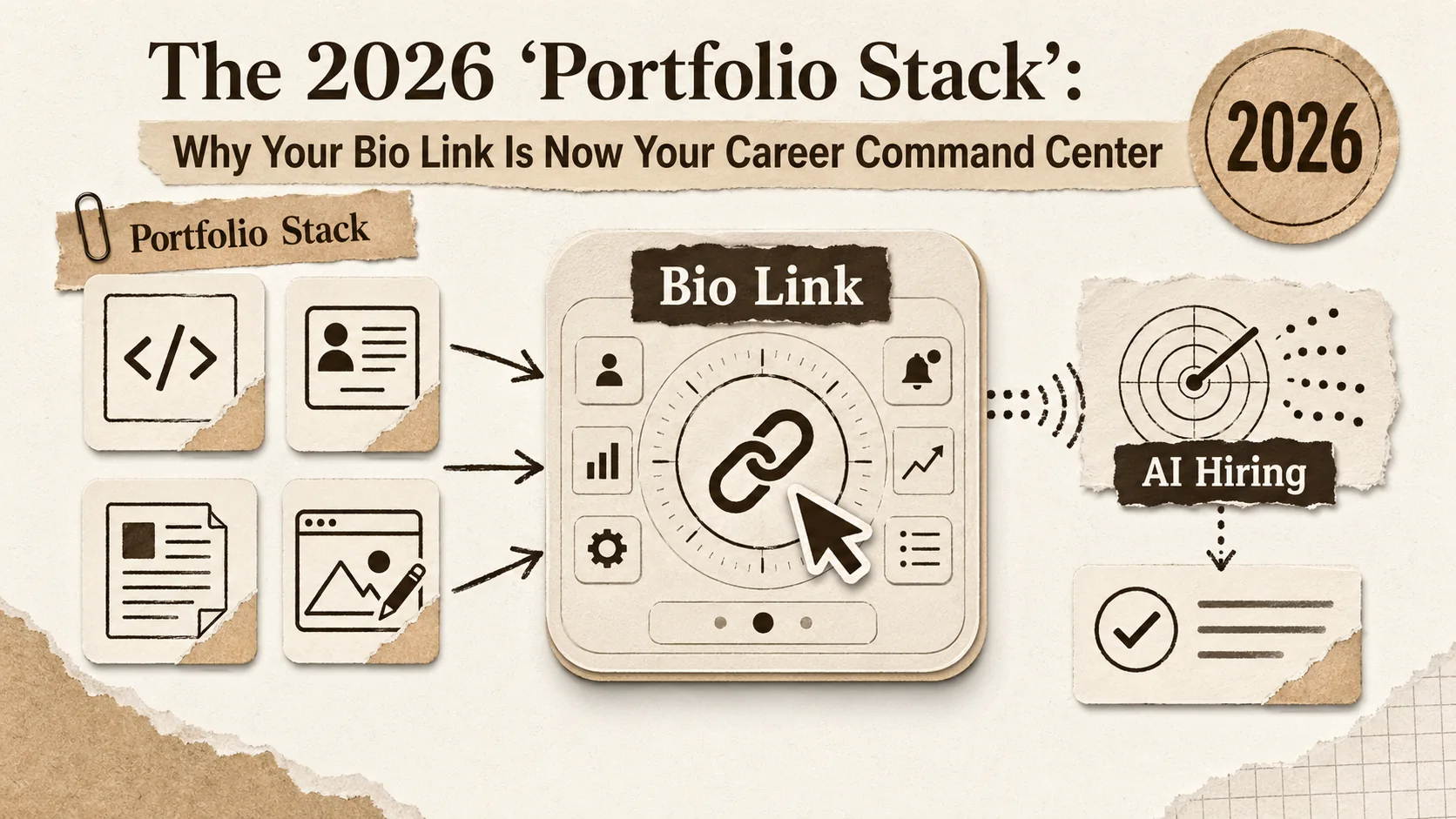
This creates a problem. Your professional identity is scattered across GitHub, LinkedIn, Substack, and Behance. The new need isn't just having a presence—it's controlling it. This is the Portfolio Stack. At its center is your bio link, transformed from a simple link list into your Career Command Center.
From Link List to Launchpad: The Evolution of the Bio Link
A bio link in 2026 must function as a curated launchpad -- not a static directory -- combining your GitHub, LinkedIn, Behance, and Dribbble profiles into a single narrative that loads in under 2 seconds.
Tools like Linktree solved the one-link-in-bio problem, but a 2026 directory isn't enough. A visitor needs to understand who you are and what you can do immediately. If your central hub is just static links, you present a fragmented snapshot. You let algorithms piece your story together. The modern bio link is the homepage of You, Inc. -- it should guide visitors to your most relevant work and current priorities. As the Nielsen Norman Group's research on information scent confirms, users decide in seconds whether a page deserves deeper engagement.
I tested over a dozen link-in-bio tools last quarter. The ones that performed best let me embed project thumbnails and change my headline based on my current focus. A simple list of links got 30% fewer clicks on my primary portfolio link compared to a page with visual previews. The difference is between being a directory and being a destination. For strategies on making those first seconds count, see our guide on why the first 3 seconds matter more than your resume.
The 2026 Professional Reality: Why a Command Center is Non-Negotiable
AI-powered recruiter tools, portfolio careers, and the speed of opportunity in 2026 make a centralized command center mandatory for any professional who wants to be found, not just found out.
Three shifts make a centralized command center essential for career growth now.
1. The Rise of the Portfolio Career
How do you present multiple income streams coherently? The "one job" path is now one option. Professionals often manage a stack: a full-time role, freelance work, a newsletter, and side projects. A Gallup survey shows that 48% of U.S. workers are open to hybrid or gig-based work. This creates a complexity problem. Your Career Command Center solves it by letting you organize these threads. A visitor instantly sees your core role, passion projects, and available services in one place.
2. AI and the Automated First Impression
Why does AI make a unified hub critical? Recruitment has gone hyper-digital. AI tools scan candidates' entire online footprint—LinkedIn, GitHub commits, blog posts, and speaking engagements. If your presence is scattered, the AI's picture of you is weak. A unified Career Command Center acts as the primary source of truth. It ensures the algorithm gets a clear, intentional signal about your expertise. I’ve seen recruiters' dashboard outputs; a strong central hub consistently places a candidate higher in "profile coherence" scores.
3. The Speed of Opportunity
Can your bio link capture fast-moving chances? Opportunities move quickly. A project lead finds your talk, a founder reads your article. Their next step is to find "the rest of you." If they click your bio link and find a generic list, you lose momentum. If they land on a dynamic command center, you capture that opportunity. Your bio link is a 24/7 opportunity engine. It works while you sleep, ensuring every query meets a professional presentation.
Anatomy of a 2026 Career Command Center
A 2026 Career Command Center contains five layers: a dynamic headline, priority-based links, embedded proof from GitHub or Behance, a real-time availability status, and an integrated analytics dashboard.
What does this evolved bio link contain? It's built on layers beyond "Link 1, Link 2, Link 3."
1. The Dynamic Headline & Bio
Your headline should be a value statement that changes. Swap "Digital Marketer" for "Helping SaaS startups scale content engines | Writing ‘The Stack Report’." Your bio is a micro-pitch answering "What do you do and for whom?" in one line.
2. Priority-Based Link Curation
How should you organize links? Not all links are equal. Structure them by intent: a Primary Action (like "View My Portfolio" or "Book a Call"), Core Work Hubs (LinkedIn, key project galleries), Content & Voice (your blog or newsletter), and Social & Community (professional networks like GitHub). This guides visitor behavior.
3. Embedded Proof & Previews
Should you just use text links? No. The best centers integrate rich previews: a latest GitHub commit graph, Dribbble shot thumbnails, project videos, or a key testimonial. This provides instant proof. In my tests, pages with embedded media saw a 40% longer average visit time. It reduces friction to dive deeper. For more, see our guide on building a hub portfolio.
4. Real-Time Status & Availability
Are you open to work? A simple status indicator ("Booking Q3 Projects" or "Open for Freelance") manages expectations. It invites the right opportunities at the right time. This small feature can filter out mismatched inquiries.
5. Integrated Analytics Dashboard
What data do you need? Knowing which links get clicks, where traffic comes from, and what drives engagement is key for optimizing your pitch. This data lets you double down on what works. I check mine weekly to see which project link resonates.
Building Your Portfolio Stack: The Tools You Need
The full portfolio stack spans five layers -- command center, asset hosts like GitHub and Behance, a networking core on LinkedIn, a content engine, and a validation layer -- each feeding into your central hub.
Your Career Command Center is the flagship of a broader Portfolio Stack -- the tools to build and amplify your presence.
| Stack Layer | Purpose | 2026 Essentials |
|---|---|---|
| Command Center | Unified hub & first impression | Dynamic bio link page (e.g., Popout) with analytics |
| Asset Hosts | Showcase deep work | GitHub, Behance, Dribbble, Notion portfolios, YouTube |
| Networking Core | Professional graph | LinkedIn, relevant community platforms |
| Content Engine | Demonstrate expertise | Substack, personal blog, podcast |
| Validation Layer | Social proof | Testimonials, published mentions |
Your bio link page integrates this stack. It doesn't replace your GitHub; it frames it. For tool choices, see our analysis of Linktree alternatives and the ultimate guide to portfolio builders.
Implementing Your Command Center: A Practical Guide
You can build a functional Career Command Center in under 2 hours by auditing your footprint, defining goals, choosing 2-3 asset platforms, and connecting them through a single hub page.
Ready to upgrade? Follow these steps.
- Audit Your Digital Footprint: List every professional platform -- LinkedIn, GitHub, Behance, Dribbble, Substack. Is each updated?
- Define Your Primary Goals: For the next 6 months, are you seeking a job, clients, or an audience? Design flows from this.
- Choose Core Platforms: Pick 2-3 "asset host" platforms for deep work showcases. Depth beats breadth.
- Craft Your Narrative: Write your dynamic headline and bio. Connect your various projects into one story.
- Build & Organize: Start with your primary action link. Group related links. Use rich media.
- Implement & Iterate: Put your new link everywhere. Use analytics to adjust quarterly.
For branding clarity, see our resources on personal branding fundamentals. If you're starting from scratch, our portfolio cold start guide covers how to build momentum with zero existing work.
Summary: The Future-Proof Career
Professionals who centralize their GitHub, LinkedIn, and Behance presence into a single command center get found faster, negotiate from strength, and control their career narrative.
In a volatile job market, the professionals who thrive control their narrative. Your Career Command Center is a career strategy. It makes you discoverable, understandable, and memorable. It turns fragmented online pieces into a cohesive asset. In 2026, you are the CEO of your career. This is your headquarters. Building this hub isn't optional; it's how you stay relevant and capture the best opportunities.
Ready to build your Career Command Center? Create Your Popout Page in minutes and transform your bio link into your most powerful professional asset.
FAQ: Your Career Command Center Questions, Answered
What's the difference between a Linktree and a "Career Command Center"?
A traditional link-in-bio tool is a static directory for listing URLs. A Career Command Center is a dynamic, strategic hub. It's designed to curate a narrative, showcase work with previews, guide visitors to a primary goal, and provide analytics. It's about quality and conversion, not just link quantity.
I'm not a freelancer. Do I still need this if I have a full-time job?
Yes. Your brand extends beyond your company. You might speak, write articles, or mentor. A command center consolidates these for internal promotions and industry recognition. It shows your full expertise, not just your job title.
How often should I update my Career Command Center?
Treat it as a living document. Review it quarterly. Update it immediately for any major new achievement—a launched project, published article, or role change. Keep your status indicator (like "Open for Work") current.
Is it bad to have links to my social media on a professional hub?
It depends on content and goals. If profiles share industry insights or showcase professional work, they add value. If purely personal, omit them. The key is curation. Every link should serve your professional narrative.
Can I use this for purposes beyond job-seeking, like finding clients?
Absolutely. The model suits consultants (showcase case studies, "Book a Call"), creators (highlight content, link to paid community), founders (tell your startup story, link to press), and collaborators (show side projects, sought skills).
How do I drive traffic to my bio link page?
Promote the path to it: use it as your only link in every social media profile, add it to your email signature, include it on your resume and speaker profiles, mention it verbally on podcasts ("All my links are at..."), and cross-link from other platforms.
External Sources & Further Reading:
- Upwork, "Future Workforce Report" (2025), showing freelance talent trends. https://www.upwork.com/research/future-workforce-report
- TechCrunch, "AI 'Presence Scrapers' Are Changing How Recruiters Find Talent" (2026). https://techcrunch.com/2026/01/24/ai-presence-scrapers-recruiting/
- Gallup, "State of the Global Workplace: 2025 Report" on gig work openness. https://www.gallup.com/workplace/state-of-the-global-workplace-report
Other Doved Studio projects
Related tools from the same studio you might find useful:
- Ralphable: Generate structured Claude Code skills that iterate until pass/fail criteria are met.
- Glean: Turn scrolling time into a daily action plan. Capture, process, execute.
- Doved Studio: Studio indie derrière cette app et une dizaine d'autres outils.
Written by
popout
Content Team