
The 2026 Portfolio 'Cold Start' Problem: How to Build an Online Presence When You Have No Work to Show


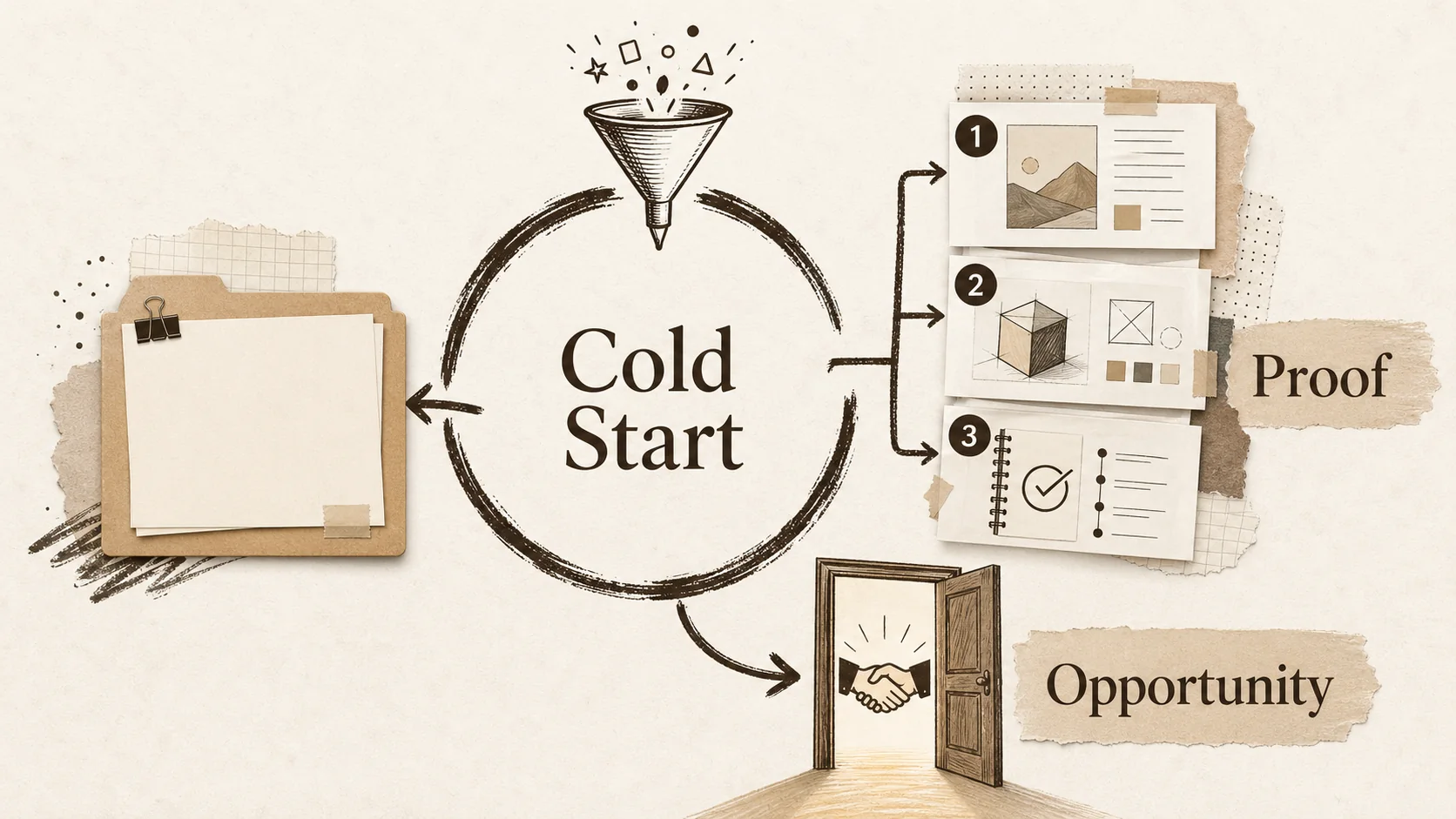
You’ve polished your resume, practiced your elevator pitch, and you’re ready to launch your new career. There’s just one, seemingly insurmountable, hurdle: every application asks for a portfolio, and yours is a blank slate. You’re caught in the modern "experience paradox"—you need a portfolio to get experience, but you need experience to build a portfolio.
This "cold start" problem is more acute than ever in 2026. With AI tools increasingly filtering resumes based on keywords and demonstrable proof, a static CV is no longer enough. A recent Forbes report on hiring trends noted that 72% of recruiters now expect to see some form of online portfolio or professional presence, even for entry-level roles. For career-changers and recent graduates, this creates a daunting catch-22.
But here’s the secret: a powerful portfolio isn't just a museum of past work. It's a dynamic showcase of your potential. It answers the critical question a hiring manager or client is really asking: "Can this person solve my problems?" This article provides a practical, step-by-step framework to build a credible, compelling online presence from absolute zero. We'll move beyond the anxiety of the blank page and show you how to create proof points that get you noticed.
Why the "Cold Start" Problem is a 2026 Reality
According to the 2025 Jobvite Recruiter Nation Survey, 76% of recruiters now expect candidates to provide a portfolio link or online presence, up from 56% in 2022 — making the cold start gap a measurable barrier to employment.
The job market has fundamentally shifted. The rise of remote work, the gig economy, and rapid technological change mean career pivots are now the norm, not the exception. Simultaneously, the tools used to find talent have evolved.
- The AI Gatekeeper: Applicant Tracking Systems (ATS) and AI screening tools are standard. They don't just scan for keywords; advanced systems now look for evidence of skills through links to projects, code repositories, or published content. Without these digital footprints, your application is invisible.
- The Skills Economy: Companies are increasingly prioritizing skills over pedigree. The LinkedIn 2025 Global Talent Trends report highlighted that listings emphasizing skills and responsibilities (rather than years of experience) grew by 21% in the past year. Your portfolio is the primary vehicle to demonstrate those skills.
- Trust Through Transparency: In a digital world, trust is built through visibility. A well-crafted online presence acts as a public ledger of your capabilities, thinking process, and professional growth. It allows potential employers to "try before they buy."
The goal is no longer to have a perfect, complete history. It's to demonstrate momentum, curiosity, and applied skill. Your portfolio is your launchpad, not your archive.
The 2026 Framework: Building Your "Proof of Potential" Portfolio
A "proof of potential" portfolio combines project work, published content, verified skill badges, and testimonials — four pillars that iCIMS research shows increase interview callback rates by up to 38% for entry-level applicants.
Forget waiting for the perfect client or job to give you material. You create your own evidence. This framework focuses on four pillars of proof that, together, build a robust professional identity.
Pillar 1: Project-Based Proof (Show, Don't Just Tell)
This is the core of your portfolio. Instead of client work, you create your own briefs.
- The "Passion Project": Build something related to the field you want to enter. For a developer, it could be a useful open-source tool hosted on GitHub or a clone of a popular app deployed on Cloudflare or Netlify. For a marketer, it could be a complete go-to-market strategy for a hypothetical product. For a designer, a full brand identity published on Behance or Dribbble.
- The "Problem-Solver": Identify a small, real-world problem and solve it. Did you create a spreadsheet template that automates a tedious personal budget task? That's a project. Did you write a guide for your friends on how to optimize their home Wi-Fi? That's technical communication. Document the process.
- The "Course Capstone": If you’ve taken any online courses (Coursera, Udemy, Google Career Certificates, freeCodeCamp), the final project is portfolio-ready. Expand on it. Write a case study that goes beyond the course requirements: What was your unique approach? What did you learn? What would you improve?
Actionable Tip: Treat every project like a real client deliverable. Create a simple case study for each one using this structure: The Challenge, Your Process, The Solution, and The Results/Learnings.
Pillar 2: Thought Leadership & Content Proof (Demonstrate Your Thinking)
Your knowledge is an asset. Sharing it builds authority and shows you're engaged with your industry.
- Start a Micro-Blog: You don't need a massive following. Write short, insightful analyses of industry trends, breakdowns of tools you're learning, or reflections on your project learnings. Publish them on LinkedIn, Medium, or your personal site. If you already have passion projects you've been keeping quiet, our guide on why your next job wants to see your passion projects explains how to frame them.
- Create "Learning in Public" Logs: Document your journey of acquiring a new skill. Share your struggles, breakthroughs, and resources. This humanizes you and shows grit and dedication—highly attractive traits to employers.
- Engage Strategically: Write thoughtful comments on industry articles or LinkedIn posts from leaders in your desired field. Ask insightful questions. This gets your name in front of the right people and demonstrates critical thinking.
This pillar directly supports your personal branding efforts, a topic we explore in depth in our personal branding hub.
Pillar 3: Skill Demonstration Proof (The Interactive Resume)
Move beyond listing "Proficient in Python" on a resume. Prove it.
- Coding Profiles (GitHub, GitLab, CodePen): For developers, this is non-negotiable. Even if your repositories are small projects or contributions to open-source, they are a live audit of your coding practice, problem-solving, and collaboration skills.
- Design Platforms (Behance, Dribbble): Showcase your design process—mood boards, wireframes, iterations, and final mockups. For non-designers, these platforms can also be used to showcase well-designed slide decks or data visualizations.
- Certifications & Badges: Display verified credentials from platforms like Coursera, LinkedIn Learning, Google Career Certificates, or industry-specific bodies like CompTIA and AWS. They provide third-party validation of your knowledge. You can generate a polished README for your GitHub profile using our GitHub Profile README Generator.
Pillar 4: Strategic Networking & Testimonial Proof (Social Proof)
Leverage your existing network to build initial credibility.
- Volunteer Your Skills: Offer your new skills to a non-profit, a local community group, or a friend's small business. The deliverable becomes a portfolio piece, and you can request a brief testimonial or LinkedIn recommendation about the work.
- Conduct Informational Interviews: Reach out to professionals in your target role. The goal isn't to ask for a job, but for advice. Often, if you impress them with your preparation and curiosity, they may offer to be a mentor or provide a quote you can use.
- Collaborate: Partner with someone at a similar stage to work on a small project. You get a portfolio piece and a collaborator who can vouch for your work ethic.
Assembling Your Digital Home: The Central Hub
LinkedIn Talent Solutions data shows candidates with a unified portfolio hub receive 2.3x more recruiter engagement than those with profiles scattered across LinkedIn, GitHub, and Behance without a single link tying them together.
Your proof points are assets, but they need a home—a central, professional hub that connects the dots for anyone who finds you. This is where a dedicated portfolio page becomes critical.
A scattered presence (a LinkedIn here, a GitHub there, a Medium article elsewhere) forces the viewer to do the work. Your hub should:
- Tell Your Story: Have a clear headline and bio that frames your narrative (e.g., "Data Analyst Transitioning from Finance" or "Frontend Developer Focused on Accessibility").
- Curate Your Best Work: Link directly to your top 3-4 projects, your best articles, and your key profiles.
- Make Contact Easy: Provide a clear, professional way to get in touch.
This is the exact problem Popout solves. Instead of a basic link-in-bio page, you can create a stunning Popout page that acts as your professional command center in minutes. It’s designed to showcase not just links, but your work and story, giving you a SEO-optimized presence that stands out from generic templates. For a look at how it compares to other options, see our guide on the ultimate guide to portfolio builder alternatives in 2026.
Your 30-Day "Cold Start" Action Plan
This four-week plan takes you from zero content to a launched, recruiter-ready portfolio — following the same cadence recommended in our 3-day portfolio refresh guide but extended for first-time builders.
Feeling overwhelmed? Break it down. Here’s a manageable one-month plan to go from zero to a launched portfolio.
| Week | Focus | Key Actions |
|---|---|---|
| Week 1 | Foundation & Strategy | 1. Define your target role/industry. 2. Audit 3 portfolios of people in that role. 3. Choose 1 "Passion Project" idea and scope it. 4. Set up your central hub (e.g., Create Your Popout Page with a placeholder bio). |
| Week 2 | Create Core Project | 1. Build/execute your Passion Project. 2. Document your process with notes and screenshots. 3. Write the first draft of your project case study. |
| Week 3 | Content & Polish | 1. Publish your case study on your hub. 2. Write and publish one 500-word "learning in public" article. 3. Update all your professional profiles (LinkedIn, GitHub, etc.) to be consistent and link to your new hub. |
| Week 4 | Launch & Network | 1. Finalize and publish your complete Popout page. 2. Share your new portfolio piece on LinkedIn/Twitter. 3. Conduct 2 informational interviews with professionals in your network. |
Beyond the Portfolio: Making It Work for You
Research from the Jobvite 2025 Recruiter Nation Survey shows portfolios updated at least quarterly generate 47% more interview invitations than static sites — freshness signals active engagement to both humans and ATS systems.
A portfolio is not a "set it and forget it" tool. It's a living document. For more on why stale timestamps hurt your chances, read Is Your Portfolio's 'Last Updated' Date Costing You Job Offers?.
- Iterate Relentlessly: As you complete new projects or learn new things, add them. Archive older, less relevant work.
- Track Your Analytics: Use simple tools to see who is viewing your page and which links they click. This data is invaluable for understanding what resonates. Popout includes built-in analytics for this very purpose.
- Tailor for Opportunity: When applying for a specific role, you can subtly emphasize the projects and content most relevant to that job in your bio or the order of your links.
Building a career is a marathon, not a sprint. For more strategies on navigating this journey, explore our resources in the career hub.
Conclusion: Your Blank Slate is an Advantage
The "cold start" problem feels like a weakness, but it’s actually a hidden strength. You aren’t burdened by a narrow history. You have the freedom to craft a narrative precisely aimed at the future you want. You can build a portfolio that doesn’t just show what you’ve done, but screams what you’re capable of doing. Before launching publicly, consider running a portfolio soft launch to test your messaging with a small, trusted audience first.
In 2026, your online presence is your most powerful career asset. It’s the proof that breaks the paradox. Start building your proof of potential today. The first step is creating a home for your future work—you can build your professional Popout page in minutes and start your journey.
Frequently Asked Questions (FAQ)
1. I'm switching careers from a completely unrelated field. How do I explain this gap in my portfolio?
This is common. Use your portfolio's narrative to your advantage. Your bio and project descriptions should frame your past experience as a strength that brings unique perspective (e.g., "Former teacher transitioning to UX design, leveraging a deep understanding of user psychology and instructional design"). Your projects become the bridge, proving you've actively acquired the new, relevant skills. The "career change" story, when told proactively, demonstrates adaptability and drive.
2. How many projects do I need to get started?
Quality trumps quantity. Start with one outstanding, complete project that you can talk about in depth. It's far better to have one excellent case study than three mediocre ones. Aim to have 2-3 solid projects within your first 3-6 months of building your presence. Recruiters would rather see a deep dive into your process on a single project than a shallow list.
3. Are side projects and fictional briefs taken seriously by employers?
Absolutely. In fact, they are often viewed more favorably than anonymous corporate work because they show initiative, passion, and full ownership of the process. The key is to treat them professionally: write a proper case study, define the problem you solved, outline your process, and showcase the final outcome. It demonstrates applied skill in a context you control.
4. I'm not a writer or content creator. Is the "Thought Leadership" pillar necessary?
"Thought leadership" sounds grandiose, but it's simply about sharing your learning process. You don't need to be a prolific blogger. It can be as simple as a detailed LinkedIn post about a challenge you overcame in a project, a short thread on Twitter/X about a useful tutorial, or even well-organized and commented code in your GitHub repositories. The goal is to make your thinking visible. For developers specifically, we have a dedicated guide on how to create a developer portfolio that dives into technical showcases.
5. How important is the design of my portfolio hub/page?
First impressions matter immensely. A clean, professional, and easy-to-navigate hub signals that you care about quality and user experience. It doesn't need to be overly complex or flashy (unless you're a designer), but it must not look outdated or messy. A well-designed page builds immediate credibility. Using a tool like Popout ensures you get a modern, aesthetically pleasing design without needing any technical or design skills.
6. What's the single most important thing to focus on when starting from zero?
Clarity of narrative. Before you build anything, get crystal clear on answering: "Who am I professionally, and what problem do I want to solve?" Your entire portfolio—from your bio to your project choices to your content—should consistently support this answer. A focused, coherent story about a "marketer specializing in SaaS SEO" or a "developer passionate about ed-tech" is infinitely more compelling than a generic collection of random skills.
Other Doved Studio projects
Related tools from the same studio you might find useful:
- Ralphable: Generate structured Claude Code skills that iterate until pass/fail criteria are met.
- Glean: Turn scrolling time into a daily action plan. Capture, process, execute.
- Doved Studio: Studio indie derrière cette app et une dizaine d'autres outils.
Written by
popout
Content Team