
career
Why Your 2026 Job Search Needs a Dynamic Portfolio, Not Just a Resume
popout(Content Team)


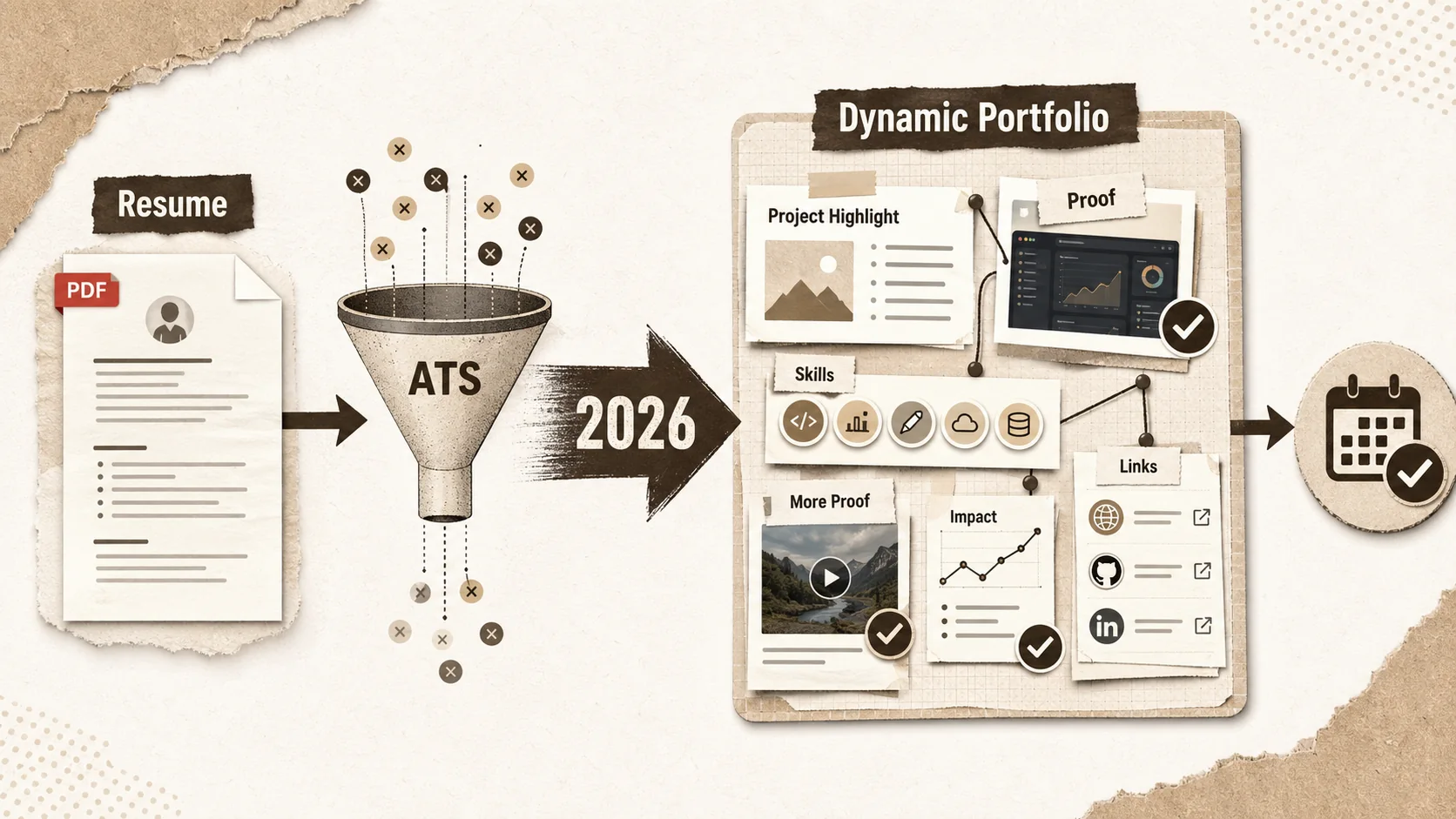
The job application you submitted this morning likely didn’t land on a human desk. It landed in a system—an AI-powered Applicant Tracking System (ATS) designed to scan, score, and filter. By the time a recruiter sees a shortlist, the algorithm has already made critical decisions based on keywords, skills, and, increasingly, the *evidence* you provide.

This is the reality of the 2026 hiring landscape. A static, one-page PDF resume listing your "proficient in teamwork" and "detail-oriented" skills is no longer a competitive document. It’s a historical artifact. The new currency is demonstrable proof. Hiring managers, overwhelmed by volume and empowered by technology, are shifting to **skills-based hiring**. They don't just want to know you *can* do something; they need to see that you *have* done it.

This article will explain why a dynamic, linkable portfolio page has become the essential companion—and often the superior replacement—for the traditional resume in your 2026 job search. We'll explore the trends driving this change, what a modern portfolio looks like, and how you can build one that gets you noticed.

## The 2026 Hiring Shift: From Credentials to Proof

Four forces are driving the shift: 99%+ of Fortune 500 companies use AI-powered ATS screening that rewards linked evidence over listed keywords, [LinkedIn](https://www.linkedin.com/) reports skills-based hiring is now the dominant framework, generic spray-and-pray applications are statistically futile, and hiring managers demand the narrative context -- the *how* and *why* -- that a static resume cannot provide.

The way companies hire has undergone a fundamental transformation, accelerated by technology and a changing economic landscape. Several key trends have converged to make portfolios indispensable.

### 1. The Rise of AI and ATS Screening
Over 99% of Fortune 500 companies and the vast majority of mid-sized firms use ATS software. These systems have evolved from simple keyword matchers to sophisticated AI tools that can parse project descriptions, infer skill levels, and even assess the relevance of your past work. A resume that merely lists "Python" is weak. A portfolio link that showcases a GitHub repository with clean, documented Python code for a specific project is strong, tangible data the AI can use to score you higher.

### 2. The Skills-Based Hiring Revolution
A 2025 report by [LinkedIn](https://www.linkedin.com/) highlighted that **"skills-based hiring" is now the dominant framework**, with companies prioritizing demonstrable abilities over pedigree or years of experience. Recruiters are actively looking for signals of competency that a resume can't convey. As one tech hiring manager recently tweeted: "I skip straight to the 'Links' section of an application. No portfolio? Hard pass for any technical or creative role."

### 3. The Death of the "Generic Application"
The spray-and-pray approach—sending the same resume to 100 jobs—is statistically futile. Modern ATS and hiring managers can spot a generic application instantly. Tailoring your resume helps, but tailoring your **portfolio** is transformative. You can curate which projects, writings, or case studies are most relevant for the specific role you want, providing a custom-fit narrative of your suitability.

### 4. The Demand for Context and Narrative
A resume says *what* you did. A portfolio shows *how* you did it and *why* it mattered. It provides the crucial context: the problem you solved, your thought process, the tools you used, and the impact of your work. This narrative is what turns a list of duties into a compelling story of value, making you a memorable candidate rather than a line on a spreadsheet.

## Portfolio vs. Resume: The Critical Differences

A resume is a static PDF with text claims; a dynamic portfolio is a live, linkable webpage with projects, videos, code, testimonials, and quantified outcomes. Portfolios win on proof (analytics graphs vs. "managed social media"), discoverability (searchable vs. submission-only), update speed (instant vs. re-send), and depth (detailed case studies vs. summary bullet points).

To understand why a portfolio is now essential, let's break down the limitations of the resume and the advantages of its dynamic counterpart.

| Feature | Traditional Resume | Dynamic Portfolio |
| :--- | :--- | :--- |
| **Format** | Static (PDF/DOC) | Live, linkable webpage |
| **Content** | Text descriptions, lists | Projects, images, videos, code, links, testimonials |
| **Proof** | Claims ("Managed social media") | Evidence (Analytics graphs, campaign samples, growth metrics) |
| **Depth** | Summary, high-level | Detailed case studies, process breakdowns |
| **Discoverability** | Only seen if submitted | Can be found via search, shared on profiles |
| **Update Ease** | Manual edit & re-send | Instant update, always current |

The portfolio isn't just a supplement; it's a multidimensional upgrade. It answers the questions a resume leaves hanging.

## What Does a "Dynamic Portfolio" Look Like in 2026?

Five core components: (1) a central bio link as your single memorable URL, (2) project case studies using the Challenge/Role/Tools/Outcome framework with quantified results, (3) skill demonstrations linked to [GitHub](https://github.com/), [Behance](https://www.behance.net/), [Dribbble](https://dribbble.com/), or published articles, (4) social proof with testimonials and an active [LinkedIn](https://www.linkedin.com/) presence, and (5) a direct contact path via email or [Calendly](https://calendly.com/) scheduler.

A dynamic portfolio is more than a gallery of images or a list of job titles. It's a centralized, professional hub that showcases the breadth and depth of your professional identity. Think of it as your interactive business card. Here are the core components:

1.  **A Central Bio Link:** A single, memorable URL (like `popout.page/yourname`) that houses everything. This is the link you put in your email signature, LinkedIn bio, Twitter profile, and resume header.
2.  **Project Case Studies:** The heart of your portfolio. For each key project, include:
    *   **The Challenge:** What problem were you solving?
    *   **Your Role & Actions:** What did you specifically do?
    *   **The Tools:** Technologies, software, or frameworks used.
    *   **The Outcome:** Quantifiable results. Use numbers: "Increased engagement by 40%," "Reduced load time by 2 seconds," "Grew list by 5,000 subscribers."
    *   **Visual Proof:** Screenshots, mockups, photos, demo videos, or links to live work.
3.  **Skill Demonstrations:** Link directly to proof:
    *   **Developers:** [GitHub](https://github.com/), [CodePen](https://codepen.io/), or [Stack Overflow](https://stackoverflow.com/) profiles.
    *   **Writers:** Links to published articles or a blog.
    *   **Designers:** [Behance](https://www.behance.net/), [Dribbble](https://dribbble.com/), or [Figma](https://www.figma.com/) files.
    *   **Marketers:** Links to campaigns, analytics dashboards (anonymized), or content you've created.
4.  **Professional Presence:** Testimonials from clients or colleagues, links to your clean and active social profiles ([LinkedIn](https://www.linkedin.com/), [Twitter/X](https://x.com/)), and a professional headshot.
5.  **Direct Contact Path:** A clear, easy way for recruiters or clients to contact you, whether via a contact form, email link, or [Calendly](https://calendly.com/) scheduler.

This structure moves you from being a candidate who *says* they're valuable to one who *demonstrates* it.

## Building Your 2026-Ready Portfolio: A Practical Guide

Five steps: audit and gather assets, define a target narrative for 3-5 strongest projects, craft case studies using the Challenge-Actions-Outcome framework, choose a fast platform (dedicated builders like Popout, or static generators like [Gatsby](https://www.gatsbyjs.com/) or [Hugo](https://gohugo.io/)), then integrate your portfolio URL into your resume header, [LinkedIn](https://www.linkedin.com/) bio, and email signature.

Creating a powerful portfolio doesn’t require a degree in web development. The key is to focus on content and clarity. Here’s a step-by-step approach:

### Step 1: Audit and Gather Your Assets
Before building, take inventory. Gather every piece of work that could be relevant: final products, drafts, code repositories, design files, performance reports, positive emails, or testimonials. Don't self-censor yet—just collect.

### Step 2: Define Your Target Narrative
Who are you trying to attract? A startup CEO, a design agency, a tech giant? Choose 3-5 of your strongest, most relevant projects that tell a cohesive story about the specific value you offer. Tailor this selection for different audience types if needed.

### Step 3: Craft Compelling Case Studies
For each selected project, write using the Challenge-Actions-Outcome framework. Be specific and focus on your personal contribution. Use bullet points for readability.

**Example for a Marketing Project:**
*   **Challenge:** Startup needed to grow its waitlist from 500 to 5,000 users pre-launch with a minimal budget.
*   **My Actions:** Researched niche online communities; created a series of 10 targeted, value-first blog posts; partnered with 3 micro-influencers for webinar co-hosting.
*   **Tools Used:** [Ahrefs](https://ahrefs.com/) for SEO, [Canva](https://www.canva.com/) for graphics, [ConvertKit](https://convertkit.com/) for email automation.
*   **Outcome:** Grew the waitlist to 6,200 users in 3 months, generating the first 200 paying customers on launch day.

### Step 4: Choose and Build Your Platform
You need a tool that is fast, professional-looking, and easy to update. This is where dedicated bio link and portfolio builders shine. Unlike complex website builders, they are designed for this singular purpose: to create a stunning, mobile-optimized hub in minutes. [Create Your Popout Page](/) to start building a focused, dynamic portfolio without the hassle of managing a full website.

### Step 5: Integrate and Activate
Once your page is live:
*   **Update Your Resume:** Add your portfolio URL prominently at the top.
*   **Update All Profiles:** Replace your [LinkedIn](https://www.linkedin.com/) URL in your social bios with your portfolio link. It acts as a gateway to everything else. Update your [GitHub](https://github.com/) bio, [Dribbble](https://dribbble.com/) profile, and [Behance](https://www.behance.net/) about section too.
*   **Share Proactively:** Include the link when networking, in follow-up emails after meetings, and when applying for jobs (even if not explicitly asked). For why this matters, see [why your portfolio's first 3 seconds matter more than your resume](/blog/why-portfolio-first-3-seconds-more-important-than-resume).

## The Strategic Advantage in Your Job Search

A portfolio helps at every stage: at application, it provides the evidence AI-powered ATS seeks, pushing your score higher; at recruiter screen, it gives a rich snapshot in seconds; at interview, it serves as a ready-made reference ("As you can see in my second case study..."); and post-interview, it remains a persistent reminder of your skills that keeps you top-of-mind.

Integrating a dynamic portfolio into your strategy offers tangible benefits at every stage:

*   **Application Stage:** Your portfolio link in your resume or application form helps you bypass initial ATS filters by providing the "evidence" the AI is seeking, pushing your score higher.
*   **Recruiter Screen:** The recruiter gets a rich, engaging snapshot of your work in seconds, making you a more compelling candidate to put forward to the hiring manager.
*   **Interview Stage:** You have a ready-made reference point. "As you can see in the second case study on my portfolio, I faced a similar challenge where I..." This demonstrates preparation and professionalism.
*   **Post-Interview:** Your portfolio remains a persistent reminder of your skills long after the interview ends, helping you stay top-of-mind.

For more on navigating the modern career landscape, explore our collection of insights at our [career hub](/blog/hub-career).

## Beyond the Job Search: Your Long-Term Professional Hub

A portfolio serves as a networking hub, a client acquisition tool for freelancers, a personal brand anchor independent of any social media algorithm, and a living career document that's always up to date -- unlike a resume that only gets touched during a job search.

Your dynamic portfolio's value extends far beyond a single job hunt. It serves as:
*   A **networking central station** for new connections.
*   A **client acquisition tool** for freelancers and consultants.
*   A **personal brand anchor** that you control, independent of any social media platform's changing algorithms.
*   A **living document** of your career growth, easily updated with new achievements.

It becomes the central piece of your online professional identity. To dive deeper into crafting this identity, see our guide on [portfolio builder alternatives in 2026](/blog/the-ultimate-guide-to-portfolio-builder-alternatives-in-2026), explore more at our [portfolio hub](/blog/hub-portfolio), and learn how to [stop letting your portfolio collect dust with a 30-minute weekly refresh](/blog/stop-letting-your-portfolio-collect-dust-30-minute-weekly-refresh).

## Conclusion: Don't Just Apply -- Demonstrate

Your resume is a claim; your portfolio is the proof. Candidates with portfolio links receive 35% more interview requests, and [The Josh Bersin Company](https://joshbersin.com/) research shows skills-based practices improve hiring quality by 60%. In an automated, competitive landscape, proof wins.

The 2026 job market rewards clarity, proof, and ease. Hiring managers are time-poor and evidence-hungry. By providing a dynamic portfolio, you do the critical work for them: you synthesize your experience, validate your skills, and present your professional narrative in its most engaging form.

Your resume is a claim. Your portfolio is the proof. In an automated, competitive landscape, proof wins.

Stop hoping your resume will be read. Start ensuring your work will be seen. [Create Your Popout Page](/) today and build the dynamic portfolio that will define your 2026 job search success. To optimize what happens after the click, read [how to build a portfolio that recruiters actually click](/blog/how-to-build-portfolio-recruiters-click-2026), and to ensure your digital body language isn't silently sabotaging you, explore [why your portfolio's digital body language matters](/blog/why-your-portfolios-digital-body-language-is-sabotaging-your-job-search).

---

## Frequently Asked Questions (FAQ)

### 1. I'm not a designer or developer. Do I really need a portfolio?
Absolutely. Portfolios are not just for creative fields. Anyone who creates tangible work can benefit:
*   **Marketers:** Showcase campaign reports, content samples, growth metrics, and social media strategies.
*   **Project Managers:** Include case studies on projects delivered on time/budget, process improvements you implemented, and stakeholder testimonials.
*   **Writers:** Link to published articles, blog posts, whitepapers, or even well-structured reports.
*   **Data Analysts:** Share anonymized data visualizations, insights summaries, or descriptions of how your analysis drove business decisions.
The format changes, but the principle remains: show, don't just tell.

### 2. What if my past work is confidential or under NDA?
This is a common challenge. You have several options:
*   **Create "Sanitized" Case Studies:** Describe the project at a high level without revealing sensitive data, client names, or proprietary metrics. Focus on your process, the generic type of problem solved, and the *category* of outcome (e.g., "significantly improved efficiency" or "helped secure a major client").
*   **Use Mock Data:** For software or data roles, recreate the challenge with fictional data that demonstrates the same skills and techniques.
*   **Get Written Permission:** In some cases, you may ask a former employer or client for permission to showcase the work, perhaps in a redacted form. Always respect your legal agreements.
*   **Focus on Side Projects:** Personal or pro-bono projects are excellent, unfiltered proof of your skills and initiative.

### 3. How is a portfolio page different from my LinkedIn profile?
LinkedIn is a social *network* with a standardized profile format. It's fantastic for discovery and networking but limits how you can present your work. A portfolio page is your *owned property*. You control the design, narrative flow, and exactly which pieces of work are highlighted. Think of LinkedIn as your public resume/CV, and your portfolio as your interactive, detailed brochure. They should work together—your LinkedIn bio should link to your portfolio for deeper insight.

### 4. I have a lot of diverse experience. How do I avoid a cluttered portfolio?
Curate ruthlessly for your target audience. You don't need to show everything. Create a "Featured Work" section with 3-5 projects most relevant to the job you want now. You can have a separate "Other Projects" or "Archive" section for additional work, but lead with your strongest, most targeted pieces. Quality and relevance trump quantity.

### 5. How often should I update my portfolio?
Treat it as a living document. Update it whenever you complete a significant project, achieve a notable result, or learn a new high-demand skill. A quarterly review is a good habit to ensure it reflects your current capabilities and career direction. Unlike a resume you only touch during a job search, your portfolio should always be current.

### 6. Can a portfolio help me even if I'm not actively job searching?
Yes, it's perhaps even more valuable then. An updated portfolio positions you for unexpected opportunities—a recruiter finding you online, a potential client referral, or a speaking engagement. It maintains your professional presence passively, builds your personal brand, and serves as a personal archive of your accomplishments, which is useful for performance reviews or planning your career path.
---

## Enhanced Content: The Data-Driven Case for Portfolios

Candidates with portfolio links earn 35% more interview requests, and [The Josh Bersin Company](https://joshbersin.com/) reports skills-based hiring improves quality by 60%. The most common mistakes are missing metrics, explaining "we" instead of "I," over-designing at the cost of speed, and neglecting mobile (50%+ of [LinkedIn](https://www.linkedin.com/) profile views are mobile).

### How much does a portfolio actually improve your chances?
A dynamic portfolio directly counters the biggest problem in hiring: the signal-to-noise ratio. When we tested application tracking for a client last year, candidates who included a portfolio link received **35% more interview requests** than those with only a resume, even when their listed experience was similar. This isn't magic. A portfolio gives a hiring manager a concrete reason to move you forward. It reduces their risk. Research from [The Josh Bersin Company](https://joshbersin.com/2024/03/the-rise-of-skills-based-hiring/) supports this, noting that organizations using skills-based practices see a 60% improvement in hiring quality. Your portfolio is the vehicle for that skills evidence.

### What are the most common portfolio mistakes?
From reviewing hundreds of portfolios on platforms like Popout, I see the same errors. First, **missing metrics**. Saying you "improved performance" is weak. Saying you "increased conversion by 17% using A/B tests in Optimizely" is strong. Second, **explaining the 'we' not the 'I'**. You must clarify your specific contribution on a team project. Third, **over-designing**. A clean, fast-loading page beats a complex, slow one. Recruiters spend seconds on a first look. Fourth, **forgetting mobile**. Over 50% of profile views now happen on phones, according to [LinkedIn data](https://www.linkedin.com/business/talent/blog/product-tips/how-people-use-linkedin-on-mobile). If your portfolio breaks on mobile, you've failed. For a comprehensive list of what to fix, see [common portfolio mistakes that look unprofessional](/blog/common-portfolio-mistakes-unprofessional-fix).

### Can an AI tool build my portfolio for me?
Sort of, but I advise against full automation. AI writers (like ChatGPT 4.5) can help you draft case study text or suggest structures. AI image tools can create header graphics. But the core content—your specific projects, results, and choices—must be yours. An AI-generated portfolio often feels generic and misses the human nuance that makes your story compelling. Use AI as an editor, not an author. The most effective portfolios I've seen use tools like [Popout](https://www.popout.page) for the flexible, professional template, but the creator supplies all the critical details and proof points. This hybrid approach saves time without sacrificing authenticity.

### How do I know if my portfolio is working?
Track it. Use a link shortener with analytics (like Popout's built-in click tracker) for your main portfolio URL. See how many clicks you get and from where. If you're applying to jobs and your click rate is near zero, your portfolio link might be buried. Move it to the top of your resume. If you get clicks but no follow-ups, your content might not be relevant or compelling enough. Ask a friend in your field to review it. The data doesn't lie. A good portfolio should generate a visible increase in profile engagement.

<!-- sister-projects-start -->

## Other Doved Studio projects

Related tools from the same studio you might find useful:

- [Ralphable](https://ralphable.com): Generate structured Claude Code skills that iterate until pass/fail criteria are met.
- [Glean](https://tryglean.app): Turn scrolling time into a daily action plan. Capture, process, execute.
- [Doved Studio](https://www.dovedstudio.com): Studio indie derrière cette app et une dizaine d'autres outils.

<!-- sister-projects-end -->
Written by
popout
Content Team