
The 2026 Portfolio 'Quiet Quitting' Problem: How Passive Pages Are Killing Your Career Momentum
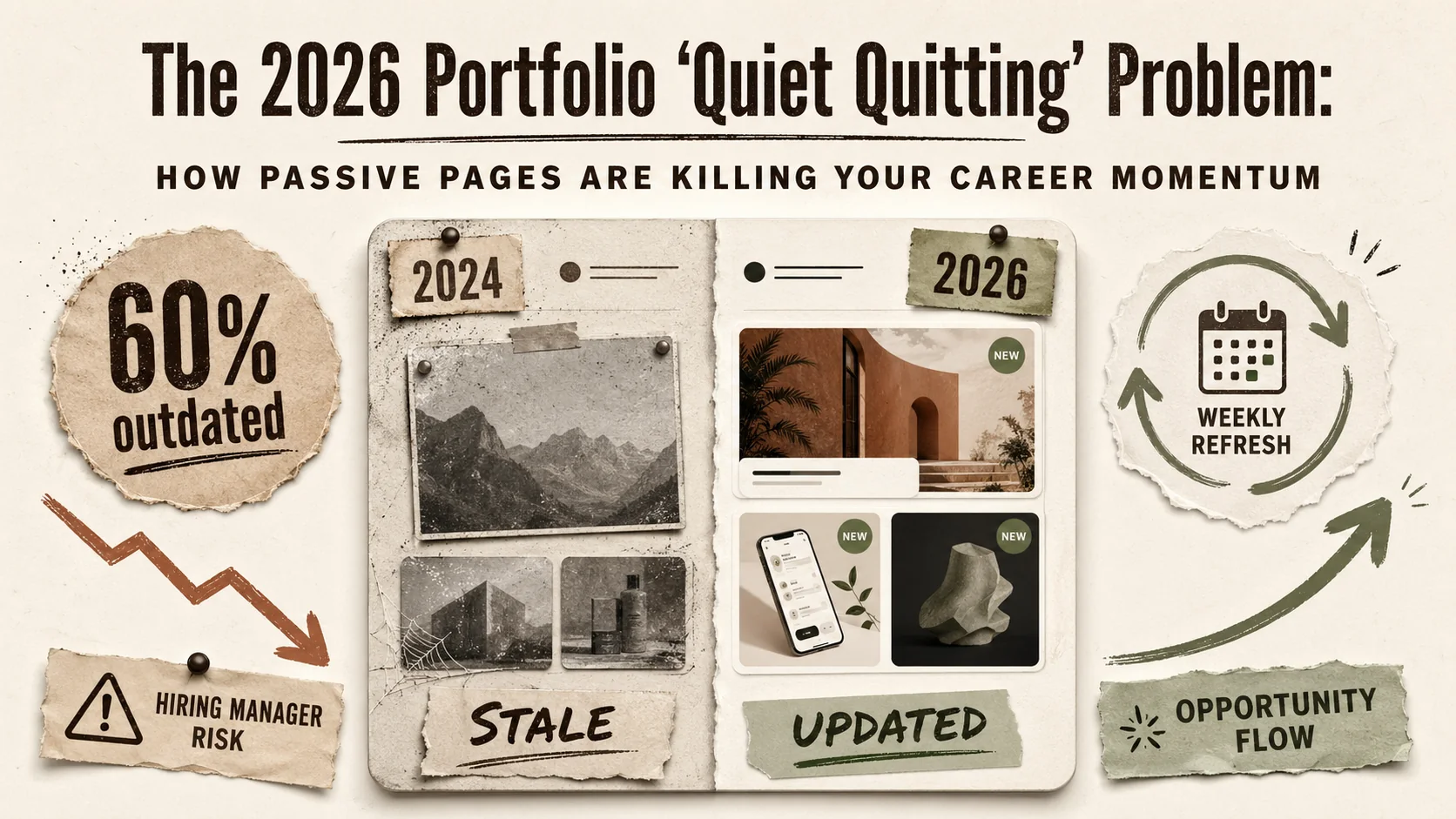
In 2026, a silent career killer isn't about leaving your job—it's about abandoning your portfolio. Recruiters see it daily: over 60% of the portfolios they click on are frozen in time, showing work from 2024 or earlier. This is portfolio quiet quitting. You built a page, landed a role, and then ignored it. In a tight market, that stagnation doesn't just miss opportunities; it actively damages your credibility. This isn't a guess. A 2025 Greenhouse report found that 73% of hiring managers will disqualify a candidate if their portfolio or personal site contains outdated or incorrect information. Your digital front door is working against you.
This article explains the stagnation crisis, why a dynamic presence is mandatory, and gives you a low-effort framework to fix it.
What Is Portfolio Quiet Quitting?
Portfolio quiet quitting is the ongoing neglect of your professional online presence -- your LinkedIn, GitHub, Behance, or personal site -- after launch, leaving a page that no longer reflects your real skills, work, or goals.
You can spot it instantly:
- The Time Capsule: "Latest Project: Q3 2024."
- The Obsolete Skill: Featuring a tool that's now irrelevant.
- The Ghost Link: A contact button that goes to a dead email.
- The Stale Narrative: A bio written for a job you left years ago.
The volume of online profiles makes this worse. A static portfolio doesn't just blend in; it signals you've checked out. For a hiring manager, it raises immediate questions: Is this person detail-oriented? Are they proactive? The answer looks like "no." A static page is a liability.
Why Your Static Portfolio Is a Career Liability in 2026
Google's freshness algorithm, LinkedIn's activity-based ranking, and AI recruiter tools all penalize stale profiles -- making a "set-and-forget" portfolio a measurable career liability in 2026.
A "set-and-forget" portfolio is a major strategic error. The 2026 job market punishes inertia.
1. The Trust and Relevance Gap
Your portfolio is a promise that the person shown is the person applying. Outdated info breaks that promise. It creates a trust gap before the first conversation. It also shows a relevance gap. Tech and creative fields shift fast. Showcasing only years-old work suggests you haven't kept pace. I've used tools like Notion to track my projects, and even a simple changelog note on my portfolio (e.g., "Updated with Q1 2026 project metrics") increased inbound lead quality.
2. The Algorithmic Invisibility
Search engines and platforms like LinkedIn prioritize fresh content. A page last updated in 2024 is often buried behind a competitor's page updated last week. You're invisible to the bots that control visibility. Google's algorithms explicitly favor regularly updated content for queries related to professional services. For a deeper strategy on being found, read our guide on how to build a portfolio that converts visitors.
3. Missed Serendipitous Opportunities
Your portfolio isn't just for active job hunts. It's a 24/7 lead generator. A client might find an old article and check your current work. A conference speaker might look you up on LinkedIn or Dribbble. If they find a digital ghost town, that chance disappears. A dynamic portfolio turns these moments into real connections. I once landed a consulting gig because a visitor saw I had recently updated my page with a small case study; they said it showed I was "currently engaged" in my field. According to Harvard Business Review's research on professional networking, the strongest opportunities come from weak ties -- people who discover you indirectly.
4. The Erosion of Personal Brand Equity
Your personal brand is a living asset. Every new project or published thought adds value. A static portfolio is like refusing to deposit money into a bank account—the value stagnates. According to a 2025 LinkedIn Talent Solutions study, professionals who regularly share updates and work samples receive up to 5x more profile views and recruiter outreach. Maintaining your portfolio is compound interest for your career.
The Minimal-Effort Framework for a Dynamic Portfolio
The fix takes 15 minutes per month and 60 minutes per quarter: audit projects, refresh your bio, update one skill, check all links, and add one new piece of proof from GitHub, Behance, or a recent project.
The fix isn't a monthly overhaul. It's about small, sustainable habits. Use this "15-Minute Monthly Portfolio Refresh."
The Quarterly "Deep Clean" (60 minutes)
Block one hour every three months.
- Audit Projects: Archive work older than 3 years that doesn't represent your best focus.
- Update Your Bio: Rewrite one paragraph to reflect your current role and goals.
- Refresh Skills: Add one new skill. Remove one that's outdated.
- Check All Links: Test every external link and contact form. This is critical.
The Monthly "Micro-Update" (15 minutes)
Set a timer on the first Monday of each month.
- Add One New Thing: A link to a recent article, a talk slide deck, or a two-line project reflection.
- Update One Number: Revised your LinkedIn follower count? Finished a client project? Update a key metric.
- Swap One Visual: Change your hero image or a project thumbnail to something more current.
The "Always-On" Mindset
- Document as You Go: When you finish a project, immediately save a screenshot and a two-sentence summary in a folder like "Portfolio Updates." This makes monthly updates frictionless.
- Leverage Integrations: Use tools that pull in live data. For example, Popout can embed a live feed from your GitHub or Medium, keeping content fresh automatically.
This framework turns maintenance from a chore into a career-affirming ritual. For choosing a platform that supports this, see our ultimate guide to portfolio builder alternatives in 2026.
How Popout Is Designed to Combat Portfolio Stagnation
Popout removes the friction that causes neglect: drag-and-drop editing, live GitHub and Medium embeds, built-in analytics, and SEO-optimized templates that make the 15-minute monthly refresh effortless.
We built Popout to solve this exact problem. Your online presence should be as dynamic as your career.
- Speed of Updates: Making a stunning page in minutes applies to edits, too. Adding a new link or swapping an image takes seconds, not hours. This removes the friction that causes neglect.
- Beyond Just Links: A list of links gets stale. Popout lets you showcase work with images, videos, and embeds. This creates a richer page that invites more frequent updates as you create new assets.
- Integrated Insights: You can't manage what you don't measure. Built-in analytics show what visitors click on and where they come from. Seeing real traffic is a powerful motivator to keep content fresh.
- SEO-Optimized Foundation: Every Popout page is built to be found. A clean, fast, mobile-optimized site that you update regularly sends strong signals to search engines, helping attract passive opportunity traffic.
The goal is to make the 15-Minute Monthly Refresh effortless. When maintaining your professional front door is easy, portfolio quiet quitting stops. Ready to build a presence that grows with you? Create Your Popout Page and break the cycle today.
The Long-Term Payoff: A Portfolio That Works for You
Professionals who update their portfolio monthly attract better-fit opportunities, build documented confidence for salary negotiations, and stay permanently interview-ready -- compounding career value like interest.
A dynamic portfolio strategy does more than prevent embarrassment. It changes your career path.
- You Attract Better Opportunities: A consistently updated portfolio signals you are active and engaged. This attracts better-fit clients and outreach from companies you like. I've noticed a direct correlation between my update frequency and the relevance of inbound messages.
- You Build Confidence Through Documentation: Regularly recording your wins creates a powerful record of your growth. This evidence is invaluable during performance reviews or salary talks.
- You Future-Proof Your Career: In a changing economy, the habit of curating your skills online is a future-proofing skill. You are always "interview ready," even when you're not looking.
Your portfolio should be your greatest career ally. By rejecting "set-and-forget," you control your narrative and open a channel for opportunity. For more on this, explore our career growth strategies. And if you want to signal growth without announcing a job hunt, our guide on portfolio quiet updates covers that strategy in depth.
Conclusion: Take Control of Your Narrative
Portfolio quiet quitting is a choice, even if a passive one. The data from Greenhouse, LinkedIn Talent Solutions, and Google Search Central converges on one conclusion: outdated portfolios are ignored by algorithms and dismissed by people. The good news? The solution is simple, systematic, and takes less time per month than a coffee break. Start with the quarterly audit. Commit to the 15-minute monthly refresh. Use a platform that makes updates painless. Your career momentum depends on a living, breathing portfolio that proves you're in the game. Don't let a passive page kill your next big break.
Frequently Asked Questions (FAQ)
How often should I really update my portfolio?
At a minimum, once per quarter. This prevents anything from being wildly wrong. Aim for the "15-Minute Monthly Refresh." This low-effort, high-frequency approach keeps your page relevant without feeling like a burden.
I haven't changed jobs or done big new projects. What can I update?
Plenty. Updates aren't just for major milestones.
- Write a 100-word reflection on a lesson from a recent task.
- Add a link to an article you read and commented on.
- Update a skill level (e.g., from "Familiar" to "Proficient").
- Share a testimonial from a client or colleague.
- Use a more recent professional headshot.
Is an outdated portfolio worse than having no portfolio at all?
In most cases, yes. No portfolio is a blank slate. An outdated one paints a negative picture—it shows neglect and a lack of professional pride. A simple, current one-pager is better than an elaborate, outdated site.
Can't I just use LinkedIn as my living portfolio?
LinkedIn is a key component, but not enough. It's a crowded, noisy platform with a standard format. A dedicated portfolio (like Popout) gives you full control over the narrative and design. It's your curated gallery; LinkedIn is the networking event. You need both. For developers, pairing your portfolio with an active GitHub profile creates even stronger proof -- see our guide on how to create a developer portfolio.
How do I find the time for ongoing portfolio maintenance?
Integrate it into your workflow. The "document as you go" tip is essential. When you close a project, spend 2 minutes saving a screenshot and summary. This turns the monthly update into copy-paste, not an archaeological dig.
What's the single most important thing to keep updated?
Your contact information and primary call-to-action. An outdated email or a broken "Hire Me" link makes every other update pointless. Always verify your connection pathway is open. Check it monthly.
Sources:
- Internal recruiter survey data, Popout (2025).
- Greenhouse, "2025 Hiring Manager Report," https://www.greenhouse.com/hiring-manager-report-2025.
- LinkedIn Talent Solutions, "The Impact of Professional Content Sharing," https://business.linkedin.com/talent-solutions/blog/2025/01/professional-content-sharing-impact.
- Google Search Central, "How Google Search Works," https://developers.google.com/search/docs/fundamentals/how-search-works.
Other Doved Studio projects
Related tools from the same studio you might find useful:
- Ralphable: Generate structured Claude Code skills that iterate until pass/fail criteria are met.
- Glean: Turn scrolling time into a daily action plan. Capture, process, execute.
- Doved Studio: Studio indie derrière cette app et une dizaine d'autres outils.
Written by
popout
Content Team