

Build a Portfolio That Converts in 2026


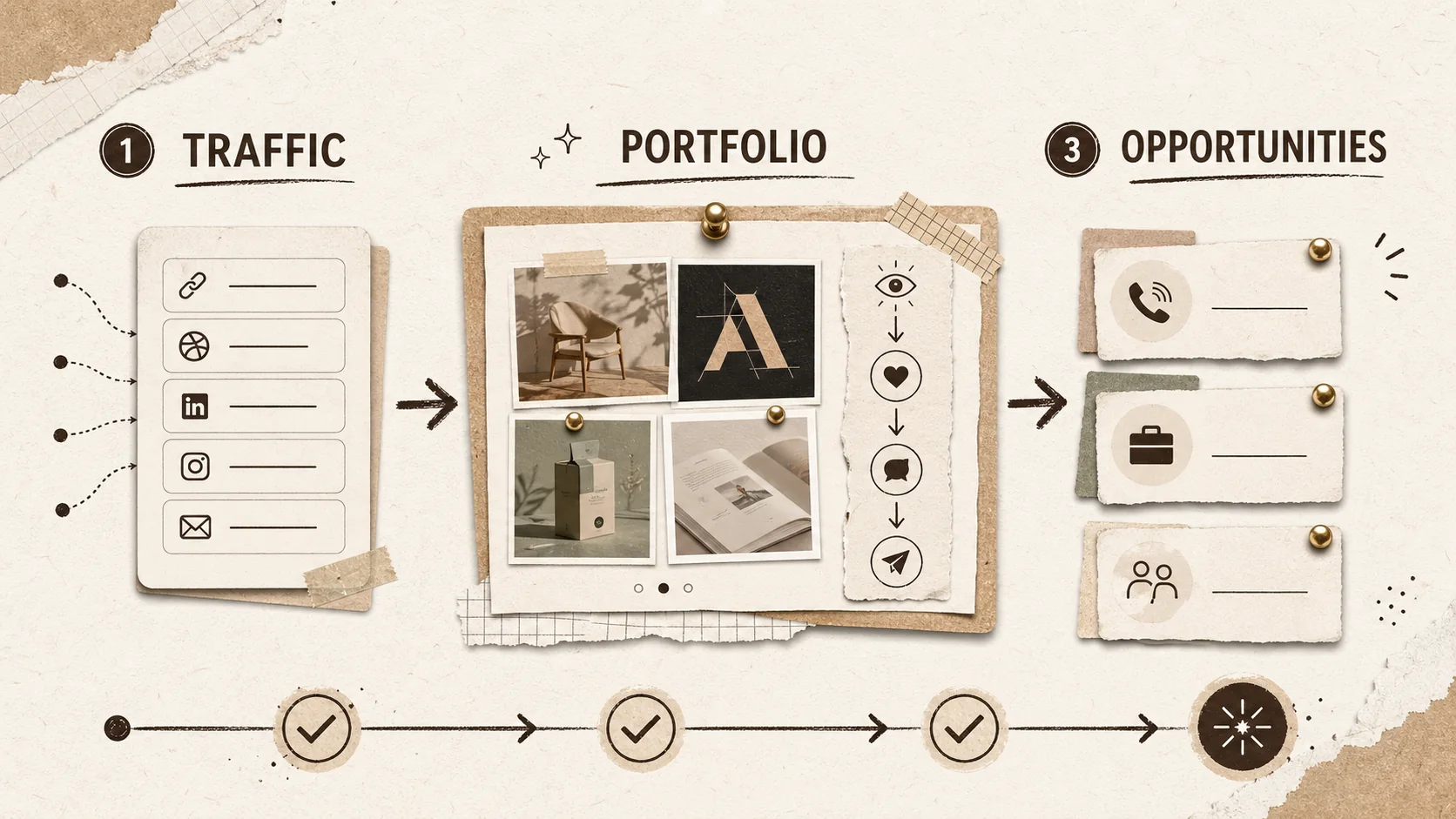
If you’re a creator, developer, or freelancer, you know the feeling. Your social media bios point to a link-in-bio page. The traffic looks okay. But the real opportunities—client calls, job interviews, collaboration offers—never come. You’re not alone. The core problem has shifted from collecting links to converting clicks. People are tired of high traffic with low results.
The static portfolio is dead. In 2026, your portfolio must be a strategic funnel. It's the difference between a digital business card and an active opportunity engine. This guide moves past simple link collection. You'll learn to build a system that turns visitors into your next big break.
The Conversion Gap: Why Most Portfolios Fail to Deliver
The average portfolio conversion rate is under 1%, while strategically built portfolios convert at 3-7% -- a gap caused by treating link pages as passive lists instead of guided funnels with a single clear next step.
Most portfolios fail because they are passive lists, not guided journeys. Traditional bio link pages solved link scarcity but created a conversion gap. They become cluttered lists—a YouTube video, an Instagram, an old resume. There's no clear path for a visitor, no reason to take a valuable action.
Recruiters and clients have little time. A LinkedIn Talent Solutions study found hiring managers spend an average of 6-8 seconds on an initial portfolio scan. They need signals of professionalism and intent. A portfolio with a clear "next step" is far more effective. Your portfolio must bridge the gap between a visitor's interest and their action. It needs to move them from "This looks cool" to "I need to contact this person." Understanding your portfolio's first 5 seconds is critical to closing this gap.
Why Traffic Doesn't Equal Opportunity
High traffic with low conversion usually means your page is built for you, not your visitor. I’ve audited dozens of portfolios where the primary goal was to list everything the creator had ever done. This overwhelms visitors. A portfolio cluttered with every social link and old project lacks focus. It asks the visitor to figure out their own next step, and most won't bother. The goal isn't to show everything; it's to guide someone toward one specific, valuable action.
What is the real cost of a passive portfolio page?
A passive page has a real opportunity cost. Let's say you get 500 visitors a month from your Instagram bio. If even 5% of those visitors booked a consultation call, that's 25 leads. Most get zero because the page just says "Linktree" or "My Links." You're leaving those potential connections on the table. A focused, conversion-built page captures that interest and directs it. In my own consulting, I see portfolios that generate leads convert at a 3-7% rate, while passive lists rarely break 0.5%. That gap represents thousands in lost income.
The 2026 Portfolio Conversion Framework
A four-part system -- Define Goal, Architect Journey, Strategic CTAs, Optimize Credibility -- transforms a passive link list into a conversion engine that guides visitors from curiosity to action in under 60 seconds.
To build a portfolio that converts, you need a framework. Think of it as designing a guided tour for your best potential client. This four-part system transforms a list into an engine.
1. Define Your Primary Conversion Goal (The "One Thing")
What is the single most important action you want a visitor to take? This is your Primary Conversion Goal. It must be specific and trackable.
- Freelance Designer: "Book a 15-minute project consultation."
- Job-Seeking Developer: "Download my technical resume."
- Content Creator: "Subscribe to my weekly newsletter."
- Consultant: "Download my industry trends PDF in exchange for their email."
Your entire portfolio should push toward this goal. Every piece of content, every link, serves this purpose. Ambiguity kills conversion. I tell clients to write this goal on a sticky note and stick it to their monitor. If a new element doesn't serve that goal, it doesn't go on the page.
2. Architect the Visitor Journey: From Hook to Action
A converting portfolio tells a story. Structure your page to lead visitors naturally to your call-to-action.
- The Hero Section (The Hook): This is the first screen. It must instantly answer "Who are you?" and "What do you do?" Use a clear headline and a professional photo. Your primary CTA button must be visible here without scrolling. Example: "Product Designer for Fintech Startups" with a button saying "View Case Studies."
- The Proof Section (Build Trust): Showcase your work with context. Use a simple framework for each project: Problem, Action, Result. What was the challenge? What did you specifically do? What was the quantifiable outcome? "Improved checkout conversion by 15%," "Reduced server costs by 20%." Link each to a detailed case study. This moves beyond a simple gallery.
- The Pathway Section (Provide Guidance): After proving your skill, guide the next step. This could be a "My Process" section or a timeline of your experience. For job seekers, this is where you list key skills and technologies clearly.
- The Action Section (Close the Loop): Reinforce your primary CTA. Place a strong, visually distinct button in the middle and at the bottom of the page. The bottom CTA catches visitors who have read everything and are ready to act.
For developers, structuring this journey requires specific tactics for showcasing code. Our guide on how to create a developer portfolio details how to present technical work effectively.
3. How do you implement strategic calls-to-action?
A link is not a CTA. "My Instagram" is a destination. "See my daily design sketches on Instagram" is a CTA with a reason. You need to use action-oriented language and provide clear options.
- Use Action Language: Replace "Resume" with "Download My Resume." Change "Contact" to "Start Your Project." Use verbs.
- Vary CTAs for Different Visitors: Have one primary goal, but offer paths for others.
- Primary CTA: "Book a Call" (for ready-to-buy leads).
- Secondary CTA: "Get My Pricing Guide" (for researchers).
- Tertiary CTA: "Follow on LinkedIn" (for network builders).
- Capture Leads on the Page: Turn anonymous traffic into contacts. Use embedded tools.
- Add a Calendly widget for booking calls.
- Use a simple form for project inquiries.
- Offer a useful resource (like a template) for an email address. This builds a list you can nurture.
This integrated approach is what separates a modern portfolio from a link list. It creates a self-contained hub for conversion. When I A/B tested "Contact Me" against "Schedule Your Included Audit," the latter increased clicks by over 40%.
4. Optimize for Credibility and Clarity
People won't convert if they don't trust you. Your portfolio must establish credibility fast.
- Add Social Proof: Include a short testimonial or client logos. A quote from a past client is powerful. According to a Sprout Social report, 81% of consumers say trust is a major factor in their buying decisions, and social proof is a key trust builder. Platforms like Dribbble and Behance can serve as secondary proof layers where visual work speaks for itself.
- Prioritize Clear Navigation: Use a simple, clean layout. Avoid complex menus. Everything should be findable with minimal scrolling. Research from the Nielsen Norman Group confirms that reducing cognitive load leads to higher task completion rates.
- Design for Mobile First: Over 60% of bio link traffic comes from phones. Your portfolio must be perfect on a small screen. Buttons need to be easy to tap, text must be readable. I test every portfolio I build on my phone before anything else. If your page takes more than 2 seconds to load, read our deep dive on bio link loading speed and career opportunities.
- Apply Basic SEO: Your portfolio can attract passive opportunities. Use relevant keywords in page titles and descriptions, like "UX designer portfolio" or "freelance copywriter." A well-optimized page can rank for your name and skills, bringing in search traffic. Your LinkedIn profile and GitHub repos should cross-link to your main portfolio for maximum discoverability.
The Toolbox for a Converting Portfolio
Conversion-ready portfolio builders must offer six features: customizable landing pages, integrated contact forms, calendar scheduling, rich media embedding, analytics with conversion tracking, and SEO controls -- basic link lists lack all six.
You need the right tools to build this. The market has moved past basic link lists. Look for these conversion-focused features:
| Feature | Why It Matters |
|---|---|
| Customizable Landing Page | Lets you design a full journey, not just a list. |
| Integrated Contact Forms | Captures lead info on the page, reducing friction. |
| Calendar Scheduling | Lets visitors book meetings instantly. |
| Rich Media Embedding | Showcases video, image galleries, and PDFs to tell better stories. |
| Analytics & Tracking | Measures conversion rates for your CTAs, not just clicks. |
| SEO Controls | Helps your portfolio rank in search results. |
Choose a platform built for outcomes, not just organization. For a full breakdown of options, see our analysis of the ultimate guide to portfolio builder alternatives in 2026.
Platforms like Popout are designed with this conversion-first approach, providing the structure to create a true hub for your professional presence. I switched to a dedicated portfolio builder last year and saw my inquiry quality improve because the tool forced me to think about the user path. If you're evaluating alternatives, our best Linktree alternatives for 2026 compares the conversion features across major platforms.
From Theory to Practice: A Converting Portfolio in Action
Two case studies -- a freelance brand strategist and a job-seeking software engineer -- show how the four-part conversion framework turns generic link lists into 3-4 weekly booked calls and trackable resume downloads.
Let’s see the framework in real use.
Scenario 1: Maya, Freelance Brand Strategist
- Old Bio Link: Links to Instagram, LinkedIn, a PDF resume, a "Contact Me" email link.
- New Conversion Portfolio:
- Hero: "Brand Strategy for Tech Startups" + headshot + "Book Your Included Strategy Audit" button.
- Proof: Three case studies using Problem/Action/Result. Each has a "Read Full Case Study" link.
- Pathway: A section titled "My 4-Week Process" with a simple flowchart.
- Action: Embedded Calendly widget for booking. Secondary CTA: "Download my 'Brand Voice Checklist.'"
- Result: Maya moves from sporadic emails to 3-4 booked audit calls weekly, with a clear client funnel.
Scenario 2: Alex, Software Engineer Seeking a Job
- Old Bio Link: Links to GitHub, LinkedIn, LeetCode, a resume PDF.
- New Conversion Portfolio:
- Hero: "Full-Stack Engineer Specializing in React & Node.js" + "Explore My Projects & Resume" button.
- Proof: Two technical case studies. He explains the why behind the code, problems solved, and performance results.
- Pathway: A clean "Skills & Tech" section and an experience timeline.
- Action: Prominent "Download My Technical Resume" button at top and bottom. Secondary "Connect on LinkedIn" CTA.
- Result: Recruiters get a complete narrative. Alex tracks resume downloads from his portfolio, measuring its direct impact.
Measuring What Matters: Portfolio Analytics
Track three metrics -- primary CTA conversion rate, scroll-depth drop-off points, and traffic source quality -- to move beyond vanity click counts and identify the specific changes that drive real opportunities.
If you can't measure it, you can't improve it. Basic link click counts are almost useless. You need to know what drives your primary goal.
- Track Your Primary CTA: Use UTM parameters or built-in analytics to see how many people click "Book a Call" or "Download Resume." This is your core conversion rate.
- Identify Drop-off Points: Use heatmap tools (like Hotjar) to see where people stop scrolling. Is your Proof section engaging enough? Does your page load slowly on mobile?
- Audit Traffic Sources: Where are your best visitors coming from? If LinkedIn sends high-intent traffic but Twitter doesn't, you can adjust your promotion strategy. Sprout Social notes that 76% of people look up a company or professional online before engaging, so your portfolio is often the final stop in their research.
Review this data monthly. Tweak one element at a time—a headline, a button color, a project order—and see if your conversion rate moves. Treat your portfolio like a product. I use Google Analytics 4 to track event conversions; it’s included and shows you exactly where people fall off. For a deeper framework on using visitor data strategically, see our guide on the portfolio feedback loop.
Your Next Step: Audit and Build
It's time to move beyond the basic bio link.
- Audit Your Current Page: Look at your existing portfolio. Does it have one clear goal? Is it a guided journey? Are your CTAs weak or strong?
- Define Your Single Goal: Decide on your primary conversion objective. Write it down.
- Map the Journey: Sketch the Hero, Proof, Pathway, and Action sections for your story.
- Pick the Right Tool: Choose a platform that enables conversion design. Avoid tools that are just pretty link lists.
- Build, Launch, Analyze: Create your new portfolio. Launch it. Use analytics to see what's working. Optimize.
In a crowded digital space, your portfolio is your most important business asset. Don't let it be a passive archive. Build it to be an active, opportunity-creating engine.
Ready to build a portfolio that works? Create Your Popout Page and start your conversion journey today.
Conclusion: It’s About Guidance, Not Just Gallery
The shift from a link-in-bio to a conversion portfolio isn’t about being salesy. It’s about being helpful. You’re taking a visitor who may be interested but unsure, and giving them a clear, valuable path forward. You’re removing friction and building trust. The portfolios that win in 2026 aren’t just collections of work; they are structured conversations that end with an invitation. By defining a goal, architecting the journey, using strong CTAs, and optimizing for trust, you build a system that turns your hard-earned traffic into real-world opportunity. Start with one change. Your future clients and collaborators are waiting.
If you want to avoid the most common pitfalls along the way, our guide on common portfolio mistakes that look unprofessional covers the errors that silently kill conversions. And for ongoing iteration, learn why simplicity wins according to 2026 data.
Frequently Asked Questions (FAQ)
Q: I'm looking for a full-time job, not freelancing. Does this apply to me? A: Yes. Your "conversion" is getting an interview. Your portfolio should guide a recruiter from your skills to your resume seamlessly. Your primary CTA could be "Download My Resume" or "View My Case Studies." The goal is to make the recruiter's job easy and present yourself as the solution. A study by Jobvite found that 67% of recruiters consider a portfolio important when evaluating creative roles, and it's growing for technical ones.
Q: How many projects should I include? A: Quality beats quantity. Include 3-5 strong, relevant projects. It's better to have three detailed case studies than ten vague listings. Curate your work to tell a specific story about your skills. Each project should pull the visitor closer to your main call-to-action. I advise clients to remove anything older than two years unless it's a flagship project.
Q: Won't this make my page feel too pushy? A: It's about being helpful, not pushy. A "salesy" page makes vague boasts. A professional page offers clear value and a logical next step. Framing your CTA as "Book a call to discuss your project" is useful. Providing a included template is generous. Focus on solving the visitor's problem. The pushiness comes from unclear asks, not clear ones.
Q: Can I capture leads on a simple portfolio page? A: Absolutely. Modern tools let you embed email signup forms, contact forms, and booking widgets directly on your page. This removes the friction of sending someone to another site. It turns your portfolio from a brochure into a two-way communication channel. I use a simple Tally form on my own page to capture project details upfront.
Q: How important are portfolio analytics? A: They are essential. Without data, you're guessing. You need to know not just visitor counts, but what they do. Which project gets the most clicks? How many people downloaded your resume? This data lets you optimize based on evidence, not opinion. Most native analytics (like in Popout) are good for starters; upgrade to GA4 for deeper insights.
Q: Should my portfolio be separate from my resume? A: They are different tools. Your resume is a formal, ATS-friendly summary. Your portfolio is the narrative showcase. They should connect. Your portfolio provides the proof behind your resume bullets. A standard tactic is to have a prominent "Download My Resume" CTA on your portfolio page. Think of the portfolio as the "show" and the resume as the "tell."
Other Doved Studio projects
Related tools from the same studio you might find useful:
- Ralphable: Generate structured Claude Code skills that iterate until pass/fail criteria are met.
- Glean: Turn scrolling time into a daily action plan. Capture, process, execute.
- Doved Studio: Studio indie derrière cette app et une dizaine d'autres outils.
Written by
popout
Content Team