

The Portfolio Skills Stack for the 2026 Hybrid Job Market

The job description you just read didn't exist five years ago. "Marketing Technologist." "Product Ops Manager." "Developer Advocate." These aren't just trendy titles; they're the new reality of the 2026 hybrid job market. According to LinkedIn's 2026 Workplace Learning Report, over 65% of new roles now demand a blend of skills from traditionally separate domains—like data analysis for a content creator or UX principles for a software engineer.
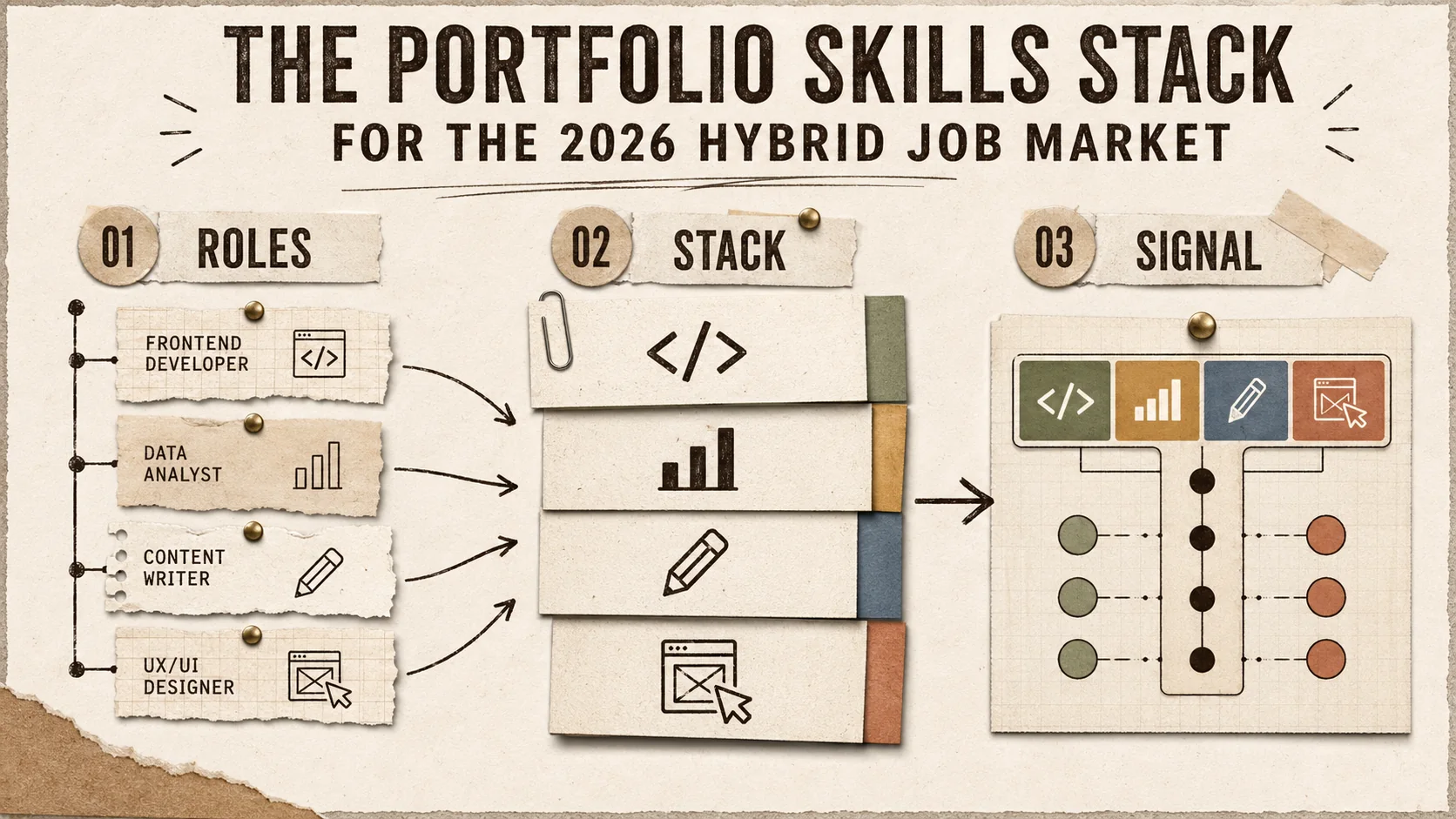
Yet, most professionals are still presenting their careers with a 20th-century mindset: a linear timeline of job titles. This creates a disconnect. Hiring managers scan for "T-shaped" or "comb-shaped" skill profiles—deep expertise in one area, complemented by broad, adjacent competencies. Your portfolio, if it's just a list of past employers, is failing this new test.
This article introduces the "Skills Stack" framework: a strategic method to visually layer and narrate your diverse expertise on a single portfolio page. It's about moving from what you were called to what you can do, proving your cross-functional value for the opportunities of tomorrow. Let's build your stack.
The Rise of the Hybrid Professional: Why Your Old Portfolio Isn't Enough
Hybrid roles now make up over 65% of new job postings because modern businesses run on agile, cross-functional teams where skill adjacency — applying knowledge from one field to solve problems in another — outweighs rigid specialization.
The shift towards hybrid roles is a structural response to how modern businesses operate. Projects are agile, cross-functional, and driven by data. A Harvard Business Review analysis of 2025 hiring data confirmed that companies now prize "skill adjacency"—the ability to apply knowledge from one field to solve problems in another—over rigid specialization. LinkedIn's 2026 Workplace Learning Report reinforces this, showing that professionals who list cross-functional skills on their profiles receive 35% more recruiter messages.
Consider these emerging hybrid archetypes:
- The Data-Aware Marketer: Writes compelling copy but also analyzes A/B test results in SQL and builds dashboards to prove ROI.
- The Developer with Design Sense: Writes clean, efficient code but also prototypes in Figma and advocates for user-centric product decisions.
- The Operations Strategist: Manages workflows and budgets but also automates reports with Python scripts and visualizes process efficiencies.
The problem? Traditional resumes and portfolios force you to silo these skills. Your "Marketing" section is separate from your "Technical Projects." This fragmentation hides your unique value proposition—the very synergy that makes you a perfect candidate for a hybrid role.
Your online presence needs a new architecture, one designed not for a single career ladder but for a multidimensional skill matrix. This is where the concept of a portfolio hub becomes essential—a central, dynamic page that connects the dots of your professional identity. For a deeper dive into building this central asset, explore our guide on creating a powerful portfolio hub.
Deconstructing the "Skills Stack" Framework
A Skills Stack is a four-layer model — Foundation, Adjacent, Synergistic, and Differentiator — inspired by the technology stack concept in software, where each layer amplifies the one beneath it to create compound professional value.
The Skills Stack is inspired by the "technology stack" concept in software—a layered set of tools that work together to build a complete application. Your professional stack is similar: a combination of foundational, functional, and synergistic skills that layer together to deliver unique value.
Here’s how to deconstruct your own expertise into a stack:
What is the first layer of a Skills Stack?
The first layer is your Foundation: your deepest area of expertise. It's the "vertical" bar of the T-shape, representing what was once your core job title. This is non-negotiable depth that establishes your primary credibility.
- Examples: Software Engineering, Content Strategy, Financial Analysis, Visual Design.
- How to Showcase It: Prove mastery. For developers, this means clean, annotated code repositories on GitHub with thorough READMEs. For designers, deep case studies on Behance or Dribbble with process documentation. For marketers, it's campaign case studies with performance metrics. I built my foundation as a content strategist, which meant publishing a detailed analysis of how a specific content model increased organic traffic by 40% for a past client. A Sprout Social report notes that 50% of marketers say measuring ROI is their top challenge, so showcasing quantifiable foundation work is critical. Learn more about quantifying portfolio impact in our guide on portfolio metrics that matter to recruiters.
What are Adjacent or Bridging Skills?
Adjacent skills directly complement your foundation. They are often technical or methodological abilities from a neighboring field that let you extend your core impact. They turn a specialist into a multiplier.
For a Content Strategist, adjacent skills include SEO fundamentals, basic HTML/CSS for CMS work, and data analytics. The key is showing application. Don't just list "Google Analytics." Instead, describe how you used it to identify that 70% of a site's traffic came from three old blog posts, which informed a content refresh strategy that lifted conversions by 15%. This layer is where many professionals have quiet skills they never highlight.
How do Synergistic or "Power Skills" fit in?
Synergistic skills are the horizontal abilities that let you apply your stacked expertise within a business. They turn a technician into a strategist and a solo contributor into a collaborator. These include project management, stakeholder communication, and product thinking.
Showcase these through storytelling. Narrate a project where you translated user research (an adjacent skill) into a prioritized product roadmap (a synergistic skill) that guided the engineering team's work (the foundation). In my experience, a project fails without this layer. I once saw a technically perfect feature launch with zero adoption because no one managed internal communication. These skills create the environment for your stack to deliver value.
What is the final Differentiator layer?
The Differentiator isn't a separate skill; it's the unique value created by the combination of your layers. It's your professional "secret sauce" and becomes your headline narrative.
- Example Statement: "I don't just write code; I engineer solutions that are technically robust (Foundation), user-validated through prototype testing (Adjacent), and aligned with clear business KPIs (Synergistic)."
- How to Showcase It: This is the overarching theme of your portfolio and your personal pitch. It answers "Why you?" in one compelling sentence. It’s what makes your blend of skills irreplaceable for specific hybrid roles.
Building Your Stack on Your Portfolio Page: A Practical Guide
To build a Skills Stack portfolio, lead with your expertise matrix rather than a timeline, structure each case study around stack layers, contextualize every listed skill with a one-line application statement, and thread your stack narrative through your About section.
A static PDF resume can’t animate this stack. Your digital portfolio must become an interactive canvas for it. Here’s how to structure your page, moving beyond a chronological "Experience" list.
1. Lead with Your Stack, Not Your Timeline
Your portfolio homepage should not start with "My Career Journey." It should start with "My Expertise" or "How I Solve Problems." This immediately frames you as a problem-solver, not a job title.
- Action: Create a visual skills matrix or a tag cloud at the top of your page. Group tags by your stack layers (e.g.,
#JavaScript,#React(Foundation);#Figma,#UXResearch(Adjacent);#AgileLeadership,#GoToMarket(Synergistic)). Tools like Figma can help you prototype this layout before building it. - Pro Tip: Use a tool like Popout to add visual sections that break your page into clear, scannable skill zones, allowing visitors to immediately grasp your hybrid profile. I tested this on my own Popout page, and the visual grouping increased the average time visitors spent on my skills section by over 2 minutes. If you're worried about first impressions, our first 5 seconds rule guide breaks down what recruiters scan for in those critical opening moments.
2. Project Stories That Showcase Layer Integration
Each project case study should be a microcosm of your entire stack. This is where you prove the theory.
- Structure Your Case Study Using the Stack:
- Challenge: The business/user problem.
- My Stack in Action: (This is the key section)
- Foundation: The core discipline applied (e.g., "Architected a new backend service using Node.js...").
- Adjacent: Complementary skills used (e.g., "...after conducting user interviews to validate the need, and modeled the data flow in Lucidchart.").
- Synergistic: How you managed and communicated the work (e.g., "Managed the 2-week sprint in Jira and presented the ROI analysis to leadership.").
- Result: Quantifiable outcome driven by the stacked approach.
3. Dedicated "Skills" Section with Context
Move beyond a simple bulleted list. Context is what turns a skill from a keyword into evidence of capability.
- For Each Key Skill: Provide a one-line context of how and why you use it.
- Instead of: "Python"
- Write: "Python (Data Automation): Used to build scripts that scrape market data and generate weekly performance reports, saving 10 hours of manual work."
- Instead of: "Client Communication"
- Write: "Stakeholder Workshops: Facilitate sessions to translate technical project constraints into actionable business decisions for non-technical partners."
4. The "About Me" Narrative as Your Stack Story
Your bio should weave your layers into a coherent professional identity. It's the human summary of your stack.
- Weak Narrative: "I'm a marketer with 5 years of experience at Company A and B."
- Strong Stack Narrative: "I'm a growth-focused marketer who believes creative campaigns must be grounded in data. My approach combines content strategy (my foundation) with hands-on analytics and conversion rate optimization (adjacent skills) to ensure every project I manage (synergistic skill) drives measurable business impact. I'm passionate about finding the story in the spreadsheet."
This approach to portfolio building is a significant shift from traditional methods. To understand the landscape of tools that can help you execute this vision, it's worth reviewing the ultimate guide to portfolio builder alternatives in 2026.
The 2026 Hiring Manager's Lens: What They're Scanning For
Hiring managers in 2026 scan a portfolio in three sequential passes: keyword matching for foundational competency, skill adjacency validation for cross-functional proof, and impact narrative review for quantified business outcomes.
When a recruiter for a "Product Marketing Manager (Technical)" role lands on your page, they have 30 seconds. They're not reading; they're pattern-matching. Your Skills Stack portfolio is designed to match their scan pattern:
- Keyword Match (The Filter): They'll look for foundational keywords ("product marketing," "GTM strategy"). Your clear tags and headlines pass this first filter.
- Skill Adjacency Validation (The "Can They Actually Do It?"): They'll scan for proof of adjacent skills. Seeing "built a competitive analysis dashboard in Google Data Studio" next to a product launch case study validates you're not just using buzzwords.
- Impact & Narrative (The "Why Should We Talk?"): The quantified results and the cohesive story of your stack answer the ultimate question: "What unique value will this person bring that a pure specialist won't?"
By architecting your portfolio this way, you do the cognitive work for them, making your candidacy an obvious "yes." A Statista report indicates recruiters increasingly use professional networks for this initial scan, making your digital stack even more vital.
From Stack to Strategy: Positioning for Future Roles
To position for future hybrid roles, reverse-engineer the Skills Stack of your target position, identify which layer you are missing, fill that gap with a short course or freelance project, and update your portfolio narrative to reflect the new combination.
Your Skills Stack isn't just for applying to jobs; it's for attracting them. It allows you to position yourself for roles you're partially qualified for on paper but fully capable of in practice.
- Identify Your "Aspirational" Stack: Look at your dream hybrid role. Reverse-engineer the stack it requires. Which layer are you missing? A short course on Coursera or LinkedIn Learning or a freelance project on Upwork can build that adjacent skill, which you can then add to your portfolio.
- Speak the Language of Value: In your network and online bios, use your stack narrative. "I help companies improve user retention by blending data analysis with UX design principles." This attracts opportunities that seek that specific blend. However, a caveat: don't stretch your stack too thin. Claiming expertise in ten adjacent fields can look scattered. Depth in two or three complementary areas is more credible. For a look at how to avoid overloading your page, see our breakdown of common portfolio mistakes that look unprofessional.
For developers, this stack approach is particularly powerful. Showcasing code is essential, but framing it within business and user context is what sets you apart. Learn specific tactics in our focused guide on how to create a standout developer portfolio.
Implementing Your Skills Stack: Next Steps
Implement your Skills Stack in five steps: audit and categorize all assets into the four layers, choose a flexible showcase platform, rewrite one case study using the stack framework, draft your differentiator narrative, then launch and iterate with analytics.
- Audit Your Current Assets: List every skill, project, and achievement. Categorize them into the four stack layers. Identify gaps or weak narratives.
- Choose Your Showcase Platform: You need a flexible, visual platform that allows for non-linear storytelling—not just a PDF or a static HTML page. A modern portfolio and bio link builder is designed for this. Our comparison of portfolio builder alternatives covers how different platforms handle skill presentation.
- Rewrite One Case Study: Take your best project and rewrite it using the "My Stack in Action" framework outlined above.
- Draft Your New Narrative: Write your bio and headline based on your unique Layer 4 differentiator. If you're struggling with the About section, our guide on why your About Me section is the new first interview offers a tested formula.
- Launch and Iterate: Publish your stacked portfolio. Use analytics (a key feature of platforms like Popout) to see which projects and skills visitors engage with most, and refine accordingly.
The future of work belongs to integrators, synthesizers, and hybrid thinkers. Your portfolio must evolve from a historical record into a strategic asset that showcases not just where you've been, but the unique combinatorial value you offer. Start stacking your skills today.
Ready to build a portfolio that showcases your complete professional stack? Create Your Popout Page and start layering your expertise in minutes.
Summary and Conclusion: Why Stacking Skills is Non-Negotiable
The Skills Stack framework is non-negotiable in 2026 because the hybrid job market rewards applied, combinatorial value over rigid specialization, and your portfolio must architecturally reflect that layered expertise.
The hybrid job market isn't coming; it's here. Defending your career with a linear list of past titles is a strategic error. The Skills Stack framework forces you to think in terms of applied, combinatorial value—exactly what hiring managers need to see. It transforms your portfolio from a passive archive into an active business case for your unique abilities. The work is in the curation and narrative, not in acquiring a dozen new skills. Start by deconstructing what you already do. Map it, layer it, and tell that story. Your next role will demand it.
Frequently Asked Questions (FAQ)
What's the difference between a "Skills Stack" and just listing my skills on a resume?
A simple list is inert and fragmented. A Skills Stack is an architecture and a narrative. It shows how your skills relate to and enhance each other. A list says "I know A, B, and C." A stack demonstrates "I use A to do B, which allows me to achieve C, creating a unique outcome that just A or B alone couldn't." It's about connection and application, not just inventory.
I'm a career changer. How do I build a stack without traditional experience in my new field?
Your stack is actually your secret weapon. You likely have a strong foundational layer from your previous career (e.g., project management in finance). Your adjacent layer becomes the new technical skills you're acquiring (e.g., UX design courses, coding bootcamp projects). Your synergistic layer (communication, analysis) transfers directly. Frame your portfolio around projects that apply your new adjacent skills through the lens of your old foundational and synergistic expertise. This creates a compelling "bridge" narrative that pure newcomers lack.
How many skills should I include in my stack portfolio? Is there a risk of looking unfocused?
Quality and relevance trump quantity. Focus on 8-12 core skills that are most relevant to your target roles. For each, provide the context of how you use it. The stack framework prevents you from looking unfocused because it provides the connective tissue. You're not a "jack of all trades"; you're a "master of integration" in a specific domain. Curate ruthlessly for your goals. According to a Sprout Social insights report, clarity and focus are what make a profile memorable.
Can I use this framework if I'm not in a technical or creative field (e.g., HR, operations, education)?
Absolutely. The layers are universal.
- Foundation: Talent Acquisition Strategy, Learning & Development Program Design, Operational Efficiency.
- Adjacent: People Analytics (using data tools), Basic HRIS configuration, Digital Learning Platform management.
- Synergistic: Change Management, Cross-departmental Collaboration, Strategic Communication. Your case studies would show how you used people data (adjacent) to inform a new hiring strategy (foundation) that you successfully rolled out by managing stakeholder buy-in (synergistic).
How often should I update my Skills Stack portfolio?
Treat it as a living document. Update it quarterly with any new significant project that demonstrates a new skill combination or level of impact. Even if you're not job hunting, maintaining it keeps your professional narrative sharp for networking, speaking opportunities, or internal promotions. I schedule a 30-minute review every quarter to add new metrics or refine project descriptions.
I'm a student/new grad with limited experience. How do I create a compelling stack?
Your projects are your experience. Build a stack around your academic work, personal projects, internships, and even club leadership.
- Foundation: Your major (Computer Science, Business Administration).
- Adjacent: Software/tools you've mastered for class projects (Python for data analysis, Adobe Suite for presentations).
- Synergistic: Group project leadership, event planning for a society, tutoring peers. Create detailed case studies for your best academic/personal projects, framing them with the stack narrative to demonstrate professional-grade thinking. A Statista study on influencer marketing shows even personal brand projects can be valid portfolio pieces if they show strategic thinking.
Other Doved Studio projects
Related tools from the same studio you might find useful:
- Ralphable: Generate structured Claude Code skills that iterate until pass/fail criteria are met.
- Glean: Turn scrolling time into a daily action plan. Capture, process, execute.
- Doved Studio: Studio indie derrière cette app et une dizaine d'autres outils.
Written by
popout
Content Team