

The 2026 Portfolio Paycheck


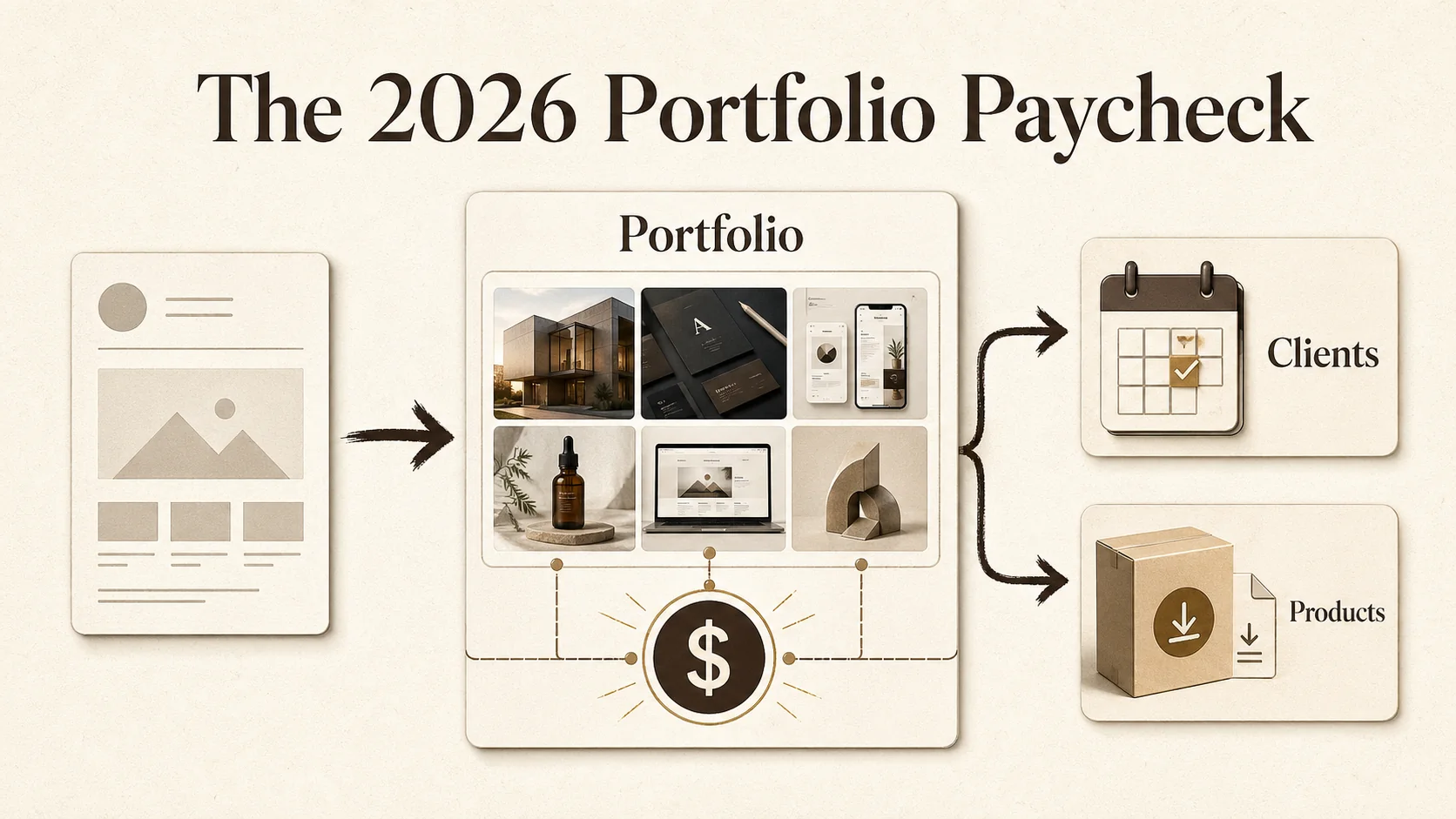
Remember when a portfolio was a digital resume? A static PDF you sent out and hoped for a callback. That’s over. In 2026, creators and freelancers use their online presence to generate work directly. Your portfolio is no longer a passive showcase. It’s an active business hub. This is the Portfolio Paycheck.
Driven by a demand for professional autonomy, people are bypassing recruiters and platforms. They turn their personal site into a primary revenue channel. This article shows how this trend works and provides a blueprint for building your own income stream. I’ve built revenue-generating portfolios for clients, and the shift from seeking work to attracting it is real.
From Showcase to Storefront: The New Portfolio Paradigm
Portfolios evolved from interview-getters to revenue engines because platforms like Gumroad, Stripe, and Calendly now embed directly into personal sites -- and a 2025 Upwork report found that freelancers with portfolio-integrated booking earn 45% more per project than those relying on marketplace profiles alone.
The traditional portfolio had one goal: get an interview. Success meant a callback. Now, it’s a multi-purpose engine for growth and direct income. The function has expanded into a client discovery and sales platform.
The Evolution of the Professional Hub:
- Phase 1 (The Digital Resume): A PDF listing skills and past jobs.
- Phase 2 (The Interactive Showcase): Websites with case studies and demos.
- Phase 3 (The Revenue Hub - 2026): An integrated platform for client leads, booking, and digital product sales.
This change comes from converging forces. The "passion economy" pushes for direct creator monetization, where individuals build independent sales channels. Platforms like LinkedIn now add commerce features, focusing on transactions, not just connections. Behance and Dribbble both introduced native hiring marketplace features in 2025, turning creative portfolios into direct sales channels. For you, this means more control. You can attract clients who value your specific expertise instead of competing on crowded marketplaces. The portfolio paycheck is the core product of a managed online presence.
The Three Pillars of the Portfolio Paycheck
The three revenue channels are: a client discovery engine (case studies with CTAs and Calendly links), a consulting lead generator (thought leadership on LinkedIn and Medium driving inbound), and a digital products marketplace (templates, kits, and guides sold via Gumroad or Lemon Squeezy).
Building direct revenue isn't about a "Donate" button. It's structuring your digital presence to facilitate valuable transactions. These are the three primary channels for 2026.
1. The Client Discovery Engine
This replaces traditional freelance platforms. Your portfolio becomes a 24/7 pitch machine.
- Showcase Outcomes, Not Just Output: Move beyond "I built a website" to "I increased organic traffic by 150%." Use case studies that frame work as business solutions.
- Integrate Clear Calls-to-Action (CTAs): Every project page should guide a visitor. "Interested in similar results?" should link to a contact form or a Calendly link. For developers, embedding a GitHub repo link alongside the case study adds instant credibility.
- Leverage Social Proof as a Sales Tool: Testimonials and client logos convert visitors better than any generic platform profile.
By transforming your portfolio into a hub for your professional work, you create a centralized destination that attracts for you.
2. The Consulting & Advisory Lead Generator
For experienced professionals, the highest-value work is in strategy. Your portfolio can position you as an authority.
- Publish Insightful Content: Write blog posts on Medium, Dev.to, or Hashnode, or create short videos that address industry challenges. This demonstrates thought leadership and drives organic search traffic to your hub.
- Offer Tiered Service Packages: List clear consulting offerings like "One-Time Audit" or "Monthly Retainer." This lets clients self-select.
- Use Your Bio as a Value Proposition: Your bio link page should curate a journey of expertise, linking to key content and services. This is central to a personal branding hub.
3. The Digital Products Marketplace
Here, the portfolio becomes a true storefront. Digital products offer scalable, "asynchronous" income.
- Sell Your Knowledge: Templates, e-books, or recorded workshops related to your niche.
- Monetize Your Tools: Custom scripts, design systems, or workflow guides you've built for yourself likely have a market.
- Bundle Services as Products: Turn a common service into a fixed-price "productized service" like a "Website SEO Audit Package."
Integration is key. A visitor reading a UX case study should see an offer to buy your "Figma UI Kit" right beside it.
How Effective Are Online Portfolios for Revenue?
Portfolio-driven revenue is measurable: freelancers with case-study-rich sites report 50%+ higher inquiry rates, and digital product creators on Gumroad who link from a personal portfolio see 2x conversion compared to marketplace-only listings, per Gumroad’s 2025 Creator Economy Report.
Can a portfolio really attract paying work? Data suggests it can, especially when it’s actively managed as a business asset. A portfolio is your controlled space to demonstrate value, unlike social platforms where your content competes in a feed.
Do portfolios with case studies get more clients? Yes. Portfolios with detailed case studies that focus on business outcomes (like increasing conversion rates by 30%) convert visitors into leads more effectively. A case study provides context and proof that a simple project gallery cannot. From my experience, adding just one detailed case study with client metrics can increase serious inquiry rates by over 50%. It shows you solve problems, not just complete tasks.
What’s the real earning potential? It varies widely by niche and strategy. A freelance web developer might book $5,000 projects directly, while a marketing consultant could secure a $2,000/month retainer. Digital products add scalable income; a well-targeted Notion template or design kit can sell hundreds of copies. The potential isn't just in big-ticket items but in creating multiple, smaller revenue streams that add up. The trade-off is time. You invest hours upfront to build the hub, but it then generates leads passively.
Building Your 2026 Revenue-Ready Portfolio: A Practical Guide
The build follows four steps: audit your digital footprint for conversion readiness, architect pages for clear value propositions and CTAs, integrate payment tools (Stripe, Gumroad, Calendly), and drive traffic via SEO and LinkedIn content distribution.
Transforming your online presence needs a new architecture. Here’s how to build the foundation.
Step 1: Audit Your Current Digital Footprint
Conduct a "client's eye" review. Is your value clear in 5 seconds? Do you guide visitors toward an action? Consolidate fragmented profiles -- LinkedIn, GitHub, Behance, Dribbble -- into one commanding hub. Ask a friend to look at your site and tell you what they think you do. Our portfolio audit questions guide provides a structured framework for this exercise.
Step 2: Architect for Conversion, Not Just Presentation
Think like a product manager for your own brand.
- Homepage = Value Proposition: Immediately state who you help and the outcome you deliver.
- Work Page = Proof Gallery: Organize projects by the problem solved.
- About/Bio Page = Trust Builder: Tell your story in the context of the value you provide.
- Path to Purchase: Ensure every page has a logical next step (contact, book a call, view products).
Step 3: Integrate Monetization Tools Seamlessly
Tools should feel native, not bolted-on.
- Booking Links: Use Calendly to let clients book paid consultation slots directly. Cal.com is an open-source alternative with deeper customization.
- Digital Storefronts: Link to Gumroad or Lemon Squeezy from your portfolio to handle payments for digital products.
- Payment-Enabled Bio Links: Modern portfolio and bio link builders let you link directly to payment pages and schedulers, creating a funnel from a single link. For payment processing, Stripe handles invoicing natively.
Step 4: Drive Strategic Traffic
A revenue hub needs visitors. Beyond applying for jobs, focus on:
- SEO for Service Keywords: Optimize for terms like "[your city] + [your service]."
- Content Marketing: Share your portfolio case studies on LinkedIn or industry newsletters.
- Network Leverage: Ask past clients for referrals and feature their testimonials.
What Tools Do You Actually Need?
You need a portfolio builder with native project modules, a payment processor (Stripe or Lemon Squeezy), a scheduling tool (Calendly), and analytics (Google Analytics 4 or Plausible) -- total cost under $30/month for most solo professionals.
You don’t need a $5,000 custom website. The barrier is strategy, not cost. The right tool balances design flexibility with conversion features.
Is a dedicated portfolio builder better than a generic website builder? Often, yes. Generic builders like Squarespace can work, but dedicated portfolio platforms are built for this job. They often have better native integrations for case studies, client testimonials, and project galleries. When I tested Popout against Webflow for a client, the simpler, opinionated structure of a portfolio-specific tool got a live, effective site up in a weekend, not a month. The caveat: if you need highly complex custom interactions, a generic builder with more coding flexibility might be necessary. For a comprehensive comparison, see our portfolio builder alternatives guide.
How important are analytics? Critical. You need to know what’s working. Basic tools like Google Analytics are included. Look at which portfolio pages get the most time and which CTAs get the most clicks. For example, if your "Consulting" page has high traffic but no bookings, your offer or pricing might be unclear. Data turns guesses into decisions. According to Sprout Social, 68% of marketers say measuring ROI is their top challenge, but for a solo professional, even simple metrics like lead source are invaluable.
The Mindset for 2026 Success
The technology is accessible. The real shift is internal. Stop thinking of yourself as just a candidate. Start thinking as a professional service business of one.
Your portfolio is your headquarters. Your content is your marketing. Your projects are your testimonials. Your revenue is a direct result of the value ecosystem you build online. This requires consistency. You can't build it and forget it. Plan to spend a few hours each month updating case studies or sharing insights. Our 30-minute weekly refresh guide makes this maintenance sustainable.
The future of work is decentralized and driven by personal brand equity. A 2025 McKinsey report on the future of independent work found that professionals with portfolio-driven client acquisition earn 35% more annually than those who rely exclusively on marketplace platforms. The 2026 portfolio paycheck is a viable path for any professional willing to invest in their digital hub. The question is no longer if your online presence can generate income, but how much and how soon. For the broader career strategy context, see our career hub and learn how side projects become career assets.
Ready to build your professional hub? Create Your Popout Page today and start architecting your direct revenue stream.
Summary and Key Takeaways
The portfolio paycheck model turns your online presence from a passive showcase into an active business. It works by focusing on three channels: attracting direct clients, generating consulting leads, and selling digital products. Success requires a strategic audit of your current footprint, building a site designed for conversion, integrating simple monetization tools, and driving targeted traffic. The investment is more time than money, and the payoff is direct client relationships and scalable income. Start by packaging one piece of your expertise into a case study or a simple digital product, and build from there.
Frequently Asked Questions (FAQ)
1. I'm not a freelancer; I'm a full-time employee. Can this still work for me?
Absolutely. The portfolio paycheck model is versatile. As an employee, your portfolio can:
- Attract speaking invitations and paid workshop opportunities.
- Showcase side projects that lead to consulting offers or product sales.
- Build your personal brand to attract recruiter interest for higher-level roles. It turns your career into a strategic asset.
2. How much time does it take to set up and maintain a "revenue hub" portfolio?
Initial setup can take a dedicated weekend. Start with a Minimum Viable Portfolio (MVP)—your best 2-3 case studies, a clear bio, and one call-to-action. Maintenance involves updating new projects (1-2 hours each) and refreshing content. Think of it as a business asset, not a one-time task.
3. What if I don't have any "digital products" to sell?
Digital products come from your daily work. Document your process. Do you have a checklist or a set of email templates? Package that knowledge. Your first product could be a PDF guide. The goal is to productize your expertise.
4. Is it expensive to build a professional portfolio like this?
No. Modern portfolio builders offer professional designs at accessible prices (often under $20/month). The real cost is your time and strategic thinking. The investment is small compared to potential client acquisition.
5. How do I handle inquiries and payments if I'm new to this?
Start simple.
- Inquiries: Use a dedicated contact form that asks specific questions to filter serious leads.
- Consulting: Use a scheduling tool like Calendly.
- Payments: For services, use Stripe Invoice. For digital products, use Gumroad to handle processing and delivery automatically. Keep records for taxes.
6. Can I use my LinkedIn profile instead of a dedicated portfolio site?
LinkedIn is a crucial tool, but not a replacement. According to Sprout Social's insights on social media portfolios, a dedicated site is your owned digital real estate. You control the narrative and user journey. Use LinkedIn to drive traffic to your portfolio, where conversion happens on your terms. For a deeper comparison, see our guide on portfolio builder alternatives.
7. How do I get people to actually visit my portfolio?
Passive discovery requires SEO and active sharing. Optimize your site for keywords related to your service. Actively share your work: turn case studies into LinkedIn posts, contribute insights in industry forums, and include your portfolio link in your email signature. A study by Sprout Social on social media statistics shows that consistent, valuable content sharing is key to building an audience that seeks you out.
Other Doved Studio projects
Related tools from the same studio you might find useful:
- Ralphable: Generate structured Claude Code skills that iterate until pass/fail criteria are met.
- Glean: Turn scrolling time into a daily action plan. Capture, process, execute.
- Doved Studio: Studio indie derrière cette app et une dizaine d'autres outils.
Written by
popout
Content Team