Stop Building Static Portfolios. Your 2026 Career Demands a Living Document.
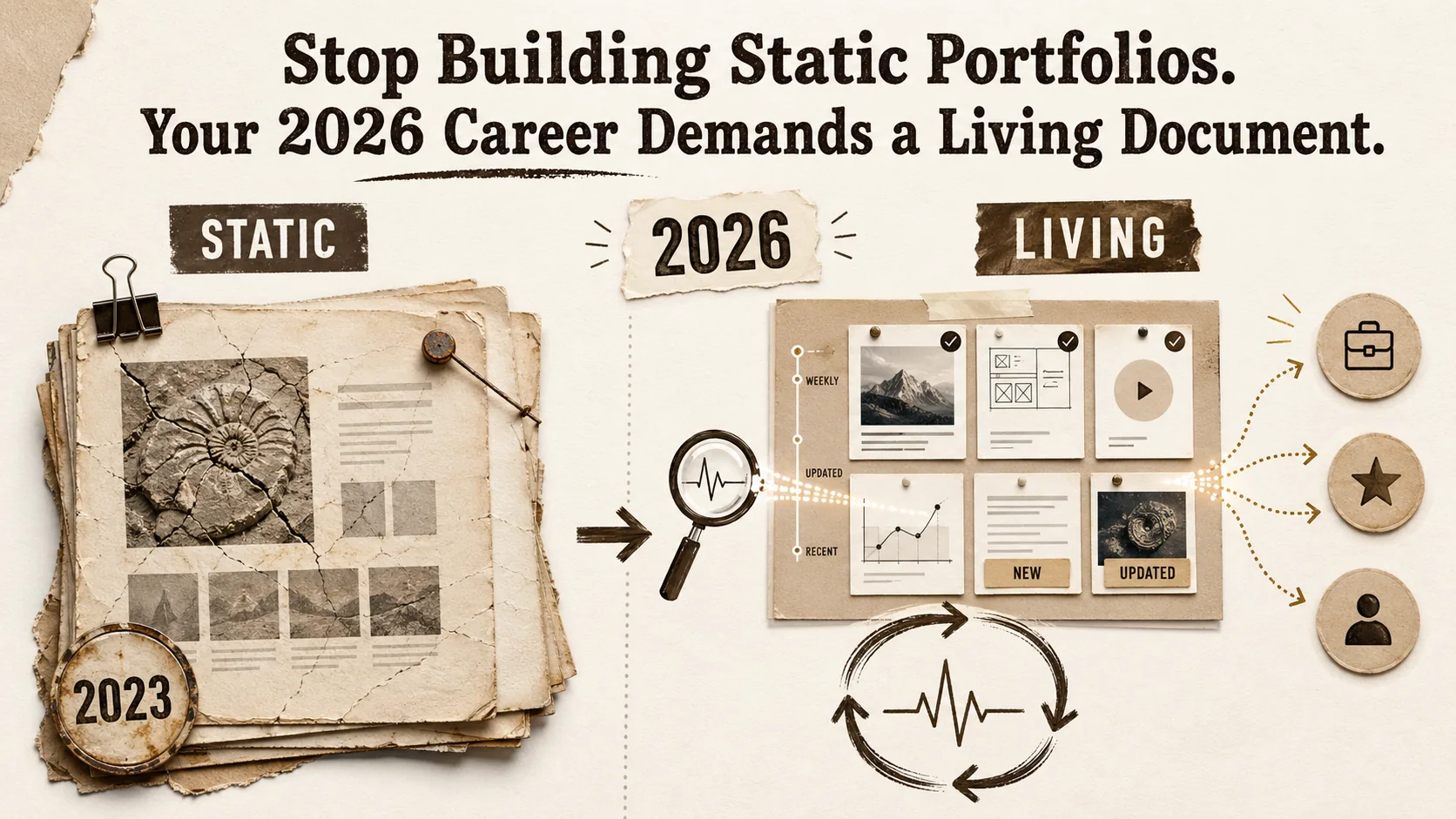
Last month, a client forwarded me an email from a recruiter. The subject line was polite, but the subtext was brutal: "Thanks for sharing your portfolio. It looks great, but the most recent project is from 2023. Are you still actively working in this space?"
The portfolio was technically perfect—clean design, case studies, the works. But it was a fossil. It told a story that ended three years ago, and in 2026, that’s a career-ending move. The recruiter’s algorithm, likely scanning for "recent activity" and "skill recency" signals, had already deprioritized it before a human even clicked the link.
This isn't an isolated incident. We’ve moved beyond the era where a portfolio was a trophy case—a static monument to past achievements you built once and forgot. The professional landscape, turbocharged by AI-driven recruitment and a hyper-competitive gig economy, now treats your online presence like a heartbeat. No pulse, no opportunity.
Your portfolio is no longer an artifact. It’s a process. A living document.
The Death of the "Set-It-and-Forget-It" Portfolio
Static portfolios are penalized by algorithms and recruiters alike -- "recent project activity" ranks in the top five non-resume signals used by ATS and LinkedIn ranking systems (Lighthouse Research & Advisory 2025), and the half-life of technical skills is now under 2.5 years (World Economic Forum 2025).
The traditional portfolio model is broken. It was built for a slower, more linear career path. You’d graduate, build a site showcasing your best student work, land a job, and maybe update it once every five years when you were looking again. The portfolio was a transaction tool, pulled out only during a job search.
That model is catastrophically outdated. Here’s why:
1. Algorithms Reward Freshness, Not Perfection. Platforms like LinkedIn, GitHub, and the Applicant Tracking Systems (ATS) used by 99% of Fortune 500 companies now incorporate temporal signals into their ranking algorithms. A 2025 report by Lighthouse Research & Advisory on AI in talent acquisition found that "recent project activity" and "continuous learning indicators" are among the top five non-resume signals used to score candidate profiles. A static portfolio, no matter how beautiful, sends a signal of dormancy. In the algorithm's eyes, dormant equals irrelevant.
2. Skills Have a Half-Life. The World Economic Forum’s "Future of Jobs Report 2025" estimates that the half-life of skills is now under 2.5 years for technical roles. The JavaScript framework you mastered in 2024 might be legacy code by 2026. A portfolio that doesn’t reflect your current, evolving toolkit doesn’t just look old—it implicitly questions your relevance. It shows you were capable, not that you are capable.
3. Trust is Built on Consistency, Not Peaks. Think about the creators or professionals you follow. You trust them not because of one viral piece of content from years ago, but because of their consistent, ongoing output. The same principle applies to your professional brand. A living portfolio demonstrates an active, engaged professional. It shows you’re in the arena, not watching from the stands. This builds a narrative of growth and reliability that a single, polished snapshot never can.
In my seven years advising on personal branding, I’ve seen a direct correlation between update frequency and inbound opportunity flow. The professionals who treat their portfolio like a blog—a channel for their professional journey—consistently attract more recruiter touches, speaking gigs, and client leads. They’re not just looking for opportunities; they’re magnetizing them.
What is a "Living Document" Portfolio? (It’s Not a Blog)
A living portfolio has three traits: dynamic content that changes without a full redesign (a "Recent Work" carousel, updated skills cloud), process visibility showing works-in-progress and lessons learned, and an integrated timeline that makes career evolution scannable at a glance.
Let’s be clear: A living document portfolio isn’t about turning your professional site into a daily diary. That’s unsustainable and misses the point. It’s about strategic, low-friction updates that signal active growth and current focus.
A living portfolio has three core characteristics:
- Dynamic Content: It features elements that change without a full redesign. Think: a "Recent Work" carousel, a "Latest Learning" note, an updated skills cloud, or a "Current Focus" statement.
- Process Visibility: It doesn’t just show finished products. It occasionally shares works-in-progress, lessons from a failed experiment, or a quick breakdown of a new tool you’re testing. This humanizes your brand and showcases problem-solving in real-time.
- Integrated Timeline: Your career narrative is visual and chronological, making it easy for visitors to see your evolution at a glance.
Contrast this with the static portfolio: a perfectly curated, frozen-in-time gallery that only changes during periods of career panic. The living portfolio is a breathing extension of your professional self.
The Continuous Portfolio Update Framework: A 30-Minute/Month System
The system takes 30 minutes per month in three steps: a 5-minute monthly triage to identify one update-worthy item, a 15-minute "atomic update" adding a single content unit (a GitHub commit link, a Behance project addition, or a case study bullet), and a 10-minute signal refresh updating meta-dates and bio text.
The biggest barrier to a living portfolio is the perceived time cost. The old model required a 20-hour weekend overhaul. That’s why it never happened. The new model is built on micro-updates.
Here’s a practical, sustainable framework I’ve tested with hundreds of developers, designers, and content creators. It requires about 30 minutes of scheduled time once a month.
Step 1: The Monthly Triage (5 mins) At the end of each month, block 5 minutes. Scan your recent activity:
- Did you ship a feature, even a small one?
- Did you write a piece of internal documentation or a helpful Slack explanation that could be abstracted?
- Did you complete a course module or read a book that shifted your thinking?
- Did you give or receive feedback that led to a tangible improvement?
Jot down one or two tangible items. The goal isn’t to document everything, but to capture one piece of evidence that you’re actively growing.
Step 2: The Atomic Update (15 mins) Take your chosen item and create an "atomic update" for your portfolio. This is a single, small unit of content. Examples:
- For a Developer: Add a new bullet point to your "Projects" section for a minor feature launch. Write two sentences on the technical challenge and solution. Link to the commit or pull request.
- For a Designer: Add a single new image to a project case study showing an iteration based on user feedback. Write a 50-word caption on what you learned.
- For a Content Creator: Add a new link in your "Latest" section pointing to your most recent article, video, or podcast appearance. Write a one-sentence takeaway.
The key is to use a platform that makes this trivial. If updating your portfolio feels like deploying a production application, you’ll never do it. The tool should get out of your way. (This is where a builder focused on ease-of-update, like Popout, shifts from a nice-to-have to a critical career tool. The ability to drag, drop, and edit in seconds is what makes this system possible).
Step 3: The Signal Refresh (10 mins) Finally, update the meta-signals. These are the small pieces of data that algorithms and quick-scanning humans look for:
- Update the copyright year in your footer (it sounds trivial, but it’s a powerful visual cue).
- Refresh the "Last Updated" date if your platform has one.
- Skim your bio/"About Me" text. Does one sentence feel stale? Change it. Swap out "I’m passionate about responsive design" for "I’m currently exploring the accessibility implications of the new CSS viewport units."
That’s it. 30 minutes. You’ve now sent a powerful signal to both machines and humans: I am active. I am current. I am growing.
The 2026 Recruiter’s Playbook: What They’re Really Scanning For
Recruiters spend under 90 seconds on initial portfolio scans, pattern-matching for green flags (recent activity, active GitHub/Dribbble/LinkedIn profiles, learning notes, current project timestamps) and red flags (dated frameworks, broken links, no timestamps anywhere).
To understand why this works, you need to see your portfolio through the 2026 recruiter’s eyes. I spoke with Anya Volkov, a senior tech recruiter at a major cloud provider, about her process.
"Honestly, I spend less than 90 seconds on an initial portfolio scan," she told me. "I’m not doing a deep dive. I’m pattern-matching for green flags and red flags."
Her green flags now include:
- A "Recent Activity" section that’s updated within the last quarter.
- Links to active profiles (GitHub, Dribbble, Substack) that show consistent, recent contributions.
- Notes on learning—a short list of recent courses, conferences, or books.
- Project timestamps that are current. "A project from this month, even if it’s small, tells me more than a massive project from 2021."
Her red flags?
- "Designed in 2020" or any dated framework/tech mentioned as a "core skill" without newer context.
- Broken links or placeholder "lorem ipsum" text. (It screams neglect).
- No dates anywhere. "If I can’t tell when anything was done, I assume it’s all old."
Her most telling comment: "The candidates with portfolios that feel 'alive' are almost always the ones who are already successful and engaged in their field. It’s a virtuous cycle. We want to talk to them because they clearly love the work, not just the job."
Beyond the Job Hunt: The Living Portfolio as an Opportunity Engine
A living portfolio generates passive inbound opportunities -- speaking engagements, client work, and collaborations -- because event organizers, clients, and peers actively scout for professionals with current, relevant content rather than static archives.
Framing the living portfolio only as a job-search tool sells it short. That’s a reactive, defensive mindset. Its real power is proactive.
When your portfolio is a dynamic hub of your professional activity, it becomes an opportunity engine.
- Speaking Engagements: Event organizers scout for speakers with current, relevant expertise. A blog post from last month on your portfolio about a new AI API is a better pitch than a three-year-old case study.
- Client Work: Potential clients, especially in the freelance and consulting space, are risk-averse. They want proof you’re currently solving problems like theirs. A living portfolio reduces their perceived risk.
- Collaborations: Other professionals look for active peers to partner with. Your ongoing project log is an invitation to collaborate.
- The Feedback Loop: This is critical. A static portfolio is a black box. A living portfolio, especially when paired with simple analytics (which you can learn to leverage in our guide on The Portfolio Feedback Loop), creates a virtuous cycle. You can see what content visitors click on, what projects attract attention, and double down on what works. This turns your portfolio from a brochure into a learning tool for your own career strategy.
The Tools That Make It Possible (And the One Trap to Avoid)
You need a drag-and-drop portfolio builder for frictionless edits and active feeds on GitHub, LinkedIn, or Medium to link to -- but the biggest trap is over-engineering the platform instead of updating the content.
The right toolchain is non-negotiable. The goal is to minimize friction between having a professional thought and publishing it.
The Essentials:
- A Portfolio/Bio Link Builder: This is your home base. It must be dead-simple to edit. Look for drag-and-drop editors, one-click publishing, and mobile management. The complexity of a custom-coded site is the enemy of consistency. (This is the core problem Popout solves—turning portfolio updates from a coding task into an editing task).
- Activity Feeds to Link To: Your living portfolio should be a curated hub, not the source of all original content. Link aggressively to your active profiles: GitHub for code, LinkedIn for professional commentary, Medium/Substack for long-form writing, Dribbble or Behance for design work. Your portfolio synthesizes the signal from all these noise.
The One Major Trap: Over-Engineering. The greatest threat to a living portfolio is the developer or creator’s instinct to rebuild the platform instead of updating the content. I’ve seen countless professionals spend 40 hours migrating from React to Svelte, or redesigning their entire color scheme, while adding zero new substantive content about their skills.
Resist this. Your portfolio’s primary value is its content—your story and proof of work—not its underlying technology stack (unless you are specifically selling front-end dev skills). Choose a tool that is "good enough" and that you will actually use. Consistency on a simple platform beats perfection on a complex one you dread updating.
For a deep dive on choosing the right platform without getting lost in the options, our Ultimate Guide to Portfolio Builder Alternatives in 2026 breaks down the trade-offs.
Getting Started: Your First 24-Hour Living Portfolio Sprint
Three hours spread over a single day: Hour 1 to audit and define your most outdated element, Hour 2 to make one "quick win" update (add a "Current Focus" section), and Hour 3 to set up a recurring monthly calendar reminder for 30-minute maintenance.
Feeling overwhelmed? Don’t try to build the perfect system. Start with a sprint.
Hour 1: Audit & Define. Look at your current portfolio. Write down the answers:
- When was the last update? (Be honest).
- What is the one thing that feels most outdated?
- What is one thing you’ve done professionally in the last 30 days that you’re proud of?
Hour 2: The Quick Win. Using your current platform (or quickly creating a new Popout page), make one update. Add a new section called "Recently" or "Current Focus." Populate it with the one thing from question 3 above. Write 2-3 sentences. Add a link if relevant. Publish it.
Hour 3: Systematize. Open your calendar. Create a recurring 30-minute event for the last Friday of every month. Title it "Portfolio Pulse Check." Set the reminder. This is now a non-negotiable professional hygiene task, like updating your expenses or backing up your hard drive.
You now have a living portfolio. It’s not complete. It’s not perfect. But it’s alive. And in the professional ecosystem of 2026, that’s the only thing that matters.
The Contrarian Take: When a Static Portfolio Might Still Work
The only exception is the established authority -- a renowned architect or bestselling author -- whose reputation is so solidified that their portfolio serves as a historical archive, with "activity" evidenced by press and awards tracked elsewhere. For everyone else, the living document is non-negotiable.
Let’s add nuance. Is there ever a case for a static, "set-and-forget" portfolio? In my view, almost never. But there is one edge case: the established authority whose reputation is so solidified that their portfolio is a historical archive, not a business card.
Think of a renowned architect with a 40-year career, or a bestselling author. Their portfolio site serves as a canonical record of major works. Their "activity" is evidenced by press, awards, and new publications that are tracked elsewhere. For everyone else—from the mid-level developer to the freelance writer to the aspiring creative director—the living document is non-negotiable. The moment you need to prove your current value, a static portfolio works against you.
Conclusion: Your Portfolio is Your Professional Pulse
Your portfolio is a workshop, not a museum -- consistent, small updates signal active engagement, attract opportunities passively, and build a narrative of growth that static snapshots never can.
We’ve moved from the portfolio as a museum—a place for finished, curated masterpieces—to the portfolio as a workshop. A workshop is messy, active, and interesting. It’s where things are being made. It attracts collaborators, clients, and curiosity because it radiates energy and potential.
In 2026, your career trajectory will be less about the single, perfect leap and more about the constant, visible climb. Your living portfolio is the public ledger of that climb. It’s the proof of your professional pulse.
Stop building monuments. Start documenting the journey. The opportunities will follow the trail you’re actively blazing. If you’re worried your outdated content is already hurting you, check Is Your Portfolio’s Last Updated Date Costing You Job Offers? and Is Your Portfolio’s Digital Exhaust Scaring Away Recruiters?.
Ready to build a portfolio that works as hard as you do? Create Your Popout Page in minutes and make your first update today.
Frequently Asked Questions (FAQ)
Q: I’m not a content creator. I’m a backend developer with no visual projects. How do I create a "living" portfolio? A: Excellent question. A living portfolio isn’t about pretty pictures. For a backend dev, your updates are even more valuable because they’re technical. Your atomic updates could be: a link to a significant pull request you merged with a note on the architectural decision; a bullet point about optimizing an API response time; a short note on completing a certification like AWS Specialty or a security course. Focus on problems solved and technologies applied. Link to your GitHub, but curate the narrative on your portfolio.
Q: How often is "often enough" to update? Is monthly really necessary? A: Monthly is the sweet spot for sustainability and signal strength. Quarterly is the absolute minimum to avoid the "dormant" flag. Weekly is overkill for most and leads to burnout. The monthly rhythm aligns with how most professionals naturally complete work cycles (sprints, project milestones, etc.) and is frequent enough to show consistent engagement without becoming a burden.
Q: Won’t small, frequent updates make my portfolio look cluttered or less curated? A: This is a common fear, but it’s a matter of design and information architecture. A good living portfolio has a dedicated, structured space for recent activity (like a "Latest" feed or timeline) separate from your core, curated project highlights. You’re not diluting your best work; you’re complementing it with proof of ongoing relevance. The curated projects show your depth, and the living updates show your current velocity.
Q: What if I’m in a slow period between jobs or big projects? What do I update? A: This is when the living portfolio is most important! It shows you’re proactive, not passive. Updates here can focus on learning (a course you’re taking, a technical book you’re reading), contribution (an open-source issue you fixed, a community forum answer you wrote), or thinking (a short analysis of an industry trend, a reflection on a past project). It signals you are investing in your growth during the downtime, which is incredibly attractive to employers.
Q: I’m worried about showing unfinished work or "failure." Won’t that make me look bad? A: This requires judgment, but done right, it makes you look authentic and skilled. You don’t post half-baked code. You post a lesson. Frame it as a "Learning in Public" moment. For example: "Experimented with X tool to solve Y problem. The latency was too high for our use case, so we pivoted to Z. Key takeaway: Always benchmark for your specific data load." This showcases critical thinking, problem-solving, and humility—all highly sought-after soft skills. It turns a negative outcome into a positive demonstration of your professional process.
Q: How does a living portfolio integrate with my LinkedIn and other social profiles? A: Your living portfolio should be the primary hub, with your social profiles as spokes. Your portfolio is the curated, long-form narrative of your career. Your LinkedIn, Twitter, etc., are for daily interaction and sharing. Use your portfolio as the "link in bio" for your most important work. When you post on LinkedIn about an achievement, link to the deeper case study on your portfolio. This drives traffic, gives you analytics on what resonates, and centralizes your professional story. For more on building this hub, explore our Portfolio Hub for related strategies, and see how the Portfolio Second Screen Strategy turns clicks into conversations.
Other Doved Studio projects
Related tools from the same studio you might find useful:
- Ralphable: Generate structured Claude Code skills that iterate until pass/fail criteria are met.
- Glean: Turn scrolling time into a daily action plan. Capture, process, execute.
- Doved Studio: Studio indie derrière cette app et une dizaine d'autres outils.
Written by
popout
Content Team