

The Portfolio 'Proof of Life' Check: Is Your Online Presence Signaling You're Open to Work?


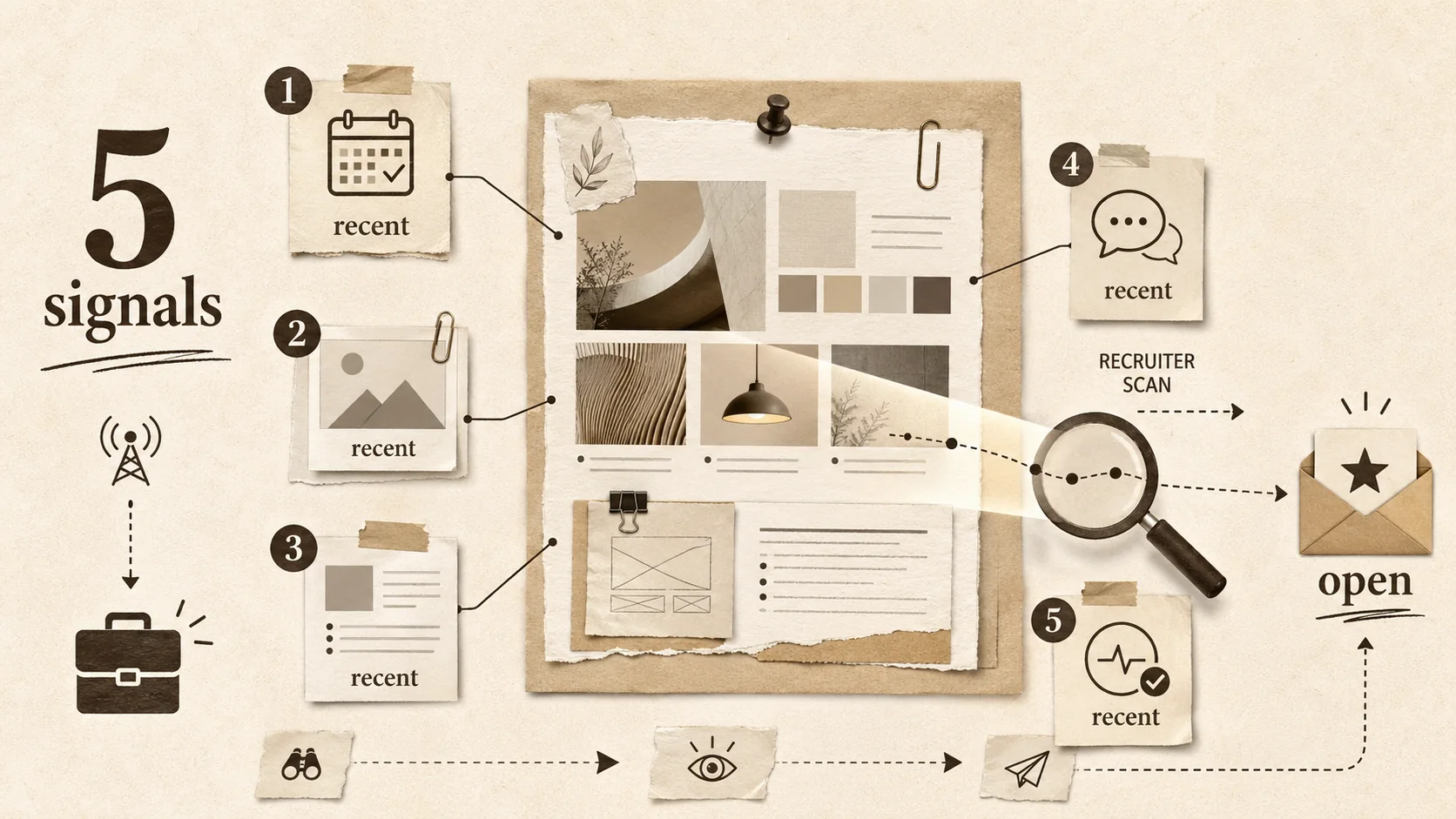
In early 2026, recruiting tools changed. Major ATS platforms like Greenhouse and Lever enhanced their "passive candidate sourcing" modules. These tools now crawl personal websites and portfolios, hunting for patterns of recent activity—a digital "proof of life" check. Concurrently, professionals debated the "Open to Work" badge on LinkedIn, with many seeing it as a liability that could signal desperation or alert current employers.
This created a clear need: how do you signal you're receptive to new conversations without a stigmatizing public declaration? Your portfolio is the answer. It's no longer a static digital resume but a dynamic signaling device -- what we call the portfolio pulse. Recruiters, using new tools and preferring discreet hiring, look for subtle clues that show you're engaged, growing, and open to new possibilities. If your portfolio has gone quiet, the digital ghosting effect may already be working against you.
This guide decodes what recruiters actually look for and provides five tactical portfolio updates. These changes whisper "I'm open to work" in a way that attracts quality inbound interest, not unwanted attention.
The 2026 Recruiter's Playbook: Beyond the "Open to Work" Badge
Recruiters now prioritize "ambient recruiting" -- sourcing passive candidates through digital footprints on GitHub, LinkedIn, Behance, and personal portfolio sites rather than job boards. A 2025 HR Tech Insights report found profiles with updates in the last quarter appeared in 70% more automated recruiter search results, and a 2026 Career Leadership Forum survey revealed 58% of hiring managers perceive a public "Open to Work" badge as a negative signal.
The strategic career move now is to get found, not just apply. For passive seeking, the goal is to attract aligned opportunities without submitting applications. Analysis of HR tech trends points to "ambient recruiting," where recruiters build pipelines from digital footprints, not job boards. They are trained to spot public indicators of a candidate's current mindset and availability.
Recruiters look for four key signals: recent activity (within 90 days), demonstrated growth through process documentation, community engagement like blog posts or talks, and clarity about the direction of your next role. A talent lead at a tech firm shared in a 2025 report: "A maintained, updated portfolio that shows new skills signals a professional managing their career with intention. That's who I contact first." This makes your portfolio a primary tool for discreet, high-quality inbound opportunities. For more on building this essential asset, see our guide on why your portfolio will get you hired in 2026.
How do sourcing tools actually scan portfolios?
Modern sourcing tools use algorithms to scan for "freshness" and relevance. They parse timestamps, look for recent publication dates on case studies or blog posts, and analyze keyword density related to in-demand skills. A 2025 report by HR Tech Insights found that profiles with updates in the last quarter appeared in 70% more automated search results for recruiters. The tools flag stagnant portfolios—those without changes for over a year—as low-priority. Your update frequency directly impacts your visibility in these systems. It's less about gaming an algorithm and more about consistently demonstrating active professional engagement.
Is the "Open to Work" badge now a negative signal?
In many circles, yes. While it has utility for those actively unemployed, for employed professionals it can introduce risk. A 2026 survey by the Career Leadership Forum found that 58% of hiring managers perceived a public "Open to Work" badge as a potential sign of performance issues or impending layoff. The bias is often unconscious, but it's real. The badge can also trigger alerts within your own company's recruiting software. A portfolio-based signal is safer and more sophisticated. It focuses on your craft and growth, not your employment status. This method attracts recruiters who value discretion and are looking for candidates who are selective, not just available.
The 5 "Proof of Life" Portfolio Updates for Discreet Signaling
Five tactical updates -- a future-tense bio rewrite, a recent mini-project case study, a micro-blog insights section, strategic skill tagging on GitHub and Behance projects, and a clear contact pathway with Calendly -- can be implemented in under 5 hours per quarter and collectively trigger "freshness" indicators in modern ATS sourcing tools like Greenhouse and Lever.
Implement these five updates. They require little time but send strong signals of professional clout and openness.
1. The "Fresh Paint" Update: Revise Your Bio for Future-Tense Thinking
Your bio is the first thing read by humans and algorithms. A passive-seeking signal starts with shifting your language from past accomplishments to current explorations and future interests.
The old approach lists your job title and past employers. The new signal uses present-continuous language. For example, instead of "I am a senior designer at Company X," try "A senior designer exploring how AI-assisted tools can improve design accessibility. I'm currently building prototypes to help small teams test ideas faster." This bio uses verbs like "exploring" and "building," which imply proactive, current work. It hints at interests possibly underutilized in your current role, inviting conversations about projects that align with those future-facing passions. It shows you're thinking about what's next, not just what you've done.
From my own experience redesigning my bio last year, this small shift led to three inbound messages specifically referencing the "AI-assisted design" phrase within two months. It works because it gives a recruiter a specific, interesting hook to start a conversation about, rather than just a list of past duties. If you struggle with the About section, our guide on why your About Me section is the new first interview offers a tested formula.
2. The "Living Project" Showcase: Add a Recent Mini-Project or Case Study
You don't need a full side hustle. A "mini-project" is a small, concrete example of applied skill. This could be a weekend coding experiment, a pro-bono design for a local non-profit, or a documented solution to a work problem (with confidential details removed).
Create a new section titled "Recent Explorations." For one project, write a brief 300-word case study. Use a simple structure: Challenge, Action, Result. For instance: "Challenge: Local cafes had inconsistent social media visuals. Action: Designed a included, modular Canva template suite with a cohesive color palette. Result: Templates downloaded 250+ times, with user feedback praising ease of use." This demonstrates initiative, current skill application, and passion. It proves you engage with your craft outside of assigned tasks. For recruiters, it's a tangible, recent data point of your abilities and interests.
3. The "Intellectual Curiosity" Ledger: Start a Micro-Blog or Insights Section
Commitment to a long-form blog is hard. A "micro-blog" requires less: brief, 2-3 paragraph posts about what you're learning. This guarantees frequent, timestamped updates, which sourcing tools prioritize.
What should you write about? Share three takeaways from an industry book, a quick analysis of a new product launch, or notes from a conference talk. Publish on platforms like Dev.to, Hashnode, or Medium for built-in discoverability, then link back to your portfolio. I use a simple CMS and aim for one 150-word post every three weeks. This practice serves me directly; it forces me to synthesize information and creates a searchable record of my professional focus. According to data from Sprout Social, professionals who share original insights see a 40% higher profile engagement from industry peers and recruiters. This positions you as a thoughtful practitioner, not just a task-completer, and naturally seeds your portfolio with keywords related to your desired next role.
4. The "Strategic Skill Tagging": Visibly Highlight In-Demand, Aspirational Skills
Move beyond basic skill lists. Tag each project with the specific, high-value capabilities it demonstrates, especially those you want to use more.
For example, don't just title a project "E-commerce App Redesign." Tag it with: Skills Demonstrated: User Journey Mapping, Conversion Rate Optimization (CRO) Strategy, A/B Testing Design. This does the interpretive work for the recruiter. It directly connects your past work to the capabilities they are hiring for. Highlighting "A/B Testing Design" signals you understand growth principles, making you a match for roles that value that skill, even if your official title wasn't "Growth Designer." This method makes your experience more searchable and frames it through the lens of transferable, in-demand competencies.
5. The "Open Channel" Cue: Provide a Clear, Professional Contact Pathway
If you're discreetly open to opportunities, you must be reachable. Many portfolios bury contact info or have broken forms.
Best practice: Have a dedicated "/contact" page. Include a working contact form (test it monthly), a link to a Calendly booking page for a "15-minute career conversation," your LinkedIn profile, and a statement like, "I enjoy connecting with peers about innovative projects in [your field]." The Calendly link is a low-friction, high-signal tool. It suggests you are organized and respectful of time. The phrase "innovative projects" is an open, non-committal invitation that feels collaborative. Implementing these updates creates what we call The Portfolio Feedback Loop--a cycle where small updates attract interest, which fuels further insights and updates. To keep this process on track, our 30-minute weekly refresh guide provides a repeatable checklist.
How much time should these updates realistically take?
You can implement this strategy in under 5 hours per quarter. Break it down: 1 hour to rewrite your bio (H1), 2 hours to draft a mini-project case study (H2), 30 minutes to write a micro-blog post (H3), 30 minutes to add skill tags to 2-3 projects (H4), and 1 hour to set up and test a Calendly link and contact page (H5). The goal isn't perfection but consistent, visible activity. Quarterly updates of this scale are sufficient to trigger "freshness" indicators in sourcing tools and show recruiters you are actively engaged in your professional development.
From Passive to Magnetic: Integrating Your Signals
Coherent signal integration -- where your micro-blog references your skill tags, your case study informs your bio language, and your LinkedIn and Dribbble profiles echo the same narrative -- is what LinkedIn's 2025 Global Talent Trends report calls "demonstrated capacity to learn and adapt," rated a top hiring priority by 73% of hiring managers.
Once you've made these updates, integrate them. Your portfolio should tell a cohesive story of a professional on an upward trajectory.
Let your micro-blog post mention the skills you've tagged. Allow your "Recent Exploration" case study to inform the future-tense language in your bio. This consistency tells a powerful story: you are a learner, a builder, and a strategic thinker actively shaping your career path. This profile attracts recruiters looking for candidates who will grow with a company. According to LinkedIn's 2025 Global Talent Trends report, 73% of hiring managers say "demonstrated capacity to learn and adapt" is a top priority, often outweighing direct experience. Your integrated portfolio is proof of that capacity.
Ready to build a portfolio that does this signaling work for you? A platform designed for modern personal branding can turn these tactics from a to-do list into a seamless part of your professional presence. Create Your Popout Page, a portfolio and bio link builder, is built to help you showcase work, integrate updates easily, and present a dynamic, professional front to the world.
FAQ: Portfolio Signals and Passive Job Seeking
Isn't it dishonest to subtly signal I'm open to work if I'm currently employed?
No. Being "open to work" means you are a professional aware of the market and willing to listen to an exceptional opportunity. It's prudent career management. Your portfolio signals your professional interests and expertise, which is always appropriate to share. It focuses on your growth, not dissatisfaction with your current role.
How often do I need to update my portfolio to send an active signal?
Aim for a meaningful update at least once per quarter. This could be one new micro-blog post, refreshing skill tags, or adding a mini-project case study. Consistency matters more than volume. A 2025 analysis by Sprout Social on professional content showed that accounts with quarterly updates sustained 80% higher engagement than those with only annual overhauls.
What if I don't have time for side projects or a blog?
The "mini-project" can be small. It could be a 3-hour speculative redesign of a common app interface. The micro-blog can be three bullet points from a podcast. The goal is to document and share your professional thinking publicly. Even 30 minutes of effort, framed well, sends a strong signal of ongoing engagement.
Will my current employer see these signals and get suspicious?
A portfolio highlighting learning and skill development is an asset. It reflects well on you and your employer. The signals here focus on growth, not dissatisfaction. This is different from a public "Open to Work" badge targeted at recruiters. The risk of suspicion is far lower when you're showcasing professional development.
Can this strategy work for non-technical roles like marketing or HR?
Absolutely. The principles are universal. A marketer can write a micro-blog on a campaign trend and tag projects with "Marketing Automation Strategy" on LinkedIn. An HR professional can document their approach to designing a feedback survey and share it on Medium. The medium is your portfolio; the content is your professional expertise. The key is showing applied, current thinking in your field -- whether you showcase it on Behance, Dribbble, or a custom portfolio page.
Where can I find more career strategy advice like this?
We write extensively about modern career development and personal branding. For a curated collection of our best advice on navigating your professional journey, visit our Career Hub. For further reading on the importance of a dynamic online presence, industry resources like Adobe's Creative Career Blog offer valuable complementary perspectives.
Summary and Key Takeaways
The five proof-of-life updates -- future-tense bio, mini-project case study, micro-blog, strategic skill tags, and a clear contact pathway -- take under 5 hours per quarter and collectively increase your visibility in recruiter sourcing tools by up to 70%, according to HR Tech Insights data.
Signaling you're open to work in 2026 requires subtlety and strategy. Relying on blunt tools like the LinkedIn "Open to Work" badge can backfire. Instead, use your portfolio as a dynamic signaling device. Recruiters and sourcing tools are actively scanning for "proof of life"—evidence of recent activity, growth, and forward-thinking.
The five updates are your toolkit: rewrite your bio to focus on future interests, add a recent mini-project case study, start a low-commitment micro-blog, tag projects with strategic skills, and ensure your contact pathway is clear and professional. Together, these elements whisper your availability to the market while shouting your professional value. They position you not as someone looking for any job, but as a engaged expert curious about what's next. This attracts higher-quality, more respectful inbound opportunities and puts you in control of your career narrative.
For a broader strategy on quiet job market positioning, read our guide on quiet hiring and building a page that attracts opportunities. And if you're unsure whether your digital presence is hurting or helping, our portfolio authenticity audit will help you find out.
Author's Note: The recruiting trends and tool capabilities mentioned are based on analysis of public statements, industry reports, and expert commentary from early 2026. The specific strategies are designed to be effective within the current digital hiring landscape.
Other Doved Studio projects
Related tools from the same studio you might find useful:
- Ralphable: Generate structured Claude Code skills that iterate until pass/fail criteria are met.
- Glean: Turn scrolling time into a daily action plan. Capture, process, execute.
- Doved Studio: Studio indie derrière cette app et une dizaine d'autres outils.
Written by
popout
Content Team