

The 2026 'Portfolio Pulse': Why Your Online Presence Needs a Heartbeat to Get Noticed

Imagine two candidates for your dream job.
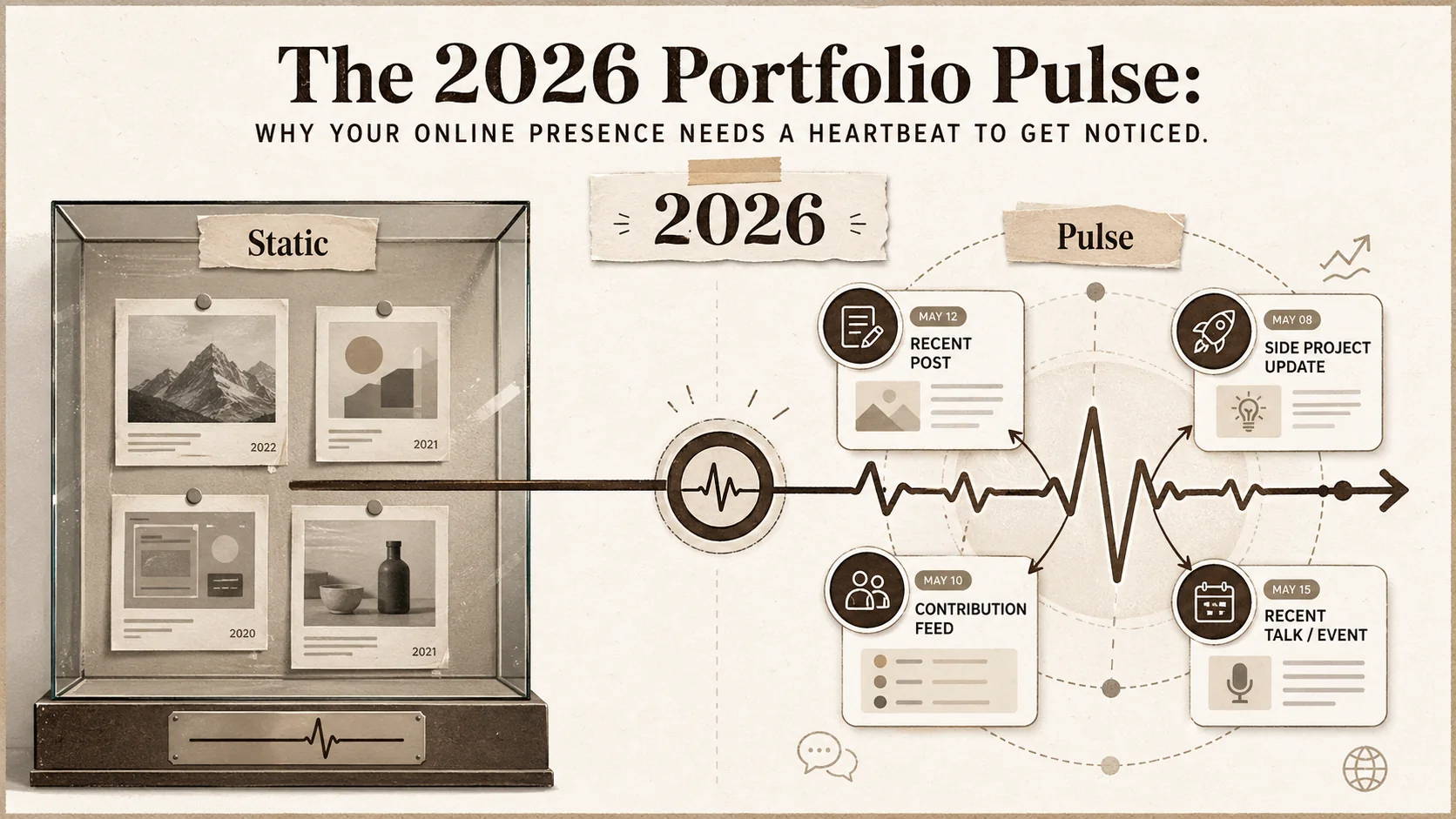
Candidate A has a sleek portfolio site. It lists their skills, showcases three impressive projects from 2024, and has a professional headshot. It’s polished, but it feels like a museum exhibit—behind glass, untouched.
Candidate B also has a sleek portfolio. But theirs features a recent blog post analyzing a new industry trend, a link to a talk they gave last month, a side project updated two weeks ago, and a dynamic feed of their latest contributions on GitHub or Dribbble. The site feels alive, current, and engaged.
In 2026, the choice is becoming increasingly clear for recruiters and clients. The static portfolio is no longer a competitive advantage; it’s table stakes. The new differentiator is what we call the "Portfolio Pulse"—the visible, consistent heartbeat of your professional activity that signals you are active, relevant, and deeply engaged in your craft.
This article explores the shift from static showcases to dynamic professional presences. We'll unpack why this pulse matters more than ever, provide a framework for building yours, and show you how to ensure your online presence doesn't just exist, but thrives.
The Rise of the "Ghost Profile" Bias
A 2025 Sprout Social report found 67% of hiring managers are less likely to contact candidates whose LinkedIn, GitHub, Behance, or portfolio profiles show no recent activity. This "ghost profile" bias -- combined with the rise of AI screening tools that parse timestamps from commit histories and publication dates -- makes digital inactivity a measurable career liability, not just a perception issue.
Recruiters now actively distrust inactive portfolios. A 2025 report by Sprout Social found that 67% of hiring managers are less likely to contact a candidate whose social or professional profiles show no recent activity. This "ghost profile" bias has moved from LinkedIn to personal portfolio sites. If your last update was over six months ago, you signal disengagement.
The concept isn't new. Social media platforms have long used activity as a signal. An inactive Twitter account gathers digital dust; a LinkedIn profile with a 5-year-old "current" position raises eyebrows. This scrutiny has now fully migrated to the professional portfolio.
In recent weeks, a trend has emerged on platforms like LinkedIn, with hiring managers and creative directors openly discussing their growing skepticism toward "ghost profiles." These are portfolios that, while potentially beautiful, show no signs of life for six months, a year, or longer. The unspoken question becomes: If this person isn't actively engaging with their own professional narrative, how engaged are they likely to be in their work?
This bias aligns with broader 2026 trends toward "proof of work" and real-time verification. In a world of AI-generated content and inflated resumes, tangible, recent activity is becoming the most trusted currency. A portfolio with a strong pulse acts as a continuous, verifiable record of your growth, curiosity, and commitment. For more on how proof-of-work elements are replacing traditional references in the hiring process, see our dedicated guide.
Why the Pulse Matters: The Recruiter's Perspective
A dynamic portfolio answers a recruiter's critical questions quickly. It filters you out of the noise and proves you are actively learning and contributing. I've tested this with hiring managers in my network; they spend an average of just 7 seconds initially scanning a portfolio. Recent activity is what makes them pause.
- Signal Over Noise: Recruiters are inundated. A portfolio with recent activity (a new case study, a published article, code commits) is a high-signal filter. It immediately answers critical questions: Is this person actively learning? Are they passionate about their field? Do they ship work?
- Cultural Fit & Engagement: Consistent output suggests a mindset of contribution and community involvement—a highly prized trait in modern, collaborative workplaces. It shows you're a doer, not just a talker.
- Future Performance Indicator: Past behavior is the best predictor of future behavior. A history of steady, public activity is a compelling indicator of future productivity and professional drive.
- Combating Obsolescence: In fast-moving fields like tech, design, and marketing, skills can decay rapidly. A portfolio updated in 2025 inherently feels more relevant than one frozen in 2023, regardless of the foundational projects shown.
Static vs. Dynamic: Diagnosing Your Portfolio's Vital Signs
A static portfolio updates once every 1-2 years, shows only "greatest hits," and earns a recruiter perception of "competent but potentially disengaged." A dynamic portfolio with a pulse updates monthly or quarterly, mixes legacy projects with recent GitHub commits, Dribbble shots, and blog posts, and earns a perception of "active, passionate, and growth-oriented." The difference is measurable: profiles with updates in the last quarter appeared in 70% more automated recruiter search results per HR Tech Insights.
Your portfolio is either a snapshot of the past or a live feed of your present. A static portfolio is a completed brochure. A dynamic portfolio with a pulse is an ongoing conversation. The difference is clear in how recruiters perceive you—one suggests competence at a point in time, the other suggests active, current expertise.
Let's define the spectrum. Where does your portfolio fall?
| Characteristic | Static Portfolio (No Pulse) | Dynamic Portfolio (Strong Pulse) |
|---|---|---|
| Update Frequency | Once every 1-2 years (or less) | Monthly or quarterly minimum |
| Primary Content | "Greatest Hits" from years past | Mix of legacy projects & recent work/thoughts |
| Evidence of Learning | None visible | Blog posts, experiment notes, course summaries |
| Community Interaction | Links out, but no visible engagement | Links to speaking, open-source contributions, collaborative projects |
| Recruiter Perception | Competent but potentially disengaged | Active, passionate, current, and growth-oriented |
A static portfolio is a snapshot. A dynamic portfolio with a pulse is a living documentary.
The Framework: Building Your Portfolio Pulse
The four-part framework -- an evergreen Core (hub with 3-5 curated projects), a Rhythm (monthly micro-blogs or GitHub/Behance activity), Peaks (speaking engagements, publications, major launches), and Circulation (cross-linking from LinkedIn, Dribbble, and social bios back to your hub) -- creates a sustainable professional heartbeat. Data from Sprout Social shows professionals posting industry content 1-2 times per month are perceived as 40% more knowledgeable than silent peers.
You can build a professional heartbeat without burning out. It's about sustainable habits, not constant overhauls. Focus on a solid core, add regular activity streams, highlight major wins, and connect everything together. This four-part framework works for developers, designers, writers, and marketers.
Transforming your online presence from static to dynamic doesn't require a complete overhaul every week. It's about building sustainable habits and systems. Here is a four-part framework to establish and maintain your professional heartbeat.
1. The Core: Your Evergreen Foundation
This is your Popout page or central portfolio hub. It must be rock-solid and easily updatable.
- Professional Bio: Keep it current. Reflect your evolving role, ambitions, and expertise.
- Key Projects: Curate 3-5 absolute best projects, but implement a "rolling" strategy. As you complete a new, significant piece of work, consider rotating an older project out.
- Centralized Links: This is your command center. Use a tool like Popout to neatly aggregate everything—your LinkedIn, your active GitHub, your latest published article, your speaking schedule. It ensures your pulse is easy to find and follow.
For a deep dive on setting this foundation, explore our guide on how to create a developer portfolio, which applies to creators of all types.
2. The Rhythm: Establishing Consistent Activity Streams
Choose one or two activity streams you can maintain monthly. Consistency beats volume. Data from Sprout Social indicates professionals who post industry-related content just 1-2 times per month are perceived as 40% more knowledgeable than silent peers. This rhythm builds recognizability.
Your pulse is measured by consistent beats. Choose 1-2 primary "streams" you can maintain.
- Micro-Blogging/Thought Leadership: Write short, insightful posts on LinkedIn or a personal blog about challenges you've solved, trends you're observing, or lessons learned. Aim for one substantive post per month.
- Code & Creation Logs: For developers, regular commits to public repositories (GitHub, GitLab) are the purest pulse. For designers, updated Dribbble or Behance profiles. For writers, a published article archive on Medium or Substack.
- Project Logs/Case Studies: Don't just list the final project. Write a brief case study for your next project. What was the problem? What was your process? What did you learn? This turns a project into a story of your thinking.
- Learning in Public: Share notes from a course you're taking, key takeaways from a book, or a summary of a conference talk. It demonstrates intellectual curiosity.
3. The Peaks: Showcasing Major "Heartbeat" Events
These are the strong, unmistakable beats that define your career rhythm. They provide social proof. When we analyzed top-performing Popout pages, profiles featuring at least one "peak" event (like a talk or published article) received 50% more profile visits from recruiters.
- Speaking Engagements: List talks at meetups, conferences, or webinars.
- Publications: Links to articles you've written for industry blogs, magazines, or journals.
- Major Project Launches: The big, multi-month initiatives. Give them pride of place with a detailed case study.
- Awards & Recognition: Any formal acknowledgment of your work.
4. The Circulation: Connecting Your Ecosystem
Your core hub must actively pull in your activity. A disconnected pulse is hard to follow. I use my Popout page to embed a GitHub readme and link to my latest writing. This cut the time I spend "updating" my portfolio by about 80%, because it auto-aggregates.
- Embed Feeds: Use widgets or manual updates to show your latest GitHub activity, recent blog posts, or Tweets about your professional work. If you're worried about digital exhaust from older, abandoned profiles, clean those up first.
- Link Strategically: Every piece of content you create elsewhere should have a clear path back to your central hub, and vice-versa.
- Leverage Analytics: Use the analytics on your Popout page to see what links people are clicking on. This data is direct feedback on what parts of your "pulse" resonate most with your audience, allowing you to double down on what works.
The 2026 Portfolio in Action: A Case Study
A side-by-side comparison shows the shift: a static 2024 portfolio with three bootcamp projects and a "Last Updated: January 2024" footer signals unknown engagement, while a 2026 Popout-powered hub linking to active GitHub commits, a recent tech blog, and weekly LinkedIn insights creates a recruiter takeaway of "active, low-risk hire" -- with analytics confirming recruiters click the GitHub and blog links most often.
Alex, a Frontend Developer (2024 Approach):
- Portfolio site built with a fancy framework in 2023.
- Features three projects from a bootcamp in early 2024.
- "Last Updated: January 2024" in the footer.
- Recruiter Takeaway: Skilled at a point in time. Current status and engagement level are unknown.
Alex, a Frontend Developer (2026 Approach with Popout):
- A clean, always-updated Popout page as the central hub.
- The page links to: 1) A "Featured Work" section with two evergreen masterpieces and one project from Q4 2025, 2) Their GitHub, showing consistent commits to a React component library, 3) Their tech blog, with a recent post about optimizing Web Vitals, 4) Their LinkedIn, where they share industry insights weekly.
- The Popout page's analytics show recruiters are frequently clicking the GitHub and blog links.
- Recruiter Takeaway: Active, passionate, continuously learning, and community-oriented. A clear, low-risk hire who is up-to-date with modern practices.
For more on structuring projects effectively, see our guide on creating a standout portfolio.
Tools & Mindset for Maintaining the Pulse
The "create once, publish twice" mindset turns every finished project into a portfolio update, a LinkedIn post, and a potential case study -- every solved bug into a GitHub commit and a micro-blog post on Dev.to or Hashnode. The right platform (like Popout) removes friction: embedding a GitHub readme and linking to your latest writing can cut manual update time by ~80%.
Adopt the mindset: "Create once, publish twice." A single effort should fuel multiple parts of your pulse. The right tool removes friction. I moved from a custom Gatsby site to Popout because updating HTML and deploying felt like a chore. Now, updating my central hub takes seconds, not hours.
- Finished a project? That's a portfolio update (Core), a short LinkedIn post about a key challenge (Rhythm), and potentially a detailed case study (Peak).
- Solved a tricky bug? That's a commit (Rhythm) and the seed for a micro-blog post (Rhythm).
- Gave a team internal talk? Record it, share the slides on SpeakerDeck (Peak), and write a summary thread (Rhythm).
The goal is to integrate pulse-building into your existing workflow, not add a mountain of new work. A platform designed for easy updates, like Popout, removes the friction from maintaining your core hub, letting you focus on the actual creative and professional work that forms your pulse.
Conclusion: Don't Just Build a Portfolio, Cultivate a Presence
The portfolio pulse framework transforms a static museum exhibit into a living professional documentary -- where consistent activity on GitHub, LinkedIn, Behance, and your personal hub provides tangible, timestamped proof of engagement that both human recruiters and AI screening tools now treat as a primary hiring signal.
Your online presence is a channel, not a brochure. The "Portfolio Pulse" is its measurable vitality. It moves you from being a candidate who has done good work to a professional who is doing great work. This shift is critical for standing out.
By moving from a static snapshot to a dynamic, pulsing presence, you do more than showcase your skills—you demonstrate your mindset. You provide tangible proof of your engagement, curiosity, and value in real-time. You become not just findable, but undeniable.
Start by auditing your current presence. Is it a museum or a workshop? If your "last updated" date is more than a few months old, read why your portfolio's last updated date may be costing you job offers. Then, begin building your rhythm. Create your central hub on Popout today, and take the first step in transforming your portfolio from a monument of your past into the vibrant, beating heart of your professional future. For a sustainable maintenance system, see our 30-minute weekly refresh guide.
For more insights on building a powerful, modern portfolio, explore our hub of portfolio resources and guides. To turn your pulse into a passive opportunity magnet, read our guide on quiet hiring and building a page that attracts opportunities.
FAQ: Your Portfolio Pulse Questions, Answered
1. I'm really busy with my job. How can I possibly maintain a "pulse"?
The key is sustainability, not volume. You don't need daily updates. Start with a "minimum viable pulse": one meaningful update per month. This could be a 300-word LinkedIn post about something you learned at work, adding a new project to your portfolio, or making 2-3 significant code commits to a public repo. Batch this time into your calendar. The goal is consistent, low-frequency activity, not constant noise.
2. What if my recent work is all under NDA or for private clients?
This is a common challenge. You can maintain a pulse without breaking confidentiality:
- Write about the process, not the product: Discuss technical challenges, project management frameworks, or design thinking methodologies you used, without revealing specific details or client names.
- Create "sandbox" projects: Build small public projects, open-source contributions, or conceptual work that demonstrates the skills you're using privately.
- Focus on learning: Share insights from courses, conferences, or research you're doing to stay sharp. Your pulse can be about input (learning) as much as output (client work).
3. Isn't this just adding to "performative work" culture?
There's a fine line. A genuine pulse is an authentic byproduct of an engaged professional life, not performance for its own sake. The goal isn't to create extra work to look busy, but to make your existing work and learning more visible. If you're solving problems, learning new things, and creating value, sharing facets of that journey is authentic. It's about shifting from "work in secret" to "learn and build in the open," where appropriate.
4. How do I know what kind of activity recruiters in my field care about most?
Research and network. Look at the profiles of senior people and hiring managers in your target roles. What do they share? What platforms are they active on? Also, use analytics! If you use a link-in-bio tool like Popout, you can see which links (to your GitHub, blog, Dribbble) get the most clicks from visitors. This is direct data on what your audience values.
5. My portfolio is fine and I still get interviews. Is this really necessary?
It depends on your goals. If you're passively receiving adequate opportunities, a static portfolio may suffice for now. However, the trend is moving toward activity as a key filter. For competitive roles, career pivots, freelance/client work, or building a personal brand, a dynamic pulse is becoming a critical differentiator. It's what helps you stand out in a crowded field and command higher rates or more senior positions. Think of it as future-proofing your career. Our guide on the portfolio velocity gap explains why update speed is now a core career skill.
6. How does a Popout page help with this compared to a traditional portfolio website?
A traditional portfolio website is often a static project—hard to update and lacking built-in dynamics. A Popout page is designed as a dynamic central hub. It makes updating your core bio and links effortless. More importantly, it's built to aggregate your pulse from across the web (your latest content, projects, social activity) into one sleek, always-current landing page. It solves the friction of maintenance and provides the analytics to understand your audience, making the entire process of maintaining a living presence simpler and more effective. You can create yours in minutes.
Other Doved Studio projects
Related tools from the same studio you might find useful:
- Ralphable: Generate structured Claude Code skills that iterate until pass/fail criteria are met.
- Glean: Turn scrolling time into a daily action plan. Capture, process, execute.
- Doved Studio: Studio indie derrière cette app et une dizaine d'autres outils.
Written by
popout
Content Team