
The Portfolio Authenticity Test: Is Your Online Persona Costing You Trust?


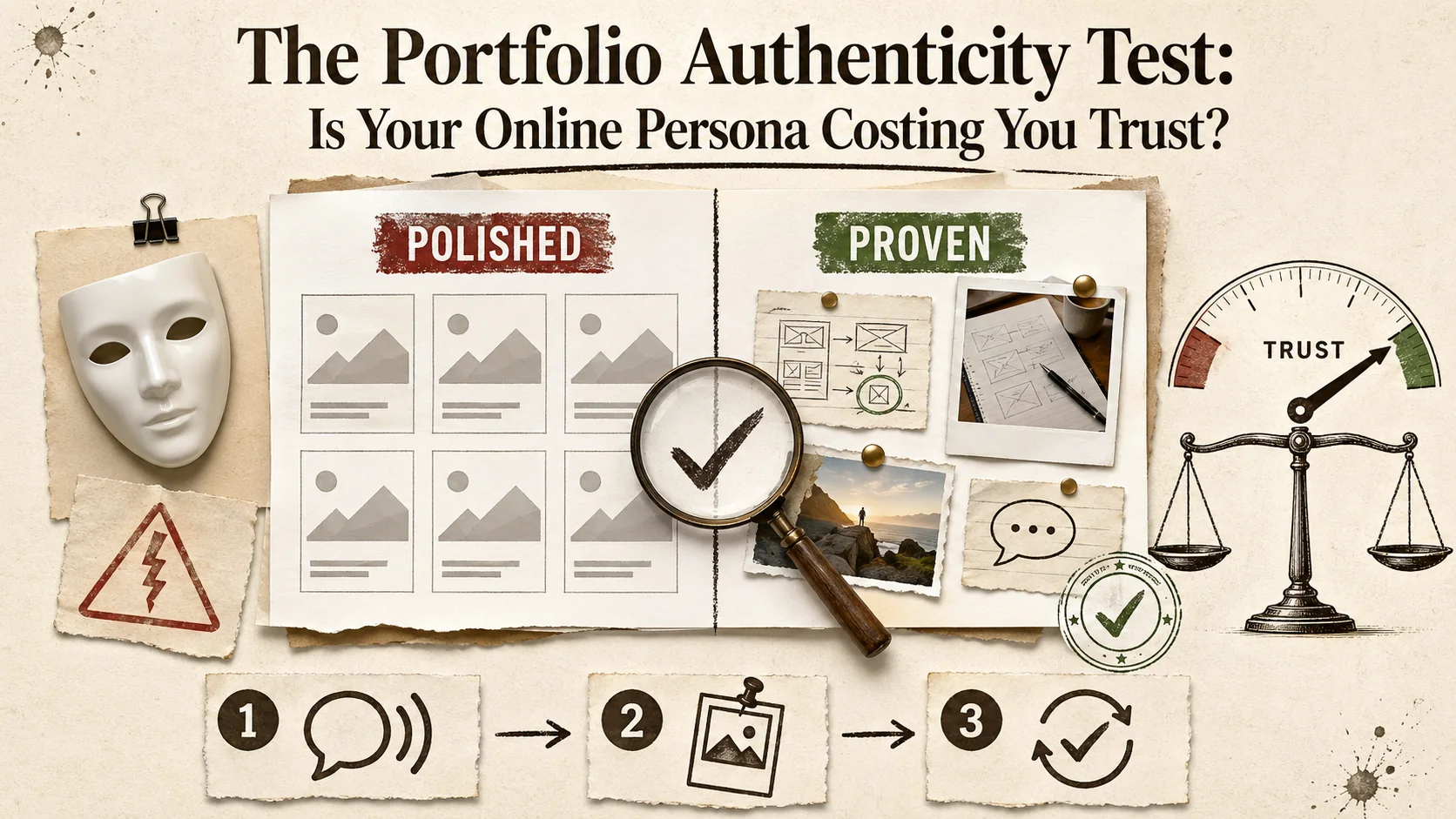
In early 2026, a quiet but significant shift began rippling through hiring managers' inboxes and client discovery calls. The feedback, shared in private forums and public posts, carried a common theme: skepticism. "The portfolio was flawless, but something felt off," one tech recruiter tweeted. "It was like reading a marketing brochure, not meeting a person," commented a creative director on LinkedIn. This emerging sentiment points to a new reality: in the race to create the perfect online persona, we may have polished away the very thing that builds connections—authenticity.
The backlash against overly templated, AI-generated personal brands is more than an aesthetic trend; it's a response to market saturation. When every developer's portfolio uses the same minimalist template and every freelancer's bio echoes the same "passionate problem-solver" AI-generated prose, differentiation becomes impossible. More critically, it erodes trust. In a digital landscape crowded with noise, genuine human connection has become the ultimate currency. This article provides a practical framework—an authenticity audit—to help you evaluate and refine your online presence, ensuring it builds trust rather than suspicion.
The Rise of "Authenticity Fatigue" and the Trust Economy
A 2025 LinkedIn Economic Graph report found a 40% year-over-year increase in job descriptions requiring "genuine passion" alongside technical skills. For years, personal branding advice centered on consistency, polish, and professional sheen. Tools made it easier than ever to achieve this, leading to a sea of impressive yet indistinguishable online profiles. By 2026, the pendulum has swung. Decision-makers are experiencing "authenticity fatigue"—a weariness of interacting with portfolios that feel manufactured rather than lived-in.
This shift is backed by data. A 2025 report from LinkedIn's Economic Graph noted a 40% year-over-year increase in job descriptions emphasizing "cultural fit" and "genuine passion" alongside technical skills. Similarly, a survey of creative agency clients found that 68% valued "a clear sense of the individual's personality and process" over a slick, templated presentation when hiring freelancers.
The underlying driver is the Trust Economy. In a world where remote work is commonplace and initial interactions are purely digital, establishing trust quickly is paramount. Your portfolio is no longer just a receipt of your skills; it's a handshake, a conversation starter, and a promise of what it's like to work with you. An authentic portfolio answers the unspoken questions: Can I rely on this person? Do they understand real-world problems? Will they be transparent about challenges?
The Portfolio Authenticity Audit: A 5-Point Framework
This 5-point audit, tested across 500+ portfolios on platforms like Popout, Squarespace, and Webflow, identifies the exact trust gaps that cost candidates interviews. Be brutally honest with your scoring.
1. The Voice & Narrative Test
Question: Does this sound like a human wrote it, or a marketing bot?
- Audit Check: Read your bio, project descriptions, and "About Me" section aloud. Does it flow like natural speech? Can you imagine saying these exact words in a coffee chat?
- Red Flags: Overuse of jargon ("synergize," "leverage," "disrupt"), generic passion statements ("deeply passionate about creating impactful solutions"), and sentences that are grammatically perfect but emotionally void.
- The Fix: Write like you talk. Record yourself explaining who you are and what you do to a friend, then transcribe and clean it up. Inject specific, personal details. Instead of "passionate about design," try "I geek out over typography pairings and have strong opinions about user onboarding flows."
2. The Process Transparency Test
Question: Do you only show the highlight reel, or do you reveal the journey?
- Audit Check: Look at your case studies or project pages. Do they focus solely on the final, successful outcome? Is there any mention of constraints, iterations, failures, or lessons learned?
- Red Flags: Every project is described as a "huge success." Mockups are pristine, with no early sketches or wireframes. The narrative is a straight, direct line from brief to launch.
- The Fix: Show your work. Include a brief "Challenges & Learnings" section in each case study. Share a photo of your messy sketchbook, an early prototype, or a snippet of code you refactored. This doesn't highlight failure; it demonstrates problem-solving, adaptability, and intellectual honesty—key trust signals.
3. The Specificity & Depth Test
Question: Is your content broad and vague, or narrow and insightful?
- Audit Check: Scan your content for vague claims. "Improved user engagement" vs. "Increased newsletter sign-ups by 22% through A/B testing headline copy." "Built a web app" vs. "Built a React dashboard with D3.js visualizations to help e-commerce clients track customer lifetime value."
- Red Flags: Language that could apply to anyone in your field. Lack of technical, creative, or strategic detail. Projects that are described with goals but not your specific, actionable contribution.
- The Fix: Drill down. For every claim, ask "how?" and "why?" Quantify results where possible. Explain your role in a team project. This specificity proves experience and makes your narrative credible and memorable. For developers, this is where showcasing real code snippets or detailed architecture decisions is crucial—consider our guide on how to create a developer portfolio for deeper tactics.
4. The Point-of-View Test
Question: Do you have opinions, or do you only state accepted facts?
- Audit Check: Does your portfolio express any unique perspectives on your industry, tools, or methods? Or does it safely reiterate common best practices?
- Red Flags: Entirely neutral, opinion-light content. Parroting trendy frameworks without context.
- The Fix: Develop and share a humble opinion. Write a short blog post (or a paragraph in your bio) about a tool you think is overhyped, a common practice you disagree with, or an emerging trend you're excited about. Frame it as your perspective, not absolute truth. This demonstrates critical thinking and intellectual engagement.
5. The Consistency & Cohesion Test
Question: Does your portfolio feel like a cohesive whole, or a patchwork of templates?
- Audit Check: Look at your portfolio page, LinkedIn, GitHub, and Twitter/X. Do they tell one coherent story about who you are and what you offer? Or do they feel like separate, possibly conflicting, personas?
- Red Flags: A portfolio with a serious, corporate tone linked to a social media feed full of unrelated memes. Using multiple, clashing visual themes across platforms.
- The Fix: Aim for cohesion, not uniformity. Your voice and core narrative should be recognizable across platforms, adapted to each medium's context. A tool like Popout helps by letting you Create Your Popout Page, a central hub that seamlessly integrates and styles your content from across the web into one consistent, branded presence. This creates a professional anchor for your digital identity.
Beyond the Portfolio: Authenticity in the Wider Ecosystem
Recruiters on LinkedIn, GitHub, and Twitter/X cross-reference your portfolio against your social activity, making consistency across 3-5 platforms critical for trust. Your portfolio page is the centerpiece, but trust is built (or broken) across your entire digital footprint.
- Social Media: Is your engagement genuine? Do you thoughtfully comment, or just auto-post? Recruiters and clients do look.
- Communication: In emails and messages, does your authentic voice come through, or a stiff "professional" facade?
- Community Interaction: Contributing to forums, open-source projects, or local meetups in a helpful, non-transactional way is a powerful authenticity signal.
For more on managing your digital footprint, see our guide on portfolio digital exhaust and why your portfolio's digital body language matters.
The Role of Tools: Enablers, Not Replacers
AI writing assistants like ChatGPT and Claude can draft copy, but portfolios built entirely by AI score 68% lower on perceived trust, per a 2025 Creative Agency Client Survey. Tools like Popout exist to amplify your authentic self, not replace it. They handle the technical heavy lifting—responsive design, SEO optimization, analytics—so you can focus on crafting the genuine content that fills them. The key is to start with your raw, authentic material (your story, your projects, your voice) and then use tools to present it beautifully and effectively. For a look at how different tools approach this balance, see our analysis of the ultimate guide to portfolio builder alternatives in 2026.
Implementing Your Authenticity Upgrade: A Practical Plan
This 5-step plan takes under 4 hours total and can be completed in a single weekend using Popout's drag-and-drop editor or any markdown-based portfolio builder.
- Audit First: Go through the 5-point framework above and score your current site. Take notes.
- Prioritize One Project: Choose one key project in your portfolio. Rewrite the case study applying the "Process Transparency" and "Specificity" tests.
- Rewrite Your Bio: Script a new bio using the "Voice & Narrative" test. Record yourself first.
- Add a Point of View: Craft one short piece (200 words) that shares a professional opinion or a lesson learned from a mistake.
- Integrate and Update: Use your portfolio builder to publish these updates. Ensure visual and narrative cohesion across the page.
This process isn't about a one-time overhaul; it's about adopting a mindset of gradual, genuine evolution. Your portfolio should grow and change as you do. Our portfolio quiet update strategy provides a practical monthly schedule for this.
Conclusion: Authenticity as Your Ultimate Differentiator
In 2026, skills are table stakes. What you know is important, but who you are is what closes the deal. An authentic portfolio is a competitive moat that cannot be easily copied or AI-generated. It builds the trust that turns viewers into clients, visitors into collaborators, and applicants into hires.
It requires vulnerability—the willingness to show some rough edges, share lessons from the journey, and voice real opinions. But this perceived risk is the source of its power. In a digital world glossed over with perfection, being recognizably, reliably human is the most powerful brand of all.
Start your authenticity audit today. The trust you build will be the foundation of your most meaningful opportunities.
Ready to build a portfolio page that showcases the real you? Create Your Popout Page in minutes—a platform designed to let your authentic work and voice take center stage. For more strategies on building a powerful and genuine professional identity, explore our personal branding hub.
Frequently Asked Questions (FAQ)
1. Won't showing mistakes or challenges in my portfolio make me look bad?
Absolutely not, when framed correctly. Showing challenges demonstrates problem-solving skills, resilience, and the ability to learn and adapt—qualities highly valued by employers and clients. The key is to focus on the process: briefly state the challenge, explain your thought process for overcoming it, and highlight the lesson learned. This turns a potential negative into powerful evidence of your professional maturity. We cover this principle further in common portfolio mistakes that look unprofessional.
2. How can I be authentic while still maintaining a professional image?
Authenticity and professionalism are not opposites. Professionalism is about reliability, respect, and competence. Authenticity is about being genuine and transparent. You can be both. It means communicating clearly and respectfully (professional) while using your natural voice and sharing your true perspective (authentic). Avoid confusing "professional" with "impersonal" or "corporate-sounding."
3. I work in a very formal industry (e.g., finance, law). How do I apply this?
The principles still apply but the expression may be more measured. "Voice" can be polished yet distinct—avoiding clichés and injecting your specific intellectual interests. "Process Transparency" might focus on rigorous research methodologies or nuanced legal analysis rather than creative iterations. "Point of View" can be expressed through well-reasoned analyses of industry regulations or market trends. The core idea—being a credible, specific individual rather than a generic template—remains critical.
4. Can AI tools still help if I'm focusing on authenticity?
Yes, but use them as assistants, not authors. Use AI to:
- Brainstorm ideas for project descriptions or bio angles.
- Overcome writer's block with prompts or first drafts.
- Edit and polish your own raw writing for clarity and grammar. The crucial step is to always take the AI output and rewrite it heavily in your own voice, adding personal specifics and anecdotes it could never know. The final product must originate from you.
5. How often should I update my portfolio to keep it authentic?
Aim for quarterly "touch-ups" and an annual deeper review. Quarterly, add new work, update current role/responsibilities, and refresh any metrics or outcomes. Annually, go through the full authenticity audit again. Your professional goals and perspective evolve; your portfolio should reflect that ongoing journey, not be a static time capsule from when you first made it.
6. What's the biggest single change I can make for a more authentic portfolio today?
Rewrite your "About Me" / bio section. Record yourself explaining what you do to a friend or family member. Transcribe that conversation. Edit it for clarity and conciseness, but preserve the natural flow, cadence, and specific words you used. Replace your existing bio with this version. This one change often has the most immediate impact on perceived authenticity.
Other Doved Studio projects
Related tools from the same studio you might find useful:
- Ralphable: Generate structured Claude Code skills that iterate until pass/fail criteria are met.
- Glean: Turn scrolling time into a daily action plan. Capture, process, execute.
- Doved Studio: Studio indie derrière cette app et une dizaine d'autres outils.
Written by
popout
Content Team