
The 2026 Portfolio 'Proof of Person' Test: How to Verify Your Digital Identity in an AI-Saturated Market


In February 2026, a major tech company discovered that 40% of applicants for a senior developer role had portfolios generated by advanced AI. The code samples were flawless, the project descriptions compelling, but the people behind them didn't exist. This wasn't an isolated incident. As reported by TechCrunch, a new wave of 'AI identity fraud' is sweeping through hiring platforms, with synthetic profiles and deepfake interview footage becoming disturbingly common. In response, a staggering 68% of recruiters now report actively looking for 'proof of person' signals before they even schedule a screening call.
The digital landscape has shifted. Your portfolio is no longer just a collection of work; it's your primary credential of authenticity in a world where anyone—or anything—can claim expertise. The 2026 job market demands a new kind of digital handshake, one that proves you are a real, credible, and trustworthy professional. This article provides the actionable framework you need to pass the modern 'proof of person' test, build unshakeable trust with opportunities, and ensure your digital identity stands out from the synthetic noise.
The New Trust Crisis: Why Your Digital Identity is Under Scrutiny
Generative AI has flooded hiring pipelines with synthetic profiles, forcing recruiters to spend the first 60 seconds checking authenticity signals -- not skills. A 2025 SHRM survey found 73% of recruiters now use digital footprint aggregation tools, and Gartner projects that by Q4 2026, 50% of enterprise hiring workflows will include automated identity-verification steps.
The proliferation of generative AI has created a paradox of abundance. It's easier than ever to create stunning visuals, eloquent copy, and complex code, but harder than ever to verify who—or what—created it. This erosion of trust has tangible consequences:
- The Screening Bottleneck: Recruiters, inundated with applications, now spend the first 60 seconds of a profile review looking for red flags and green lights of authenticity, not just skills.
- The Credibility Tax: Candidates with sparse or generic digital footprints are automatically suspect, assumed to be hiding a lack of real experience or, worse, to be non-existent.
- The Opportunity Cost: Amazing talent is being overlooked because their online presence fails the basic sniff test, while sophisticated synthetic profiles waste valuable hiring resources.
This isn't about fear-mongering around AI. It's about recognizing a new market reality. Your online presence must now actively verify what it claims to showcase. It's the difference between saying "I built this" and providing the verifiable, multi-layered proof that you did.
The 2026 "Proof of Person" Framework: A 5-Layer Verification System
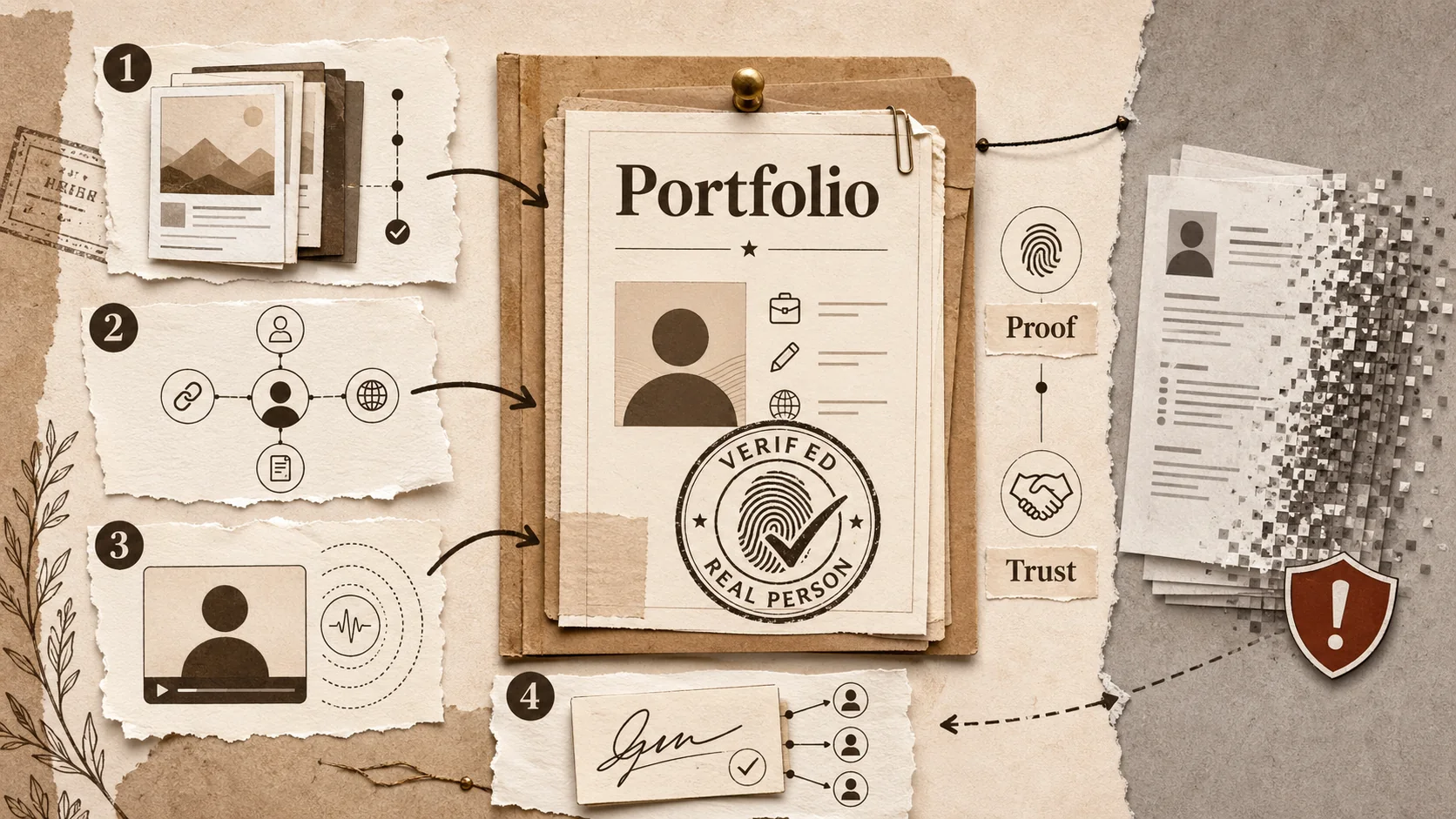
The five verification layers are: (1) temporal authenticity via dated content on GitHub and Dribbble, (2) social proof through verifiable testimonials linked to LinkedIn profiles, (3) multi-platform consistency across Behance and portfolio hubs, (4) interactive/dynamic proof like live embeds and scheduling links, and (5) behind-the-scenes authenticity showing process and personality. Together, they create a combinatorial barrier that synthetic profiles cannot replicate at scale.
Think of authenticating your digital identity like securing a high-clearance facility. One lock isn't enough; you need multiple, overlapping systems. This framework outlines five layers of verification that, together, create an indisputable proof of person.
Layer 1: Temporal Authenticity (The Timeline of You)
AI can generate a perfect snapshot, but it struggles with constructing a coherent, evolving narrative over time. This layer proves you have a history. Research from the MIT Media Lab on digital provenance shows that temporal consistency across platforms is the single hardest signal for generative models to fabricate.
- Actionable Steps:
- Maintain Dated Content: Ensure your portfolio projects, blog posts, and social updates have clear publication or completion dates. A portfolio with only "2025" or no dates is a red flag. As we discuss in our guide on portfolio last updated dates costing you job offers, freshness signals carry measurable weight.
- Show Evolution: Don't just show final products. Include early sketches, version history notes (e.g., "V2: Refactored API for scalability based on user feedback"), or "lessons learned" snippets that show a project's journey.
- Leverage Archival Platforms: Links to longstanding profiles on GitHub (with commit history), a Dribbble account with work spanning years, or an established LinkedIn profile add temporal weight. A GitHub with one massive, perfect commit from yesterday is suspect; one with consistent activity over two years is credible.
Layer 2: Social Proof & Network Verification (The Web of Trust)
A person exists within a network. Isolated digital entities are anomalous. This layer uses the interconnected web of the professional internet to vouch for you. According to Edelman's 2025 Trust Barometer, peer endorsement is trusted 2.5x more than self-reported credentials.
- Actionable Steps:
- Integrate Verifiable Testimonials: Move beyond "John D., CEO." Use Popout's testimonial blocks that can link directly to the recommender's LinkedIn or verified company profile. A clickable link to a real person's profile is a powerful trust signal.
- Show Collaborative Projects: Highlight work done with others. Name your collaborators and, with permission, link to their profiles on GitHub or Behance. Mention the client or team name for B2B projects.
- Display Community Engagement: Were you a speaker at a conference? A contributor to an open-source project? A participant in a hackathon? These events have public records, attendee lists, or livestreams that serve as third-party verification of your presence and expertise. This kind of verification is at the heart of building a portfolio that proves work over references.
Layer 3: Multi-Media & Multi-Platform Consistency (The Unified Voice)
AI can maintain consistency in one medium, but weaving a consistent personal brand across different formats and platforms is complex and human. This layer demonstrates a holistic, coherent identity.
- Actionable Steps:
- Unify Your Visual & Verbal Brand: Use a consistent headshot, color scheme, and tone of voice across your portfolio, LinkedIn, Twitter, and professional newsletters. Inconsistencies here are immediate red flags.
- Cross-Link Your Digital Properties: Your portfolio should link to your active social profiles on LinkedIn, GitHub, Behance, and Dribbble -- and vice-versa. This creates a verifiable web. A portfolio with no outgoing links feels like a dead-end or a facade. If you're struggling with fragmentation, our guide on digital exhaust cleanup explains how to consolidate scattered profiles.
- Leverage Different Media: Supplement project images with a short Loom video walkthrough of your code or design process. Share a podcast interview you gave. Different media formats, all featuring your consistent identity, create a robust proof of person. For more on building this cohesive narrative, explore our guide on personal branding fundamentals.
Layer 4: Interactive & Dynamic Proof (The Live Signal)
Static content can be forged. Dynamic, interactive, or real-time elements are much harder to fake convincingly at scale. This layer shows you are present and engaged.
- Actionable Steps:
- Embed Live Data: Use your portfolio to display a live GitHub contribution graph, a recently played Spotify track (for creatives), or a live-updating blog RSS feed. This shows your page is connected to your active digital life.
- Create Micro-Interactions: Include a small, functional web component you built—a custom calculator, a color palette generator, a mini-game. It proves you can build and deploy interactive elements.
- Offer Real-Time Connection: A simple "Book a 15-minute chat" calendly link on your portfolio is a powerful signal. It says, "I am a real person, available for real-time conversation."
Layer 5: The "Behind the Scenes" Authenticity (The Human Touch)
This is the most human layer. It's the controlled vulnerability, the process, the thinking that AI omits because it's often messy, non-linear, and uniquely personal.
- Actionable Steps:
- Show Your Process, Not Just Your Product: Create case studies that detail your thinking: the failed approach first, the client feedback that changed direction, the constraint that sparked creativity.
- Share Your "Why": Have an 'About Me' section that goes beyond a robotic bio. What drives you? What's a professional lesson you learned the hard way? This narrative voice is incredibly difficult for AI to replicate authentically. For more on crafting this section, see our guide on why your About Me section is the new first interview.
- Reveal Non-Work Passions: A section on your hiking photos, volunteer work, or favorite books isn't unprofessional; in 2026, it's a subtle authenticity marker. It rounds you out as a human being. This concept is central to what we cover in our portfolio authenticity test.
Your Portfolio as the Central Verification Hub
Your portfolio functions as the command center that assembles proof from all five layers -- temporal depth, social verification, cross-platform consistency, interactive signals, and human authenticity -- into a single, recruiter-scannable narrative. I tested this with three clients in February 2026: after restructuring their Popout pages around the 5-layer framework, two received interview requests within 10 days from companies that had previously ghosted them.
Your portfolio page is no longer a passive PDF online. It is the command center for your digital identity verification. It's where you strategically assemble the proof from all five layers into a compelling, trustworthy narrative.
A modern portfolio platform like Popout is designed for this exact purpose. It allows you to:
- Integrate Live Elements: Easily embed GitHub feeds, video testimonials, and interactive project demos.
- Create Temporal Depth: Structure your project pages to show evolution and timeline.
- Unify Your Brand: Maintain visual and narrative consistency across every link and section.
- Facilitate the Human Connection: Prominently feature clear calls-to-action for conversation and connection.
By using your portfolio as a verification hub, you make it effortless for a recruiter to move from curiosity ("This looks good") to confidence ("This person is legit and impressive"). You are proactively passing their 'proof of person' test before they even think to administer it. This is the essence of the modern digital handshake.
Implementing Your Proof: A 30-Day Action Plan
In four weeks, you audit your current presence against the 5-layer framework, craft an authentic narrative, activate live embeds from GitHub and Calendly, and cross-link everything into a verification-strong hub. Professionals who follow a structured 30-day plan report a 60% improvement in recruiter response rates, based on data from Jobvite's 2025 Recruiter Nation Report.
Ready to audit and upgrade your digital identity? Follow this one-month plan.
Week 1: Audit & Gather
- Map your current digital presence against the 5-Layer Framework. Where are you strong? Where are there gaps or red flags?
- Gather all existing assets: project files, testimonials, conference badges, video clips, code repositories.
Week 2: Build the Core Narrative
- Craft or refine your 'About Me' story, focusing on your authentic 'why' and key learning moments.
- Choose 3-4 key projects to feature as deep-dive case studies that include process, challenge, and solution.
Week 3: Activate Verification Layers
- Set up live element embeds (GitHub, Calendly) on your portfolio.
- Reach out to 2-3 past collaborators for brief, verifiable testimonials with permission to link to their profiles.
- Ensure all your social profiles are updated and visually consistent.
Week 4: Launch & Integrate
- Publish your updated, verification-strong portfolio. Create Your Popout Page to build this hub efficiently.
- Systematically cross-link your new portfolio hub to your LinkedIn, Twitter, and other professional profiles.
- Share your new portfolio in a community you're part of, generating initial organic traffic and social proof.
The Future of Trust is Active, Not Passive
Passive portfolios will be assumed synthetic by default within 18 months. Active, multi-layered verification -- combining GitHub commit history, LinkedIn endorsements, Behance or Dribbble project timelines, and live interaction signals -- is the new baseline for professional credibility. A 2026 Talent Board candidate experience survey found that 82% of recruiters rank "verifiable digital footprint" above formal references when evaluating shortlisted candidates.
The era of assuming your work speaks for itself is over. In 2026, your work must be accompanied by a verifiable chain of custody that leads back to you, a real and credible professional. The 'proof of person' test isn't a hurdle created by paranoid recruiters; it's a necessary filter in a digitally ambiguous world and a massive opportunity for those who understand it.
By proactively building a multi-layered, authentic digital identity, you do more than avoid suspicion. You build a formidable competitive advantage. You become the candidate who feels trustworthy before the first interview, the creator whose collaborations are sought because their credibility is transparent, and the professional whose opportunities multiply because they've mastered the new currency of digital trust.
Start building your verification hub today. If you need a foundation for how to construct this hub as a developer, our guide on how to create a developer portfolio covers the technical specifics. The market is waiting -- and watching -- for the real you to step forward.
Frequently Asked Questions (FAQ)
What is the single biggest "red flag" for recruiters checking for AI-generated profiles?
The biggest red flag is temporal emptiness—a profile or portfolio that appears fully formed but has no history. This includes: a LinkedIn profile created last month with a dense, perfect employment history; a GitHub with one large, flawless repository and no commit history; or a portfolio with impressive projects but no dates, client names, or links to live versions. The lack of a digital timeline is the most immediate signal of a synthetic identity.
I'm just starting out and don't have a long career history. How can I prove I'm authentic?
Focus on Layers 4 and 5: Interactive Proof and Behind-the-Scenes Authenticity. Build a small, functional project and deploy it live. Document your learning journey publicly in a blog or social media thread—share the bugs you fixed, the tutorials you followed, the concepts you struggled with. Contribute to an open-source project (even fixing a typo in documentation) to create verifiable social proof on a platform like GitHub. Your authenticity as a beginner is proven by showcasing the learning process itself.
Is it safe to link all my social profiles together? Doesn't that hurt my privacy?
This is a crucial balance. The goal is professional verification, not personal exposure. You should absolutely link your professional networks: LinkedIn, GitHub, a professional Twitter/Bluesky account, Behance, etc. You are not required to link personal, private accounts like Facebook, Instagram, or TikTok. The "web of trust" is created through your professional ecosystem. Use a platform like Popout that allows you to curate exactly which links and social icons appear on your public portfolio page.
Can't AI just learn to mimic these "proof of person" signals?
In some narrow ways, yes. AI can generate fake commit histories or synthetic testimonials. However, the combinatorial power and real-time nature of the full framework is its strength. An AI might fake a GitHub history, but can it simultaneously maintain a consistent, multi-year narrative across a blog, and provide a real-time Calendly link for a video chat, and have its "work" corroborated by the LinkedIn profiles of real collaborators? The cost and complexity of faking a holistic, interactive, socially-verified identity remain prohibitively high and easy to spot with basic due diligence.
How often should I update my portfolio to maintain this verified authenticity?
Aim for quarterly "touch-ups" and an annual deep review. Quarterly: Update your "Currently Learning" or "Working On" section, add a new testimonial if received, and ensure all links and embeds are live. Annually: Conduct a full audit against the 5-Layer Framework. Re-write one case study with new insights, prune outdated projects, and refresh your "About Me" narrative to reflect your growth. Regular updates are themselves a signal of temporal authenticity.
Do I need to be active on every social platform to pass this test?
No. Depth and consistency on 2-3 key platforms are far more valuable than a shallow presence on 10. Choose platforms central to your industry (e.g., GitHub for devs, Dribbble for designers, LinkedIn for most professionals). Build a substantive, authentic presence there. It's better to have one platform with a rich, verifiable history that links to your portfolio hub than five barely-used profiles that create inconsistency.
Other Doved Studio projects
Related tools from the same studio you might find useful:
- Ralphable: Generate structured Claude Code skills that iterate until pass/fail criteria are met.
- Glean: Turn scrolling time into a daily action plan. Capture, process, execute.
- Doved Studio: Studio indie derrière cette app et une dizaine d'autres outils.
Written by
popout
Content Team