

7 Portfolio 'Proof of Work' Elements That Are Replacing Traditional References in 2026


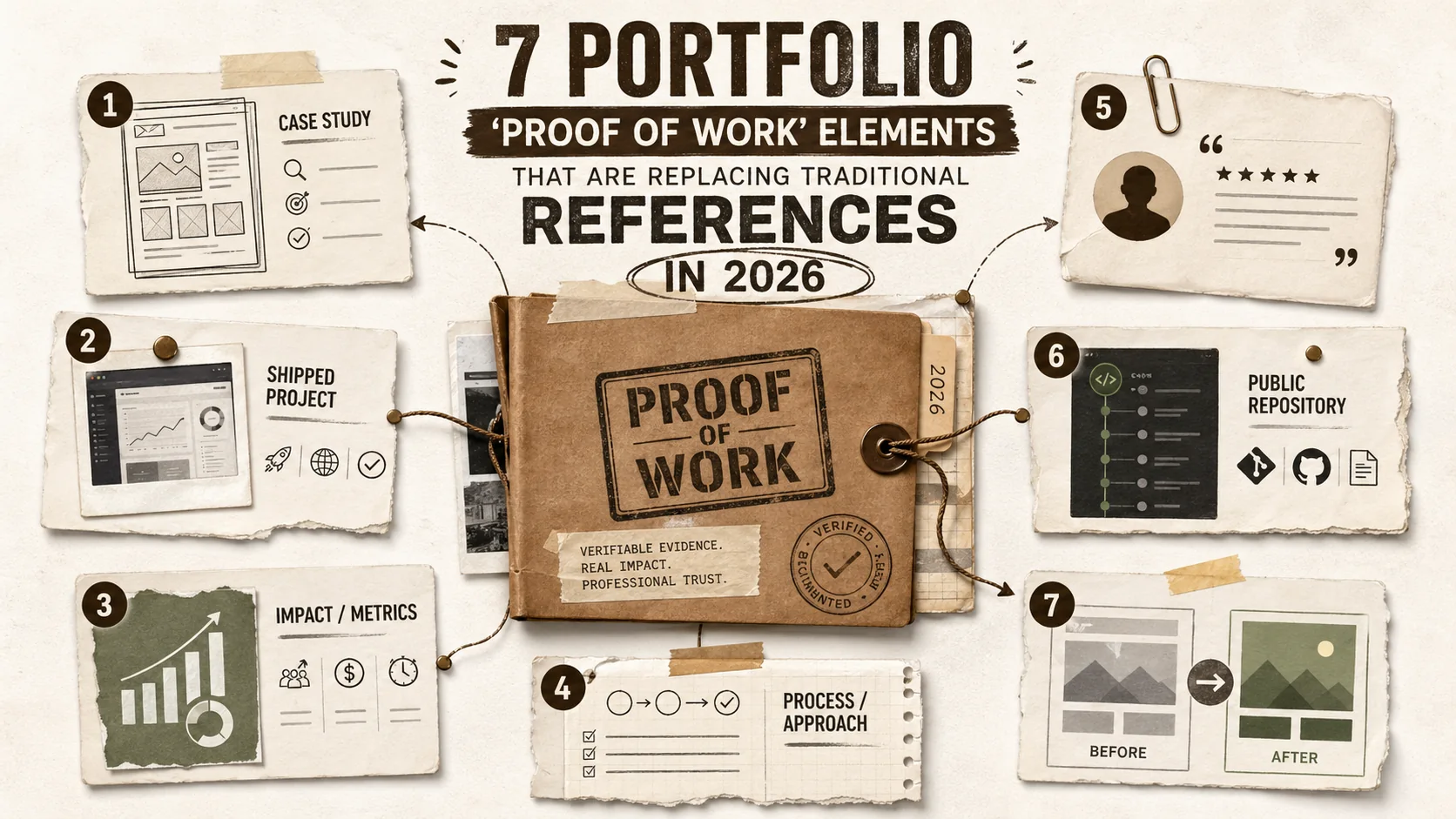
The phrase "references available upon request" is quietly becoming the "blockbuster video" of the modern job search—a quaint relic of a bygone era. In 2026, the hiring landscape has undergone a seismic shift. Fueled by a surge in remote work, project-based hiring, and a healthy dose of skepticism towards AI-polished resumes, recruiters and hiring managers are no longer satisfied with curated lists of past colleagues who will vouch for you. They want to see the work itself.
Recent reports from major hiring platforms like Greenhouse and Lever confirm a decisive move toward skills-based, "artifact-driven" recruitment. The message is clear: your word, and even the word of your references, is no longer enough. You need proof. Tangible, verifiable, and compelling proof of work that lives directly on your portfolio.
This evolution moves beyond simply showcasing a pretty final product. It's about demonstrating your process, your impact, and your unique problem-solving abilities. Your portfolio is no longer a digital brochure; it's your primary evidence file in the court of hiring. Here are the seven critical proof-of-work elements you must showcase to stay competitive.
1. Live Project Links & Deployed Applications
A deployed, functional URL is the strongest single proof element in a portfolio. It lets a recruiter interact with your work instantly -- assessing usability, performance, and attention to detail -- without relying on anyone's word.
A screenshot is a promise; a live link is proof. In an age where anyone can mock up a beautiful UI in Figma, the ability to ship functional, working software or a live website is the ultimate validator of technical and project completion skills.
What to Showcase:
- The Live URL: The most direct proof. Ensure it's hosted on a professional domain or a clean subdomain.
- Repository Links (For Developers): A link to the GitHub, GitLab, or Bitbucket repo. Make sure it's well-organized with a clear README. Stale repos create digital exhaust that can undermine the very proof you're trying to build.
- State of the Project: Is it a fully production-ready app, a prototype, or a conceptual demo? Label it clearly.
Why It Replaces References: A reference can say you're a good developer. A live app shows you can build, deploy, and maintain. It allows a recruiter to interact with your work instantly, assessing usability, performance, and attention to detail firsthand. For more on crafting a standout technical portfolio, explore our guide on how to create a developer portfolio.
2. Detailed Case Studies with Measurable Outcomes
A case study that includes the problem, your specific role, the solution, and hard numbers (e.g., "+30% engagement," "1.5s faster load time") proves business impact in a way a reference call never can. It answers the hiring manager's real question: can you connect your work to outcomes?
Moving from "what I built" to "why I built it and what happened next" is the hallmark of a professional portfolio. A case study transforms a project from a portfolio piece into a business asset. It answers the critical questions a hiring manager has: Can you solve real problems? Do you understand business context?
The Essential Framework:
- The Problem & Context: What challenge needed solving? What were the constraints (timeline, budget, tech)?
- Your Role & Process: What did you specifically do? Wireframes, user research, architecture decisions, code reviews.
- The Solution: Show the final product with clear visuals.
- The Results (The Proof): This is the most important part. Use data.
- "Increased user engagement by 30%."
- "Reduced page load time by 1.5 seconds, decreasing bounce rate."
- "Generated 250 qualified leads in the first month."
- "Improved code test coverage from 65% to 95%."
Why It Replaces References: A former manager can say you were a "valuable team member." A case study with hard numbers proves you drive measurable value. It demonstrates strategic thinking and the ability to connect your work to business goals—a skill references often fail to articulate.
3. Code Samples & Architecture Diagrams
Clean, well-commented code snippets and system design diagrams let a technical interviewer assess your coding style and architectural thinking before you ever speak. Share them via GitHub gists, GitLab snippets, or embedded directly in your portfolio.
For technical roles, especially in software engineering and DevOps, snippets of clean, well-commented code and system design diagrams are pure, unfiltered proof of competency. They cut through the buzzwords on your resume.
What to Include:
- Snippets of Complex Logic: Show how you solved a tricky algorithm, implemented an elegant function, or built a reusable component.
- Configuration Files: Clean Dockerfiles, CI/CD pipelines (GitHub Actions, GitLab CI), or infrastructure-as-code (Terraform) scripts show your operational skills.
- System Architecture Diagrams: Use tools like Mermaid, Excalidraw, or even a clean Figma file to visualize how different parts of a system you worked on connect. This proves you understand scale, data flow, and trade-offs.
// Example: A well-commented, reusable React hook for data fetching
import { useState, useEffect } from 'react';

/**
 * Custom hook for fetching data from an API with built-in loading and error states.
 * @param {string} url - The endpoint to fetch data from.
 * @returns {Object} - An object containing data, loading state, and error message.
 */
function useFetch(url) {
  const [data, setData] = useState(null);
  const [loading, setLoading] = useState(true);
  const [error, setError] = useState(null);

  useEffect(() => {
    const fetchData = async () => {
      try {
        const response = await fetch(url);
        if (!response.ok) throw new Error(`HTTP error! status: ${response.status}`);
        const result = await response.json();
        setData(result);
      } catch (err) {
        setError(err.message);
      } finally {
        setLoading(false);
      }
    };
    fetchData();
  }, [url]);

  return { data, loading, error };
}
Why It Replaces References: A reference check might confirm you know Python. A clean, efficient code sample proves you write maintainable, production-quality Python. It allows a technical interviewer to assess your coding style and problem-solving approach before you even speak.
4. Client or Stakeholder Testimonials with Context
A public testimonial with the recommender's full name, title, LinkedIn profile link, and specific project context is exponentially more credible than a private reference call. Place it directly on the relevant case study page for maximum impact.
While traditional references are private, a public testimonial is a powerful social proof element. The key difference is context. A generic "Great to work with!" is weak. A testimonial that speaks to a specific skill, project challenge, or outcome is compelling proof.
How to Frame Powerful Testimonials:
- Specificity is Key: "Sarah's UX research directly identified the checkout flow issue that was costing us 15% in abandoned carts."
- Attribution Matters: Full name, title, company (with permission), and a LinkedIn profile link add immense credibility.
- Project Association: Place the testimonial directly on the relevant project case study page for maximum impact.
Why It Replaces References: It takes the private, curated process of reference checking and makes a compelling piece of it public and verifiable. It shows you have advocates willing to put their praise on the record, attached to real work.
5. Process Artifacts: Wireframes, Sketches & Iterations
Showing early-stage work -- wireframes, user flows, mood boards, rejected concepts -- proves your creative process is deliberate, not accidental. Tools like Figma, Excalidraw, and Mermaid make it easy to include these visuals.
The journey is just as important as the destination. Showing your early-stage work—the messy whiteboard sketches, the low-fidelity wireframes, the rejected design concepts—demonstrates your creative and problem-solving process. It proves the final product wasn't an accident or a copied template.
Artifacts to Showcase:
- User Flow Diagrams: How should a user move through your app?
- Low-Fidelity Wireframes: The skeletal structure of your ideas.
- Mood Boards & Style Tiles: For designers, showing the visual exploration.
- A/B Test Results: For marketers and product folks, showing data-driven decision making.
Why It Replaces References: A reference can say you're "creative." Your early sketches prove how you think. It shows humility, iteration, and a user-centered approach—qualities that are difficult to convey in a traditional reference call.
6. Quantifiable Metrics & Performance Data
Hard numbers -- Google Lighthouse scores, Google Analytics traffic graphs, test coverage from Jest or SonarQube -- move your portfolio from subjective to objective. Numbers don't lie, and they provide impartial third-party validation.
If you can measure it, you can prove it. Attaching concrete metrics to your work moves it from subjective to objective. This is crucial for roles in marketing, product management, data analysis, and even engineering (site reliability, performance).
Types of Proof Metrics:
- Traffic & Engagement: Google Analytics screenshots (with personal data anonymized) showing growth.
- Business Impact: "Grew email list by 5,000 subscribers," "Contributed to a feature that increased MRR by $10k."
- Technical Performance: Lighthouse scores for web performance, accessibility, and SEO. Load time graphs.
- Code Quality: Test coverage reports, static analysis scores.
| Metric Category | Example Proof | Tool/Source |
|---|---|---|
| Web Performance | Lighthouse Score: Performance 95, Accessibility 100 | Google PageSpeed Insights |
| Business Growth | "Grew organic traffic 200% in 6 months" | Google Analytics, Search Console |
| Code Health | "Maintained 98% test coverage across repository" | Jest Coverage Report, SonarQube |
| User Impact | "Feature adoption led to a 25% reduction in support tickets" | Internal Analytics, Zendesk |
Why It Replaces References: Numbers don't lie. They provide an impartial, third-party validation of your impact that is far more convincing than a former colleague's subjective opinion.
7. Contributions to Open Source or Public Communities
Your GitHub contribution graph, accepted pull requests, Stack Overflow reputation, published articles, and conference talks form a continuous, verifiable public record that no reference call can match. It proves initiative, expertise, and collaboration on a global stage.
Active participation in open-source projects or professional communities (like writing technical blog posts, speaking at meetups, or providing helpful answers on Stack Overflow) is a powerful, public form of proof. It shows initiative, expertise, and collaboration skills on a global stage.
How to Showcase It:
- Link to Pull Requests (PRs): Show your accepted contributions to notable projects.
- Show Your Blog: Link to articles where you've shared knowledge or solved complex problems.
- List Speaking Engagements: Links to conference talks or meetup presentations on platforms like YouTube or Luma.
- Professional Network Profiles: A link to a robust Stack Overflow or GitHub profile can be as important as your LinkedIn. Designers should also link to Dribbble and Behance profiles.
Why It Replaces References: It's a reference check conducted in the open, over time. Your GitHub contribution graph or your published articles are a continuous, verifiable record of your skills, communication ability, and engagement with your field. You can't fake a years-long history of quality open-source contributions.
Building Your Proof-Packed Portfolio in 2026
You need a portfolio platform that supports rich case studies, embedded live projects, testimonial sections, and analytics -- not just a list of links. The shift toward artifact-driven recruitment means your portfolio is now your primary evidence file.
Assembling these elements requires a platform that can handle more than just a list of links. You need a portfolio builder that allows you to tell a rich, evidence-based story. This is where moving beyond basic link-in-bio tools becomes essential. You need a space to host detailed case studies, embed live projects, display testimonials, and organize your proof of work cohesively.
A modern portfolio platform like Popout is designed for this exact purpose. It allows you to create a stunning, SEO-optimized page that seamlessly integrates live links, project galleries, and text sections to build compelling case studies around each proof point. It turns your collection of work into a unified, professional narrative that stands up to the scrutiny of 2026's hiring managers. Create Your Popout Page today and start building your evidence-based portfolio.
The trend is undeniable. The future of hiring is transparent, verifiable, and skills-first. By proactively curating these seven proof-of-work elements, you're not just applying for jobs—you're building an undeniable case for your expertise. You're making it effortless for the right opportunity to find you, proof in hand.
For more insights on crafting a powerful online presence, dive into our ultimate guide to portfolio builder alternatives in 2026 and explore all our resources on portfolio development and career growth. You should also learn how to use the portfolio feedback loop to measure which proof elements resonate most with recruiters, and clean up any digital exhaust that might undermine your evidence.
Frequently Asked Questions (FAQ)
Q1: Isn't showing unfinished work or code snippets unprofessional? A: Quite the opposite. In the modern hiring context, showing process is a sign of professionalism and depth. It demonstrates your problem-solving journey, your ability to iterate, and your commitment to finding the best solution—not just the first one. It makes your final product more credible. Just ensure you present early-stage work clearly as part of your process narrative.
Q2: What if my work is under an NDA or for a private client? How can I show proof? A: This is a common challenge. The key is to obfuscate and generalize while still showing your skill.
- Create "sanitized" case studies: Use placeholder names ("Fortune 500 FinTech Client"), describe the problem generically, and use blurred or abstracted UI mockups.
- Focus on your process and role in detail, even if the specific product is hidden.
- Get written permission from your client/employer to discuss your role and the type of work in a portfolio context, even if the specifics are confidential.
Q3: I'm a junior professional with limited "big" projects. What can I use as proof of work? A: Your proof of work scales with your experience.
- Personal Projects: A full-stack app you built to solve your own problem is excellent proof. See our guide on the portfolio cold start problem for strategies on building an online presence from scratch.
- Coursework & Bootcamp Projects: Frame them seriously with full case studies.
- Open Source Contributions: Even small bug fixes or documentation improvements count.
- Detailed Analysis: Write a case study breaking down an existing app you admire (a "UX teardown" or "code review").
- Volunteer Work: Non-profit or community project work is valid professional experience.
Q4: How do I balance showing enough proof without overwhelming a recruiter? A: Curate and layer.
- Front Page: Show your 3-4 best, most diverse projects with a hero image, a one-line outcome, and a link to the full case study.
- Case Study Page: This is where you go deep with all your proof—metrics, process, code, testimonials.
- Dedicated Sections: Have a separate "Open Source" or "Writing" page for those types of contributions.
- The goal is to provide a clear "entry point" with the option to dive into overwhelming proof for the deeply interested hiring manager.
Q5: Are traditional references completely useless now? A: Not useless, but their role has diminished and changed. They are often now a final verification step—checking for major red flags or confirming employment dates—rather than the primary source of truth about your abilities. Your portfolio's proof of work is now expected to do the heavy lifting of demonstrating your skills. References have become a secondary, bureaucratic checkpoint.
Q6: How important is the design and UX of my portfolio page itself? A: Critically important. Your portfolio is your first product that a hiring manager experiences. If it's slow, confusing, poorly designed, or not mobile-responsive, it actively undermines all the proof of work inside it. It's proof of your ability to create a good user experience. Using a professional tool like Popout ensures the container for your proof is as strong as the evidence itself.
Other Doved Studio projects
Related tools from the same studio you might find useful:
- Ralphable: Generate structured Claude Code skills that iterate until pass/fail criteria are met.
- Glean: Turn scrolling time into a daily action plan. Capture, process, execute.
- Doved Studio: Studio indie derrière cette app et une dizaine d'autres outils.
Written by
popout
Content Team