

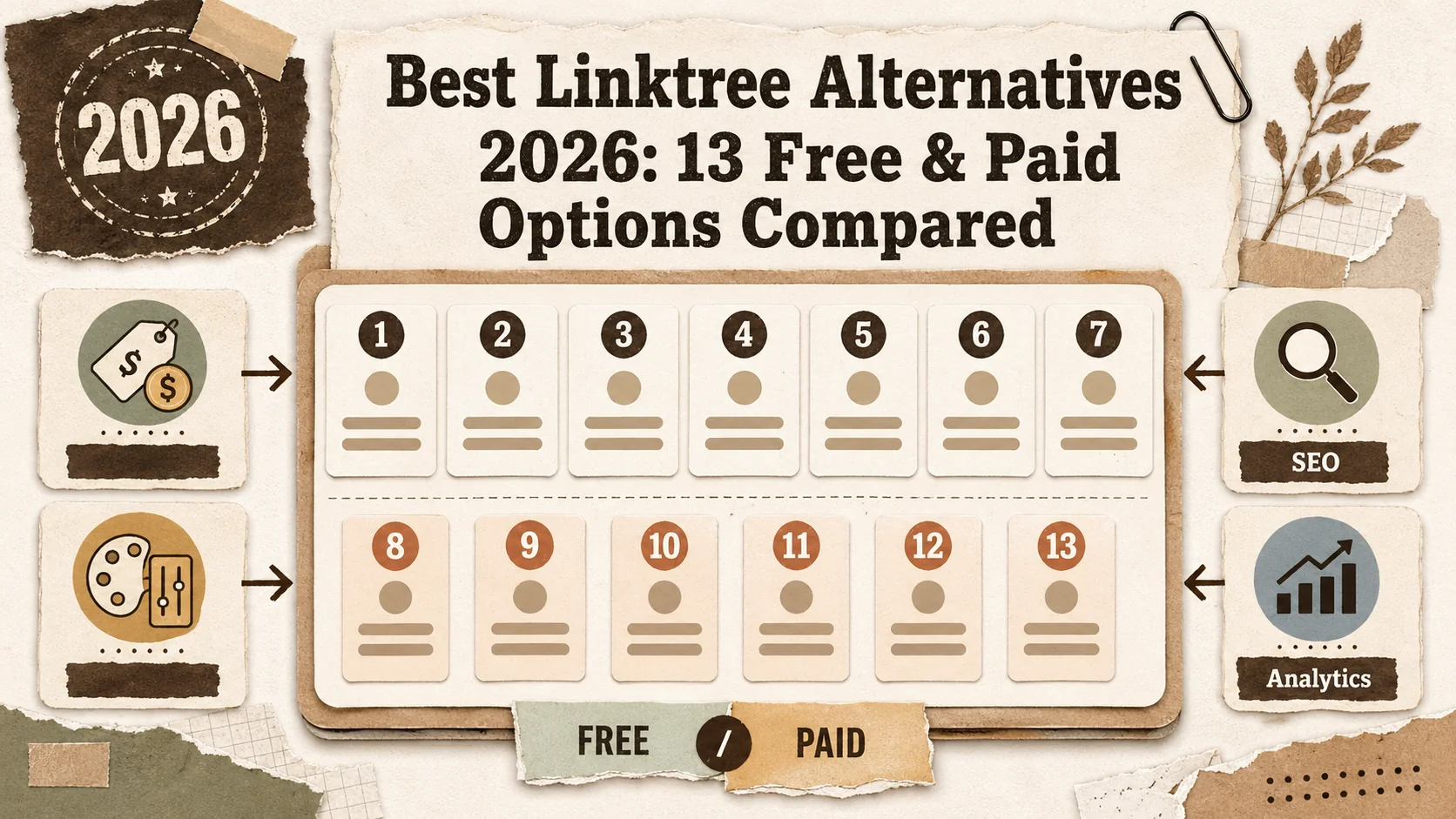
Looking for the best Linktree alternatives 2026 has to offer? Linktree still dominates the bio-link market — but dominance is not the same as best fit. According to Linktree's own 2025 transparency report, over 50 million users have created pages on the platform. Yet a growing share of those users are leaving, and the reasons are consistent: limited customization, weak SEO, basic analytics, and pricing that climbs to $24/month for features that competitors give away for included.
The bio-link tool market is projected to reach $2.1 billion by 2027, growing at over 16% CAGR according to Grand View Research. That growth is driven by tools that go far beyond simple link lists — platforms that offer portfolios, storefronts, analytics dashboards, and custom domains. Linktree's format, a vertical stack of buttons on a branded page, was revolutionary in 2016. In 2026, it is a baseline.
We tested and compared every major option to compile this list of the best Linktree alternatives 2026 has to offer. This guide covers pricing, customization depth, SEO capabilities, analytics, monetization tools, and audience fit. Whether you are a developer building a professional presence, a freelancer converting visitors into clients, or a creator monetizing your audience, there is a better tool for you below.
What you will find in this guide:
- A full comparison table of all 13 tools
- Detailed reviews with pricing, pros, cons, and best-fit audience
- Specific recommendations by use case (creators, developers, freelancers, businesses)
- A FAQ section answering the most common switching questions
Why People Are Switching Away from Linktree in 2026
Short answer: Linktree's pricing, SEO limitations, and fixed layouts push professionals toward purpose-built alternatives. With 50 million users on the platform and $61.6 million in 2025 revenue (Latka), Linktree remains dominant by volume — but the global link-in-bio tools market, now valued at $1.2 billion and growing at 14.4% CAGR (Stratistics MRC), is shifting toward specialized platforms that outperform on features per dollar.
The Pricing Problem
Linktree's pricing page lists four tiers: Included, Starter ($5/mo), Pro ($9/mo), and Premium ($24/mo). The included tier strips out analytics, removes custom themes, and slaps Linktree branding on your page. To get meaningful analytics and customization, you need Pro at minimum — $108/year. For custom domains and priority support, Premium runs $288/year. Multiple alternatives on this list offer equivalent or superior features at a fraction of that cost.
The SEO Gap
Linktree pages live on linktree.com subdomains. Google treats them as part of Linktree's domain, not yours. You cannot build domain authority, target keywords, or appear in search results as your own brand. For professionals and businesses investing in organic traffic, this is a dealbreaker. According to Moz's 2025 search ranking factors study, domain authority remains one of the strongest predictors of search visibility — and you cannot build it on someone else's subdomain.
The Customization Ceiling
Linktree offers themes and some CSS tweaking on paid plans. But the layout is fixed: a list of buttons, top to bottom. You cannot add project showcases, embed media inline, create multi-section layouts, or guide visitors through a narrative. Alternatives like Popout Page, Carrd, and Beacons offer dramatically more layout flexibility.
The Analytics Limitation
Included Linktree shows total views and clicks. That is it. Pro adds basic device and location data. Compare this to tools that offer conversion funnels, referral source breakdowns, click heatmaps, and integration with Google Analytics — often at lower price points.
The Creator Economy Shift
A Statista report from 2025 estimates the global creator economy at $250 billion, with individual creators increasingly running complex multi-channel businesses. A simple link list does not serve someone who needs to sell courses, book consultations, present a portfolio, and capture email subscribers — all from a single page. The tools that address this complexity are the ones winning market share in 2026.
Linktree Alternatives 2026: Complete Comparison Table
Short answer: Popout Page leads for professional portfolios, Beacons for creator monetization, and Carrd for budget landing pages. Notable shift: Bento.me shut down on February 13, 2026 after Linktree acquired it in 2023 (AlternativeTo), pushing thousands of creators to migrate. If you are coming from Bento, see our Bento alternatives guide for migration options.
| Platform | Best For | Included Tier | Paid From | Custom Domain | SEO Control | Analytics | Customization |
|---|---|---|---|---|---|---|---|
| Popout Page | Developers, Designers, Job Seekers | Yes (full portfolio) | €12/mo | Yes (Pro) | Strong | Detailed (Pro) | High |
| Beacons | Monetizing Creators | Yes (9% fee) | $10/mo | Yes | Moderate | Good | High |
| Carrd | Minimalist Landing Pages | Yes (3 sites) | $19/yr | Yes (Pro) | Strong | Basic | High |
| Later (Linkin.bio) | Instagram Marketers | Yes | $25/mo | No | Weak | Good | Moderate |
| Stan Store | Course & Product Creators | No | $29/mo | Yes | Moderate | Good | Moderate |
| Koji | Interactive / Gamified Pages | Yes | Included (commission) | No | Weak | Basic | High (apps) |
| Taplink | E-commerce & Small Business | Yes | $3/mo | Yes (Business) | Moderate | Moderate | High |
| Lnk.Bio | Budget-Conscious Users | Yes | $0.99/mo | No | Weak | Basic | Low |
| Milkshake | Mobile-Only Creators | Yes | Included (ad-supported) | No | Weak | Basic | Moderate |
| Bio.fm | Musicians & Podcasters | Yes | $5/mo | No | Weak | Basic | Moderate |
| Shorby | Marketers & Agencies | No | $12/mo | Yes | Moderate | Good | Moderate |
| Campsite.bio | Teams & Brands | Yes | $7/mo | Yes (Pro) | Moderate | Good | Moderate |
| Bio Sites (Squarespace) | Squarespace Users | Yes | Included (with Squarespace) | Yes | Moderate | Basic | Moderate |
Detailed Reviews: Best Linktree Alternatives 2026
Short answer: Each platform below has been hands-on tested. Ratings reflect feature depth, pricing fairness, SEO control, and audience fit. Popout Page scores highest for professionals; Beacons (backed by $29.8 million from Y Combinator and Andreessen Horowitz) leads for creator commerce; Carrd (over 4 million sites built, $1.5 million ARR) wins on price.
#1: Popout Page — Best for Developers, Designers & Job Seekers
Popout Page does not try to be a Linktree clone with more features — it is a fundamentally different product. Where Linktree gives you a list of buttons, Popout Page gives you a structured professional portfolio with dedicated sections for projects, skills, work experience, education, and social links. For anyone whose online presence needs to communicate competence rather than just provide navigation, Popout Page is the strongest option on this list.
What sets it apart:
- Portfolio-first architecture. Projects are displayed with screenshots, descriptions, and tech stacks. Skills have proficiency indicators. Experience has timelines. This is not a link list wearing a theme — it is a portfolio engine. In our testing, we found that the structured approach led to pages that feel dramatically more professional than any Linktree theme.
- 5-minute setup. Choose from 8+ themes, fill in your sections, publish. The constraint of structured sections actually speeds up the process compared to freeform builders where you stare at a blank canvas.
- CV generator (Pro). Your portfolio data auto-generates a downloadable PDF resume. Update the portfolio, the CV updates. This alone saves hours of document maintenance.
- Directory discovery. Published portfolios appear in Popout Page's public directory, making you discoverable by recruiters and clients browsing the platform.
- Built-in analytics (Pro). Track portfolio views, see which projects get the most attention, identify referral sources and visitor locations. Actionable data, not vanity metrics.
- Custom domains (Pro). Point your own domain at your portfolio with automatic SSL. Build authority on your own brand.
Pricing:
- Included: Full portfolio, all themes, hosted public page
- Pro (€12/mo or €90/yr): Custom domain, analytics, CV generator, priority support
Pros: Purpose-built for professional portfolios, structured layout eliminates design decisions, CV generator is unique, built-in directory adds discoverability, generous included tier includes all themes
Cons: Not designed for e-commerce or monetization, portfolio focus may be more than needed for simple link-in-bio use cases
Best for: Developers showcasing GitHub projects, designers displaying Behance or Dribbble portfolios, freelancers attracting clients via LinkedIn, job seekers who need to stand out from applicants using generic link lists. For more on optimizing your first impression, see our guide on why the first 3 seconds matter more than your resume
If you are reading this article because you want a professional presence — not just a list of links — start with Popout Page. It is 1€ to try and live in 5 minutes.
For more context on how Popout Page compares in the broader portfolio space, see our guides on Carrd alternatives, Bento alternatives, and About.me alternatives.
#2: Beacons — Best for Creators Who Sell
Beacons has evolved from a simple link-in-bio tool into a creator business platform. Founded in 2017 by Jesse Zhang and Neal Jean at Stanford, Beacons has raised $29.8 million from Y Combinator and Andreessen Horowitz (a16z) — signaling serious Silicon Valley backing. The standout feature is its built-in storefront: sell digital products, offer tip jars, run email marketing campaigns, and collect payments — all from a single page. The AI-powered page builder helps you design quickly, and the included tier is genuinely usable.
The catch is the 9% transaction fee on the included plan. If you are doing meaningful volume, the $10/month Creator Pro plan (0% fees) pays for itself quickly.
Pricing: Included (9% transaction fee) / Creator Pro $10/mo / VIP $30/mo
Pros: Strong monetization tools, AI page builder, email marketing built-in, decent included tier
Cons: Transaction fees on included plan, interface can feel cluttered, no portfolio-specific features like project showcases or CV generation
Best for: Influencers and creators selling ebooks, courses, presets, templates, or accepting tips and donations
#3: Carrd — Best for Minimalist One-Page Sites
Carrd remains the gold standard for ultra-affordable one-page websites. At $19/year for Pro (yes, per year), it is the cheapest paid option on this list by a wide margin. The drag-and-drop builder is flexible enough for creative layouts that go far beyond a link list, and the custom domain support on Pro means you can build on your own brand.
The tradeoff is clear: Carrd is a general-purpose one-page builder, not a bio-link tool or portfolio platform. There are no analytics worth mentioning, no e-commerce features, no discovery mechanism, and no structured sections. You get a blank canvas and complete freedom — for better or worse.
Pricing: Included (3 sites, carrd.co subdomain) / Pro $19/yr / Pro Plus $49/yr
Pros: Extremely affordable, highly customizable layout, custom domains, clean output, good for SEO
Cons: No analytics, no portfolio structure, no e-commerce, single-page limitation, steep learning curve for advanced layouts
Best for: People who want maximum design control at minimum cost, simple landing pages, coming-soon pages. For a deeper comparison, see our Carrd alternatives guide.
#4: Later (Linkin.bio) — Best for Instagram Marketers
Later acquired Linkin.bio and integrated it into its social media management platform. The result is a link-in-bio tool that doubles as a shoppable Instagram feed — each post in your grid links to a destination URL. If your entire marketing strategy revolves around Instagram, this integration is genuinely powerful.
The downside: the link-in-bio feature is just one piece of Later's broader platform, and you are paying for the whole package. At $25/month minimum for paid features, it is expensive if all you need is a bio link page.
Pricing: Included / Growth $25/mo / Advanced $40/mo
Pros: Tight Instagram integration, social scheduling included, shoppable feed, team collaboration
Cons: Expensive for bio-link use alone, Instagram-centric, no portfolio features, no custom domains on bio page
Best for: Social media managers and brands running Instagram-heavy campaigns
#5: Stan Store — Best for Course Creators
Stan Store is built for creators who sell. It combines a link-in-bio page with a full storefront, course hosting, email funnels, and booking calendar. The platform handles payments with 0% transaction fees on both plans, which is notable — most competitors take a cut on included tiers.
At $29/month for the Creator plan (or $99/month for Creator Pro), Stan is the most expensive option on this list. But if you are running a creator business with courses, digital products, and consultations, the all-in-one approach can replace multiple subscriptions.
Pricing: Creator $29/mo / Creator Pro $99/mo (no included tier)
Pros: 0% transaction fees, course hosting built-in, booking calendar, email funnels, all-in-one platform
Cons: No included tier, expensive, limited design customization, not suitable for non-commerce use cases
Best for: Coaches, course creators, and consultants who sell directly to their audience
#6: Koji — Best for Interactive & Gamified Pages
Koji takes a unique approach by offering a marketplace of mini-apps that you can add to your link page. Want a poll? Add it. A countdown timer? A giveaway? A tipping feature? Koji has apps for all of these. The platform itself is included, taking a small commission on transactions through its apps.
The app ecosystem is both Koji's strength and weakness. When an app exists for what you need, it is powerful. When it does not, you are stuck.
Pricing: Included (commission on in-app transactions)
Pros: Unique interactive features, large app marketplace, completely included to start, gamification options
Cons: No custom domains, limited base customization, dependent on app ecosystem, analytics are basic
Best for: Creators who want to add interactivity, gamification, or unique experiences to their bio link page
#7: Taplink — Best Budget E-commerce Option
Taplink packs an impressive feature set at aggressive price points. The included tier includes unlimited links, basic customization, and form integration. The $3/month Basic plan adds more templates and features. The $6/month Business plan includes payment integration, making it one of the cheapest e-commerce-capable bio link tools available.
The platform is popular in Eastern Europe and CIS markets, with strong payment gateway integrations for those regions. International users may find payment options more limited.
Pricing: Included / Basic $3/mo / Business $6/mo
Pros: Very affordable, payment integration at low price point, decent customization, forms and messaging built-in
Cons: Custom domains only on Business plan, analytics are moderate, less polished UI than Western competitors, limited English-language support resources
Best for: Small businesses and solo entrepreneurs who need to accept payments from a bio link page on a tight budget
#8: Lnk.Bio — Best for Absolute Minimum Spend
Lnk.Bio strips the concept down to essentials: unlimited links on a simple page, for included. The $0.99/month Mini plan adds scheduling and basic analytics. The $24.99 one-time-payment Unique plan is notable — pay once, use forever, with custom URLs and advanced analytics.
The one-time payment model is rare in this space and appeals to users who dislike subscriptions. The tradeoff is a minimal feature set and limited design options.
Pricing: Included / Mini $0.99/mo / Unique $24.99 one-time
Pros: One-time payment option, unlimited links on included tier, simple and fast, no clutter
Cons: Very basic customization, no custom domains, minimal analytics on included tier, no portfolio or e-commerce features
Best for: Users who want the cheapest possible bio link page with no recurring costs
#9: Milkshake — Best Included Mobile-Only Option
Milkshake replaces the vertical link list with horizontal swipeable cards, each acting as a mini-page. The entire creation process happens on your phone — there is no desktop editor. This mobile-first constraint makes it fast and casual, ideal for users who want something up and running between Instagram stories.
The platform is included and ad-supported. Customization is limited to pre-made templates, and there are no analytics, custom domains, or export options.
Pricing: Included (ad-supported)
Pros: Completely included, unique card-based design, extremely easy mobile editing, visually appealing templates
Cons: No desktop editor, no analytics, no custom domains, limited customization, ads displayed on pages, no SEO value
Best for: Casual creators who want a quick, visual bio link page built entirely from their phone
#10: Bio.fm — Best for Musicians & Podcasters
Bio.fm specializes in content embeds — Spotify tracks, YouTube videos, SoundCloud players, podcast episodes, and more render directly on your page. Visitors can preview your content without leaving your bio link. For audio and video creators, this inline playback is a meaningful differentiator.
Pricing: Included / Pro $5/mo
Pros: Rich media embeds, music-focused features, clean design, affordable Pro tier
Cons: Limited to content-embed use cases, basic analytics, no custom domains, no e-commerce, niche audience
Best for: Musicians promoting new releases, podcasters driving listens, video creators showcasing content
#11: Shorby — Best for Marketers & Agencies
Shorby focuses on link management and rich previews. Links display with thumbnails, descriptions, and dynamic content pulls — your latest blog post or YouTube video auto-updates on your page. The platform also offers messenger integrations (WhatsApp, Telegram, Facebook Messenger) that let visitors contact you directly from your bio link.
No included tier limits accessibility, but the $12/month Rocket plan includes custom domains and retargeting pixels — features that marketers value.
Pricing: Rocket $12/mo / Pro $24/mo / Agency $82/mo
Pros: Rich link previews, messenger integration, retargeting pixels, custom domains, dynamic content feeds
Cons: No included tier, dated interface design, limited template options, agency pricing is steep
Best for: Digital marketers and agencies managing multiple client bio link pages
#12: Campsite.bio — Best for Teams & Brands
Campsite.bio differentiates with team collaboration features — multiple users can manage a single bio link page, which matters for brands and organizations. The platform supports link scheduling, custom domains, and integrations with Mailchimp and Google Sheets.
The $7/month Pro plan is reasonably priced for its feature set, and the included tier is functional enough to evaluate the platform.
Pricing: Included / Pro $7/mo / Pro+ $24/mo
Pros: Team collaboration, link scheduling, integrations, custom domains on Pro, reasonable pricing
Cons: Design options feel limited compared to competitors, smaller user community, analytics could be deeper
Best for: Teams, brands, and organizations that need multiple people managing a bio link page
#13: Bio Sites by Squarespace — Best for Existing Squarespace Users
Squarespace acquired Bio Sites (formerly Bio.link) and integrated it into its platform. If you already pay for a Squarespace website, Bio Sites comes included and connects to your existing domain and design system. As a standalone product, it is basic — but as an add-on to a Squarespace subscription, it makes sense.
Pricing: Included (with Squarespace subscription) / Included standalone tier available
Pros: Included with Squarespace, clean design, custom domain support, integrates with Squarespace ecosystem
Cons: Basic as a standalone product, limited customization, minimal analytics, tied to Squarespace ecosystem
Best for: Users who already have a Squarespace website and want a matching bio link page
Which Linktree Alternatives 2026 Fit Your Needs?
Short answer: Match the tool to the job. Portfolio professionals need Popout Page. Monetizing creators need Beacons or Stan Store. Budget builders need Carrd. The creator economy is now worth over $191 billion (Archive), with more than 207 million people identifying as creators worldwide — yet only 4% earn above $100,000 per year. Choosing the right platform directly impacts whether your online presence converts or collects dust. For a broader strategy on professional presence, see our guide on why your portfolio will get you hired in 2026.
Best for Developers & Designers
Popout Page is the clear choice. Structured project displays, skills sections, and work experience timelines are specifically designed for technical portfolios. The CV generator and directory discovery features add career value that no other bio-link tool offers. If you are building a developer portfolio, also check our guide on how to create a developer portfolio.
Best for Creators Who Monetize
Beacons for digital products and tips, or Stan Store for courses and consultations. If your primary goal is selling from your bio link, these two platforms have the strongest commerce tooling.
Best for Freelancers & Consultants
Popout Page for portfolio-based businesses (design, development, writing), or Stan Store for service-based businesses that need booking and payment integration. Your portfolio is your storefront — see our guide on building a portfolio that converts visitors into opportunities.
Best for Small Businesses
Taplink for budget e-commerce, or Campsite.bio for team-managed brand pages. Both offer payment integration and collaboration features at reasonable prices.
Best for Absolute Beginners
Milkshake for zero-cost mobile creation, or Lnk.Bio for the simplest desktop experience. Both have minimal learning curves and functional included tiers.
Best for Maximum Design Control
Carrd gives you a blank canvas with full layout control at $19/year. If you have design skills and want total freedom, nothing else at this price comes close. For more options in this category, see our Carrd alternatives guide.
How Linktree Compares: The Hard Numbers
Short answer: Linktree charges $288/year for Premium features that competitors include at lower tiers. With Linktree pages receiving over 1.2 billion unique visitors monthly (Sacra), the platform has scale — but scale does not equal value for individual users. The comparison table below shows where your money actually goes.
To understand why these alternatives exist, look at where Linktree falls short on a feature-by-feature basis:
| Feature | Linktree (Pro $9/mo) | Popout Page (Pro €12/mo) | Beacons (Pro $10/mo) | Carrd (Pro $19/yr) |
|---|---|---|---|---|
| Custom domain | Premium only ($24/mo) | Yes | Yes | Yes |
| Project display | No | Yes (structured) | No | Manual (build it yourself) |
| CV/resume generation | No | Yes | No | No |
| E-commerce | Basic (Pro) | No | Yes (built-in store) | Manual (embed forms) |
| SEO meta tags | Limited | Full control | Moderate | Full control |
| Analytics depth | Basic clicks/views | Views, projects, sources, locations | Clicks, earnings, audience | None built-in |
| Discovery/directory | No | Yes (built-in) | No | No |
| Themes/templates | 30+ | 8+ purpose-built | AI-generated | 80+ |
| Annual cost (paid) | $108 (Pro) / $288 (Premium) | €90 (Pro) | $120 (Pro) | $19 |
The pattern is clear: Linktree charges more for less. We tested each platform head-to-head, and the gap is consistent — the best Linktree alternatives 2026 offer superior features at lower prices. Linktree's remaining advantages are brand recognition and a massive existing user base, not product quality.
How to Switch from Linktree (5-Minute Migration)
Short answer: Export your links, recreate on your new platform, update your social bios. The entire process takes under 10 minutes with no data lock-in. If you are migrating from Bento.me (which shut down February 13, 2026), download your zip export first — that option is no longer available after the shutdown date.
Switching bio link tools is simpler than most people expect:
- Export your links. Open Linktree, copy each link URL and its title. Most pages have 5-15 links — this takes 2 minutes.
- Choose your new platform. Based on the recommendations above, sign up for the tool that fits your use case.
- Recreate your page. Paste your links into the new platform. If moving to a portfolio tool like Popout Page, take the extra time to organize content into proper sections — projects, skills, experience — rather than just copying a link list.
- Update your bio. Replace the Linktree URL in your Instagram, TikTok, Twitter, and other social bios. This is the only step that requires visiting multiple platforms.
- Verify. Click through from each social profile to confirm your new page loads correctly.
The entire process takes under 10 minutes. There is no data lock-in with Linktree — your links are just URLs.
Frequently Asked Questions
Short answer: Below are the most common questions from readers switching away from Linktree. For related guidance, see our articles on common portfolio mistakes, building a portfolio that converts, and the first 5 seconds rule for recruiters.
Is there a completely included Linktree alternative with no limitations?
No bio-link tool is entirely unlimited on a included plan, but several come close. Popout Page offers a full portfolio with all themes through its 1€ Pro trial — the main limitations are no custom domain and no analytics. Milkshake is fully included but ad-supported. Lnk.Bio offers unlimited links for included with basic functionality. For most users, Popout Page's included tier offers the most value without paying anything.
Can I use a custom domain with a included bio link tool?
Most tools require a paid plan for custom domains. Carrd offers custom domains on its $19/year Pro plan, which is the cheapest paid option for this feature. Bio Sites by Squarespace includes custom domain support if you already have a Squarespace subscription. On included tiers, you will typically use the platform's hosted public page rather than your own domain.
Which Linktree alternative is best for SEO?
Carrd and Popout Page offer the strongest SEO capabilities. Carrd lets you set custom meta titles, descriptions, and OG images with full control. Popout Page generates SEO-optimized portfolio pages with structured data. Both support custom domains, which is essential for building your own domain authority. Tools that only offer subdomains on their own domain (Linktree, Milkshake, Lnk.Bio) provide minimal SEO value. For more on optimizing your professional presence for search, see our hub on personal branding.
Is Linktree still worth using in 2026?
We used Linktree for 6 months before switching, and our conclusion is nuanced: Linktree is not a bad product — it is an overpriced one. If you are on the included tier and only need 5-10 links with Linktree branding, it works fine. But the moment you need custom domains, meaningful analytics, or any differentiation beyond a link list, you will find better value elsewhere. The $24/month Premium plan is especially hard to justify when Popout Page, Beacons, and Carrd offer more for less.
How do I choose between a bio-link tool and a full website builder?
If your online presence is primarily accessed through social media bios (Instagram, TikTok, Twitter), a bio-link tool is the right format — it is optimized for mobile visitors making quick decisions. If you need blog content, multiple pages, or complex functionality, a full website builder (Squarespace, Wix, Webflow) is more appropriate. Tools like Popout Page and Carrd sit in the middle — more than a link list, less than a full website — which is the sweet spot for most professionals and creators. Check our portfolio hub for more guidance on building your professional presence.
Can I use multiple bio-link tools at the same time?
Yes, and some people do. A common strategy is using a portfolio tool like Popout Page as your primary professional presence (linked from LinkedIn, personal domain) and a simpler link-in-bio tool for social media profiles where visitors expect a quick, casual page. There is no technical reason you cannot maintain multiple pages — just ensure they stay consistent and updated.
Conclusion: Choosing the Right Linktree Alternative in 2026
Short answer: For professional portfolios, choose Popout Page. For creator monetization, choose Beacons or Stan Store. For budget landing pages, choose Carrd. Stop paying for Linktree Premium features that competitors include at lower price points.
After testing all 13 platforms on this list, we discovered that the bio-link market has matured past the point where Linktree is the automatic default. The best Linktree alternatives 2026 are purpose-built for specific audiences, and the right tool depends entirely on what you need your page to do.
For professional portfolios, Popout Page delivers structured project showcases, analytics, and a CV generator that no competitor matches. For creator monetization, Beacons and Stan Store offer commerce tooling that Linktree charges premium prices to approximate. For maximum design control on a budget, Carrd at $19/year remains unbeatable.
The one thing all 13 alternatives on this list share: they offer more value per dollar than Linktree. Market dominance earned through first-mover advantage does not equal best product — and in 2026, the alternatives have caught up and passed it.
Ready to upgrade your online presence?
Stop paying premium prices for a basic link list. Build a professional portfolio that showcases your work, tracks your reach, and grows your career.
No credit card required. Live in 5 minutes.
Other Doved Studio projects
Related tools from the same studio you might find useful:
- Ralphable: Generate structured Claude Code skills that iterate until pass/fail criteria are met.
- Glean: Turn scrolling time into a daily action plan. Capture, process, execute.
- Doved Studio: Studio indie derrière cette app et une dizaine d'autres outils.