
Why Your Portfolio's 'Digital Handshake' Is Failing the 2026 Trust Test
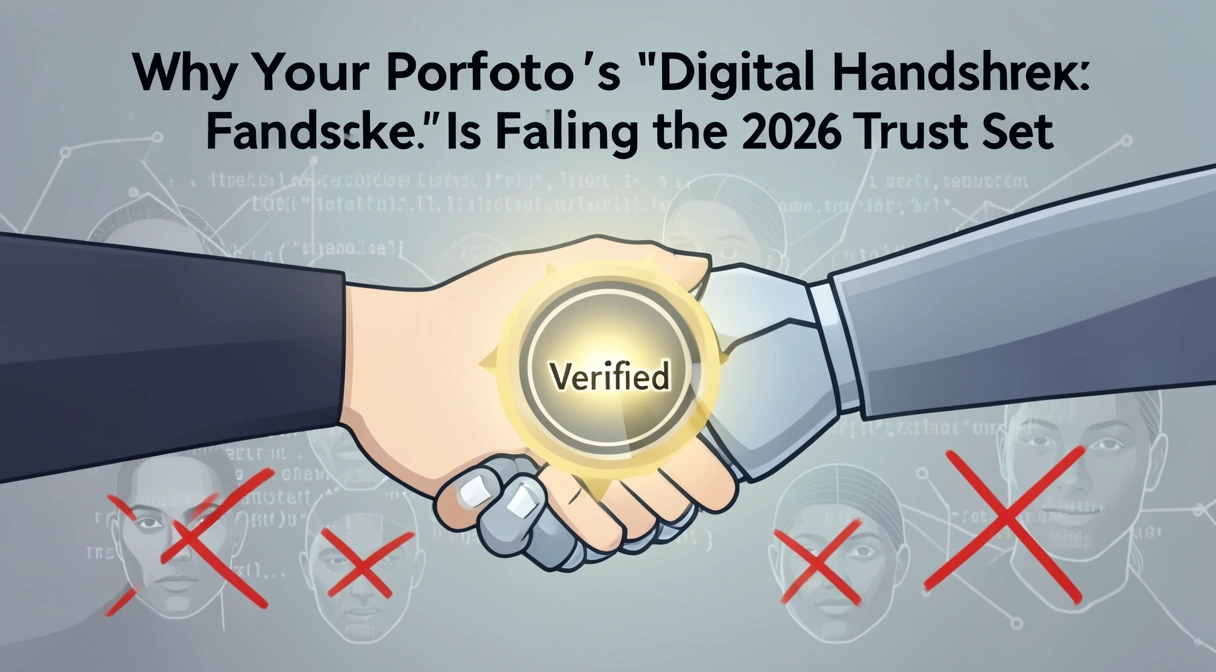
You know the feeling. You send your portfolio link into the void, hoping it lands on the right desk. You've spent hours curating projects, writing case studies, and polishing your bio. It's your digital handshake—your first and sometimes only chance to make an impression. But in 2026, that handshake is being met with a skeptical glance, not a firm grip.
A recruiter at a major tech firm recently told me they now spend the first 90 seconds of reviewing a candidate not assessing skills, but running authenticity checks. They’re looking for signs of life—real human work, not AI-generated filler. This isn't paranoia. It's a direct response to incidents like the one TechCrunch reported in March 2026, where a startup discovered over 30% of applicants for a senior developer role had portfolios with AI-generated code samples and fabricated project timelines. The tools to create convincing fake work have outpaced our ability to instinctively trust what we see online.
Your portfolio is no longer just a showcase. It's a trust anchor in a sea of digital noise. The old rules of a clean layout and a list of bullet points have collapsed. Today, your portfolio must actively prove its humanity, demonstrate verifiable ownership, and pass what I call the "2026 Trust Test." If it doesn't, you're not just being overlooked; you're being silently flagged as potentially inauthentic. This article breaks down why this trust crisis emerged and provides a concrete, actionable framework to rebuild your professional credibility from the ground up.
Understanding the 2026 Trust Test
The Trust Test is the unconscious 30-second audit recruiters run on every portfolio, evaluating four dimensions: authenticity (human vs. AI-generated work), verifiability (can claims be checked via GitHub commits, live deployments, or LinkedIn testimonials?), currency (updated within 3 months), and cohesion (consistent narrative across platforms like Behance, Dribbble, and your personal site).
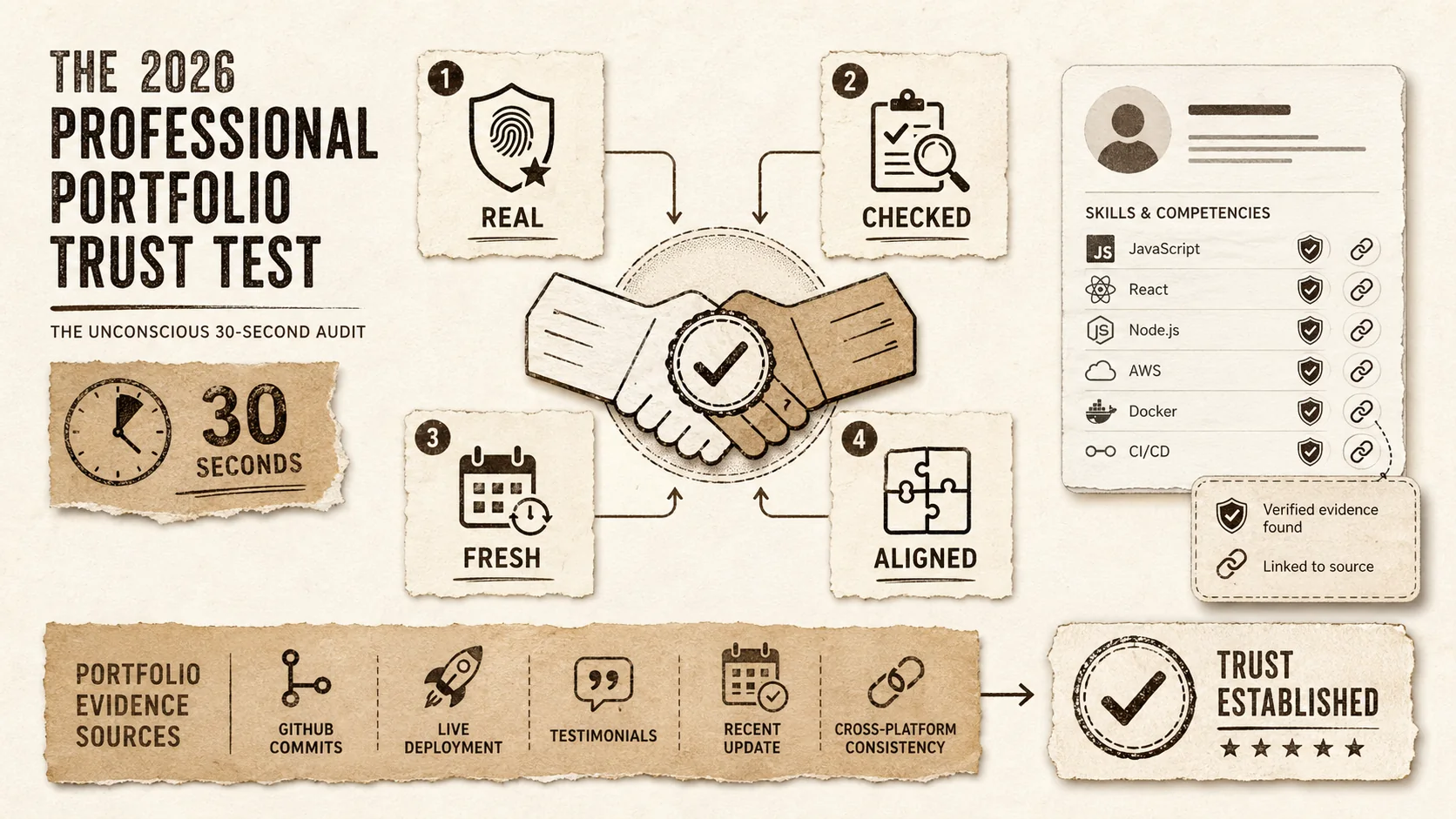
The "2026 Trust Test" is the unconscious audit happening when someone reviews your work. It's the sum of cues that answer one question: "Is this person, and their work, real?" A portfolio's primary job is now to verify, not just impress. This shift is driven by accessible AI generation, normalized digital fraud, and eroding trust. Platforms are reacting—LinkedIn's "Verified Skills" is a direct response. The test evaluates two dimensions: Authenticity (is this genuinely your work?) and Verifiability (can I check your claims?).
At its core, the Trust Test evaluates two dimensions: Authenticity and Verifiability.
- Authenticity asks if the work genuinely originated from you. Does the voice in the case study match the person on the video call? Do the design decisions reflect a human thought process with constraints and iterations, or a perfectly generic AI output?
- Verifiability asks if claims can be independently corroborated. Can I see the live website? Check the commit history on GitHub? Contact a past client mentioned in the testimonial?
A portfolio that is authentic but not verifiable relies on charm and hope. A portfolio that is verifiable but not authentic (e.g., stolen work with solid proof) is fraud. You need both.
| Trust Dimension | What It Means | Failing Signal | Passing Signal |
|---|---|---|---|
| Authenticity | Work reflects genuine human creation, thought, and process. | Generic, flawless case studies with no mention of obstacles or learning. "Perfect" code without comments or messy commits. | Stories of project pivots, lessons from failures, sketches, and early prototypes. |
| Verifiability | Claims can be checked through independent, third-party evidence. | Stating "Increased conversion by 300%" with no link to the live site or data source. Listing "Python" with no public projects or certs. | Links to live deployments, public GitHub repos with commit history, client testimonials with LinkedIn profiles. |
| Currency | The portfolio is a living document, not a relic. | Copyright date says 2023. Latest project is from two years ago. No social media links or recent activity. | Recent blog post (last month), updated project with Q1 2026 notes, active professional social links. |
| Cohesion | The narrative across platforms and projects is consistent. | A developer portfolio full of marketing buzzwords. A designer's Behance style that clashes completely with their Instagram. | A clear, consistent "voice" and visual style from your Popout page to your GitHub READMEs. |
The test happens fast. A recruiter might open your portfolio, glance for a live project link, scan for a GitHub icon, and look for dates. In under 30 seconds, they’ve made a subconscious judgment about your credibility. This is why understanding the broader context of personal branding is no longer optional; it’s a fundamental career skill. Your online persona must be built with this scrutiny in mind from the start. The Nielsen Norman Group has documented that users form trust judgments about websites in as little as 50 milliseconds -- meaning your visual design, logo, and layout are part of the trust signal before a single word is read. If your portfolio’s first 5 seconds fail this visual scan, the content never gets evaluated.
Why Your Current Portfolio Is Failing the Test
Four failure modes kill trust: the Perfection Paradox (58% of recruiters are now "more skeptical" of portfolios that seem too polished, per HireRight 2025), the Static Showcase Fallacy (a 2023 copyright date signals abandonment), the Evidence Gap (claims without live links, GitHub repos, or analytics screenshots), and the Narrative Disconnect (mismatched stories across LinkedIn, GitHub, and your personal site).
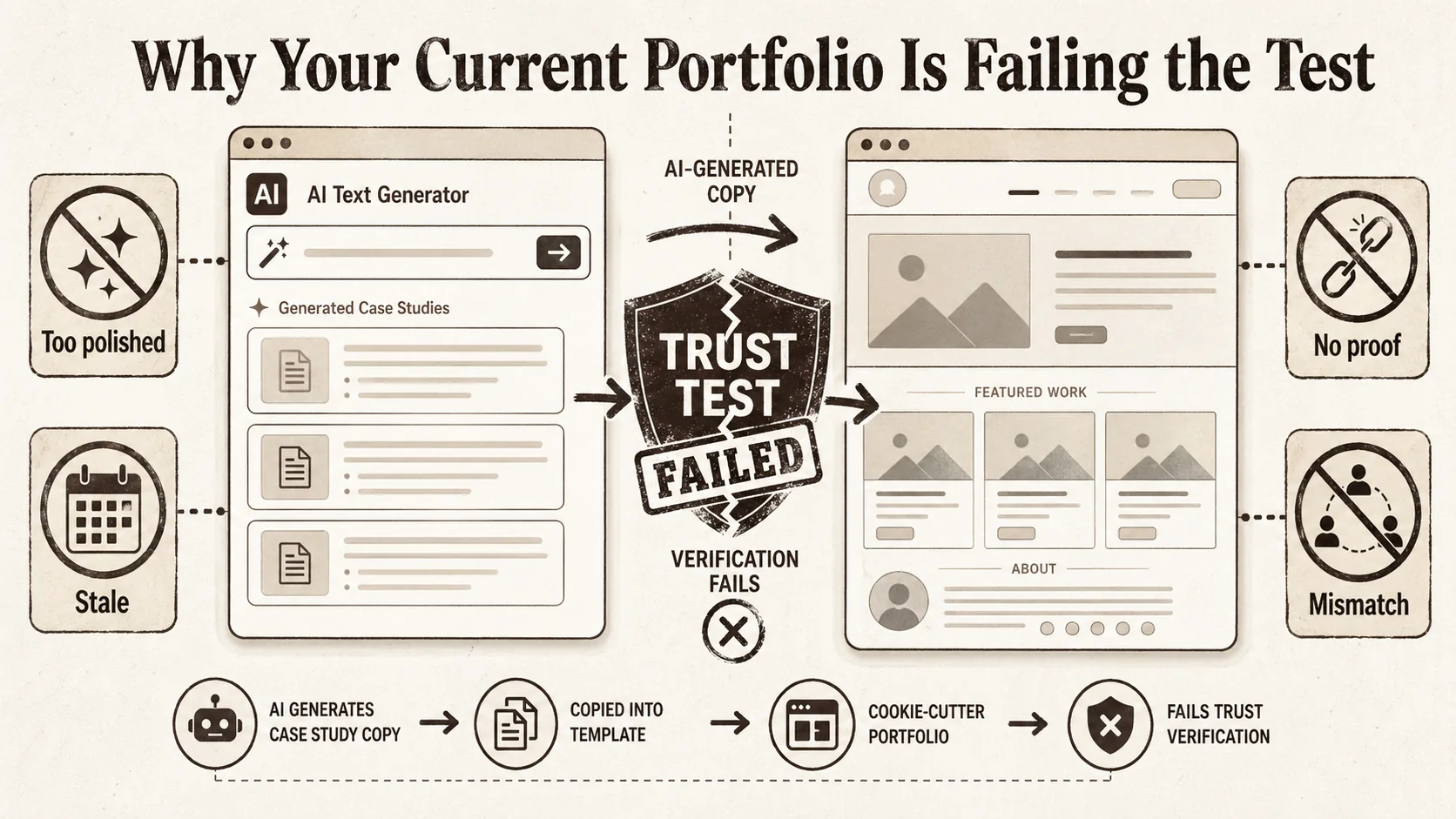 generating "impressive project descriptions." Right: a generic, cookie-cutter portfolio website template filled with that AI-generated text.)
Most portfolios aren't built with malicious intent. They fail the Trust Test because they follow an outdated blueprint in a new world. The very things we were taught to do—polish, simplify, and present only the best—can now work against us. Here’s where the cracks are showing.
The Perfection Paradox
For a decade, the advice was clear: your portfolio should be flawless. Remove the messy bits, the failed experiments, the half-finished ideas. Present only the final, shining product. This created a generation of portfolios that look eerily similar: sleek, impersonal, and suspiciously competent.
The problem? AI is the ultimate perfection engine. It generates flawless, grammatically impeccable case studies. It can produce code without syntax errors or design mockups without awkward alignment. When a human reviewer sees a portfolio devoid of any roughness, any trace of a learning curve, their skepticism spikes. In a world where perfection is cheap, imperfection—the right kind—becomes a badge of authenticity. A study by the recruiting software firm HireRight found that in 2025, 58% of recruiters reported being "more skeptical" of portfolios that seemed "too polished or generic," a significant jump from just two years prior Source.
The Static Showcase Fallacy
You built it in 2022, landed a job, and forgot about it. Your portfolio is a museum, not a workshop. It sits frozen in time, with a copyright notice from three years ago and projects that reference technologies that are now legacy.
This screams inactivity. In fast-moving fields like tech and design, a static portfolio suggests you stopped learning or, worse, that the work isn't actually yours to update. The Trust Test heavily penalizes staleness. It asks, "If this is your ongoing professional identity, why does it look abandoned?" Your portfolio needs to breathe. It needs to show current thinking, even if it's just a monthly log of what you're learning or a link to a recent talk you gave. This active curation is a core part of building a resilient online persona, one that accumulates trust over time rather than decaying. If your last updated date is already costing you job offers, that staleness is compounding the trust deficit -- recruiters see an old date and skip the content entirely. A Sprout Social study found that 67% of hiring managers view portfolio recency as a proxy for professional engagement.
The Evidence Gap
This is the most common and damaging failure. You write: "Redesigned the checkout flow, increasing revenue by 15%." It's a great result. But where's the proof? Where's the link to the live flow? A screenshot of the analytics dashboard (with sensitive data blurred)? A quote from the product manager?
Without evidence, a claim is just a story. And in 2026, everyone has a great story written by an AI. Recruiters are trained to look for this gap. They want to connect the dots themselves. A link to a live site lets them experience your work. A public repository lets them see your coding process. A case study that links to a related blog post you wrote shows deeper thinking. When you don't provide these verification paths, you force the viewer to take a leap of faith. Most won't.
The Narrative Disconnect
Your portfolio says you're a "data-driven UX designer." Your LinkedIn headline says "Marketing Guru." Your Twitter is mostly memes about video games. This inconsistency creates cognitive dissonance.
The Trust Test isn't confined to one URL. A curious recruiter will Google you. They'll check your LinkedIn, GitHub, Twitter, maybe even your Instagram if it's public. They're looking for a cohesive professional narrative. A disconnect doesn't just confuse them; it makes them wonder which version—if any—is the real you. Crafting a unified story across platforms isn't about being boring; it's about being credible. It proves you have a clear, stable professional identity.
How to Build a Verifiable, Trust-Worthy Portfolio: A 5-Step Framework
Five steps: (1) run a self-audit in incognito mode checking proof-of-life, evidence trails, and currency, (2) embed verifiable evidence at every claim via live links, GitHub repos, and Credly certification badges, (3) show your messy creative process (sketches, failed experiments, Loom walkthroughs), (4) establish a consistent multi-platform presence across LinkedIn, Behance, Dribbble, and Twitter/X, and (5) implement a quarterly dynamic update cadence.
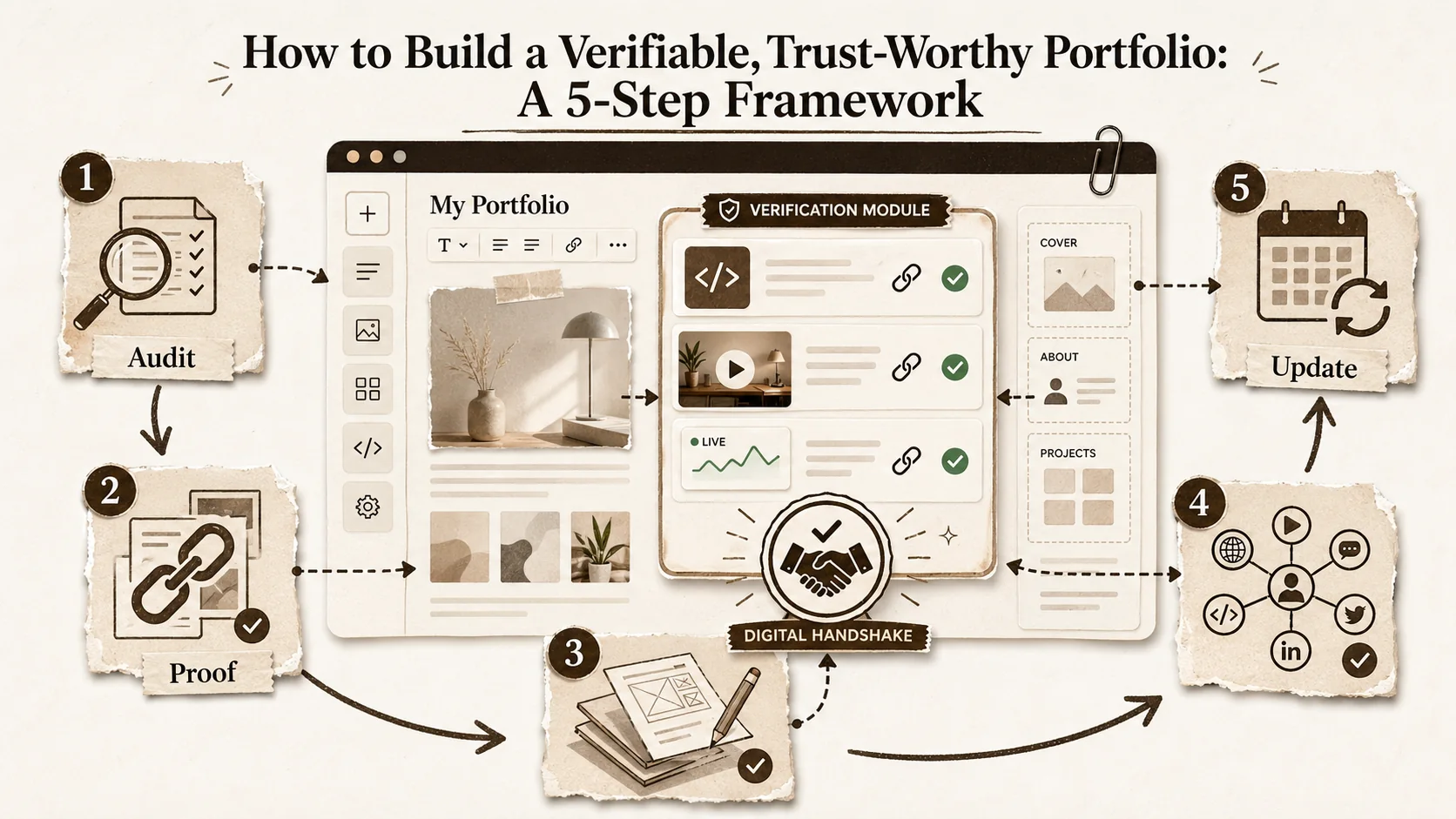
Rebuilding trust isn't about adding a single "Verified" badge. It's about architecting your entire professional presence to be transparent and checkable. This framework moves you from a passive showcase to an active trust-building engine.
Step 1: Conduct Your Own Trust Audit
Before you build anything new, diagnose the current state. Open your portfolio in an incognito window and pretend you're a skeptical recruiter with 90 seconds.
- Check for "Proof of Life": Is there anything that unmistakably proves a human is behind this? Look for a recent photo (not an AI avatar), a casual video introduction, a personal blog post with opinions, or social media links showing real-time activity.
- Follow the Evidence Trail: Click every claim. If it says "see live project," does the link work? If it mentions a GitHub repo, is it public? Are client names listed, and can they be found on LinkedIn? Note every dead end.
- Assess Currency: Find the date of the most recent update. Is it within the last 3 months? Check if project descriptions mention outdated tech ("built with jQuery" for a front-end dev in 2026 is a red flag).
- Test Narrative Cohesion: Quickly view your LinkedIn, GitHub, and main portfolio. Do they tell the same core story about your skills and career trajectory?
Document your findings. This audit will reveal your specific trust gaps. For many, the initial audit is a wake-up call, highlighting just how much their portfolio authenticity has been assumed rather than demonstrated. If you find a trail of outdated artifacts and broken links, our guide on digital exhaust scaring recruiters provides the five-step cleanup framework.
Step 2: Embed Verifiable Evidence at Every Claim
This is the most critical technical step. Every significant claim in your portfolio must have an adjacent, clickable path to verification.
-
For Projects: Never just describe. Link to:
- The live application or website.
- The public code repository (GitHub, GitLab, Bitbucket). Ensure your commit history is meaningful—frequent, well-commented commits are more trustworthy than one massive "initial commit."
- A detailed case study (on Medium, your blog, or a dedicated page) that walks through your process, decisions, and challenges. Tools like Google Analytics can provide anonymized traffic data to back up performance claims, and linking to its official documentation shows you know how to use it properly.
- Third-party platform badges: If your app is on the App Store, Google Play, or a platform like Product Hunt, embed their official "View on" badges.
-
For Skills & Certifications:
- Link to the official certification page (e.g., your AWS Certified Solutions Architect credential on the AWS Training portal).
- For soft skills or methodologies (e.g., "Agile Project Management"), link to a blog post you wrote about managing a sprint or a certificate from a course on Coursera or LinkedIn Learning.
-
For Results & Impact:
- Use sanitized screenshots from analytics tools (blurring actual numbers if confidential) with clear captions explaining what they show.
- Create simple data visualizations (using a tool like Datawrapper or even Google Sheets charts) to represent growth or improvements.
- Quote testimonials verbatim and, with permission, link to the client's or colleague's LinkedIn profile.
The goal is to make verification effortless. Don't make someone email you for proof; bake it into the experience.
Step 3: Show Your Work (The Process, Not Just the Product)
This is where you weaponize imperfection. Showcasing your process is the ultimate proof of humanity. AI can generate a final product; it struggles to fabricate a believable, messy, iterative creative journey.
-
The "Swipe File" Section: Dedicate a part of your portfolio to "Process" or "Behind the Scenes." Include:
- Early sketches, wireframes, and mood boards.
- Photos of your physical notebook or whiteboard sessions.
- Screenshots of failed experiments or A/B tests that didn't work, with a sentence on what you learned.
- Short Loom videos walking through a code snippet or a design decision.
-
Document Your Learning Publicly: Start a learning log. It could be a dev blog on Dev.to, a series of Twitter threads, or a "What I Learned This Month" section on your Popout page. This demonstrates continuous growth and a genuine engagement with your craft. A GitHub repository dedicated to your learning notes or tutorial code is a powerful, verifiable record of your journey. Platforms like Hashnode and Medium also cross-index your content, creating additional verification nodes that strengthen your trust profile.
-
Tell the Story of the Struggle: In each case study, include a "Challenges" subsection. What went wrong? How did you debug the impossible error? How did client feedback force a major pivot? These narratives are complex, specific, and incredibly difficult for AI to fake convincingly.
Step 4: Establish a Consistent, Multi-Platform Presence
Your portfolio page is your home base, but your trust is built across the entire web. You need to own and connect your digital footprint.
- Claim Your Name: Secure the same username (or a close variant) on key platforms: GitHub, LinkedIn, Twitter/X, Instagram (if professional), and a domain name (YourName.com). This makes you easy to find and confirms a unified identity.
- Create Content Bridges: Your portfolio should actively pull in content from other platforms to show you're a living, participating member of your professional community.
- Embed your latest blog post from your personal site or Medium.
- Showcase your top GitHub repositories with their stars and commit activity.
- Display a feed of your professional Tweets about industry topics.
- Use a platform like Popout to seamlessly bring these disparate elements together on one link-in-bio page that serves as the hub for your entire online identity. This solves the narrative disconnect problem by providing a single, curated view of your multi-platform self.
- Be Findable (and Checkable): A simple "About Me" page with a clear, friendly photo and a contact email that uses your domain (hello@yourname.com) is more trustworthy than a generic Gmail address. It shows investment and professionalism.
Step 5: Implement the "Dynamic Update" Rule
A trustworthy portfolio is a current portfolio. Commit to a minimum update schedule.
- Quarterly: Review and refresh. Update your "Now" page (a page describing what you're currently focused on). Add any new small wins or learnings. Check all external links are still alive.
- With Every Project: When you complete significant work, add it within two weeks. The description will be fresher and more detailed.
- The "Living Bio": Instead of a static third-person bio, consider a first-person, dated log. "As of March 2026, I'm deep into learning Rust and working on a new open-source tool for data visualization. Last month, I gave a talk at Local Meetup X..." This format is inherently authentic and current.
This framework turns your portfolio from a brochure into a dialogue. It invites verification, showcases humanity, and builds credibility through transparency. It’s the antidote to the AI-generated facade. For more tactical advice on executing this without overcomplicating things, the data shows that simplicity often wins when it comes to clear, effective communication. And to understand how your About Me section functions as the new first interview, that guide covers the dual-audience writing framework for both AI screeners and human readers.
Advanced Strategies: Becoming a Trust Magnet
Three advanced tactics: publish an "open source" career narrative on GitHub or Notion with transparent goals and decision logs, leverage third-party verification layers (video testimonials, "Featured In" badges, platform verification on GitHub and Dribbble), and build a "Trust Portfolio" that proves collaboration skills via mentorship, open-source PRs, and Stack Overflow contributions.
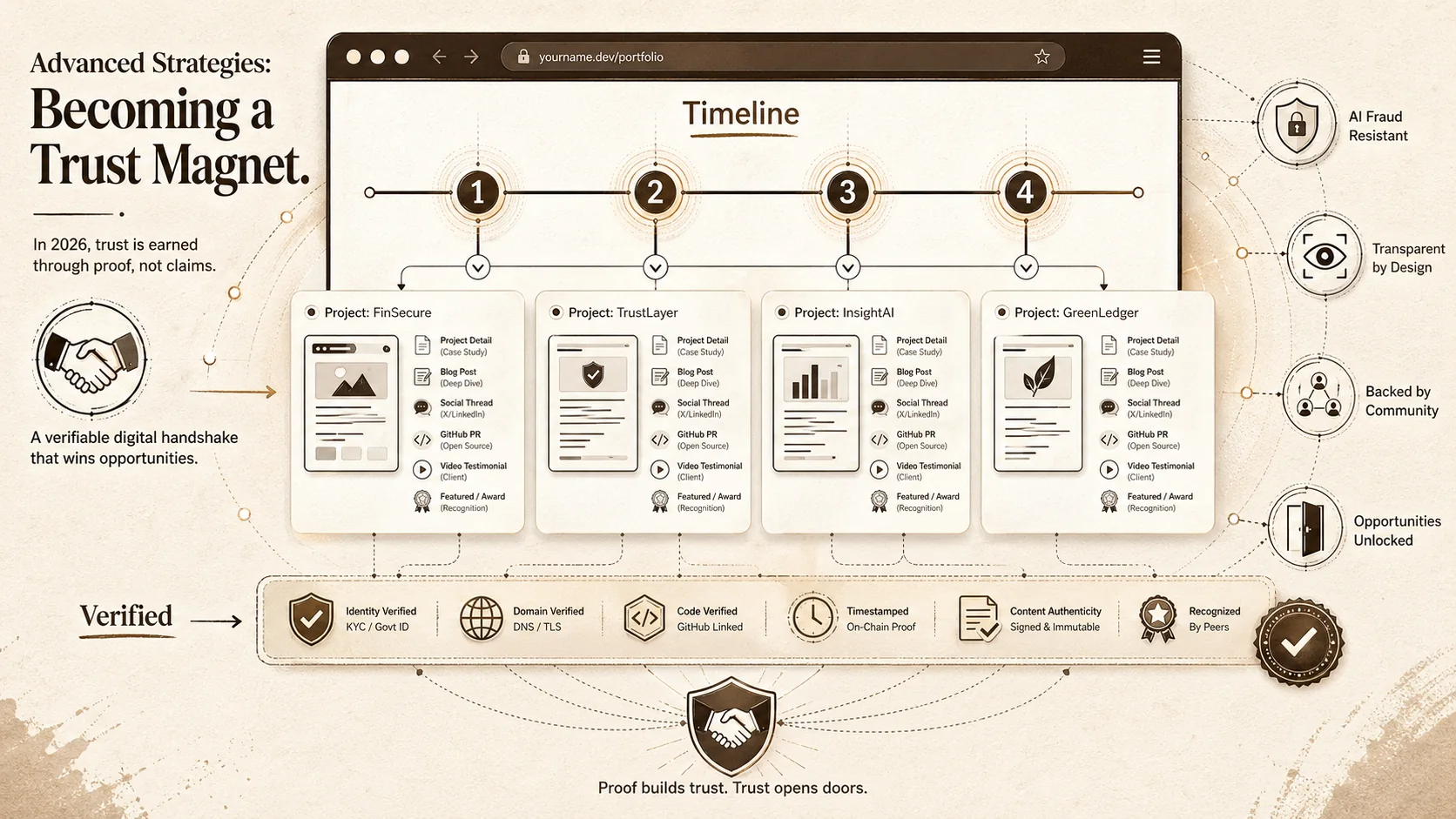 is a clickable node that expands to show project details, press links, and contemporaneous social media posts.)
Once you've implemented the foundational framework, you can layer in advanced tactics that don't just pass the Trust Test—they make you a magnet for trust and opportunity. These strategies signal a level of professional maturity that shortcuts skepticism.
Create an "Open Source" Career Narrative
The most trusted entities in tech are open-source projects. Their code, decisions, and history are transparent for anyone to audit. Apply this philosophy to your career.
- Publish a "Career Repository": Create a public document (a Notion page, a GitHub repo with a README) that outlines your career goals, learning roadmap, and even your resume. This radical transparency is disarming. It shows confidence and invites collaboration. You're saying, "This is who I am and where I'm going. Let's build something together."
- Document Decision-Making Publicly: When you face a significant career choice (e.g., "Why I chose framework Y over Z for Project Alpha"), write about it. Publish the pros/cons list, the articles you read, the conversations you had. This provides a deep, verifiable look into your professional judgment, something no AI can replicate.
Leverage Third-Party Verification Layers
Don't just say you're trustworthy; get others to say it for you in ways that are hard to fake.
- Collect Video Testimonials: A written quote is good. A 60-second video from a past client or colleague saying your name and describing your work is gold. It's synchronous proof—voice, face, and spontaneous praise. Embed these directly on your portfolio.
- Get Featured or Cited: Contribute to industry blogs, speak at meetups (even virtual ones), or participate in podcasts. A "Featured In" section with logos and links to these external sources acts as a powerful trust transfer. The authority of the publisher rubs off on you.
- Use Platform-Specific Verification: Obtain the blue check or verification badge on platforms where it matters (e.g., GitHub for developers, Dribbble for designers). While not perfect, these signals are processed subconsciously as markers of legitimacy.
Build a "Trust Portfolio" Beyond Your Work
Your projects prove you can do the work. A "Trust Portfolio" proves you are a reliable, ethical professional.
- Show Your Collaboration: Include screenshots of positive interactions in project management tools (Trello, Asana) or Slack (with names blurred). Show that you communicate well within a team.
- Demonstrate Mentorship: If you've mentored others, document it. A testimonial from a mentee or a link to a workshop you led shows leadership and generosity.
- Highlight Contributions: List your open-source contributions (with links to pull requests), pro-bono work for non-profits, or answers you've provided on Stack Overflow. These activities show engagement with your community for reasons beyond direct payment.
These strategies move you from being a candidate who seems credible to one who has systematically engineered credibility into their digital presence. It’s the difference between hoping you’re trusted and knowing you will be. For the measurement side of this equation, our guide on portfolio pingback and proving impact covers how to track which trust signals actually drive recruiter engagement.
Conclusion: Your Trust is Your New Currency
Verified trust is the 2026 career currency: conduct a trust audit, embed evidence at every claim via GitHub repos and live deployments, show your messy process, unify your narrative across LinkedIn and Behance, and commit to quarterly updates -- because in a market flooded with AI-generated facades, being provably real is your strongest competitive edge.
The 2026 job market runs on verified trust. Your portfolio is no longer a static trophy case; it's a dynamic engine for building professional credibility. The shift from showcasing to verifying isn't a trend—it's a permanent correction. By conducting a trust audit, embedding evidence, showing your process, unifying your narrative, and committing to updates, you build a presence that withstands scrutiny.
This work pays off. A verifiable portfolio doesn't just help you pass a test; it makes you a magnet for serious opportunities. It signals that you're authentic, thorough, and confident enough to be transparent. In a digital landscape crowded with AI-generated facades, being provably real is your strongest competitive edge. Start treating your digital handshake as the critical trust-building tool it is.
Frequently Asked Questions (FAQ)
Update quarterly, use AI as an editor not a ghostwriter, keep older projects framed as growth evidence, and maintain a cohesive narrative across all platforms -- over 70% of hiring managers check social media profiles, making multi-platform consistency a non-negotiable trust signal.
How often should I update my portfolio to maintain trust?
Aim for a meaningful update at least once per quarter. This doesn't mean a full redesign. It could be adding a new project, writing a short "What I Learned This Quarter" post, or even just updating the copyright date and a few skill keywords. The key is showing activity. A portfolio that changes even slightly every few months signals an engaged professional. A portfolio untouched for a year or more starts to feel like an abandoned storefront, raising questions about your current status and skills.
What's the single biggest mistake people make that destroys portfolio credibility?
The "black box" project description. Writing "Built a full-stack application that improved user engagement" and providing no links, no code, and no way to see or test the application is the most common trust-killer. It turns your accomplishment into an unverifiable claim, which in the current climate is often assumed to be an exaggeration or a fabrication. Always pair a claim with a path to proof. If you can't share the live app due to an NDA, share the architectural diagram, the problem-solving process, or sanitized code snippets. Show something of the work.
Can I use AI to help build my portfolio without making it seem inauthentic?
Yes, but you must use it as an editor, not a ghostwriter. Using AI to brainstorm section headers, check grammar, or rephrase a clunky sentence is a productivity tool, just like spellcheck. The trust breaks down when AI writes the entire narrative. The voice becomes generic, the details vague, and the human perspective vanishes. A good rule: write the first draft yourself. Pour in your specific struggles, your unique solutions, and your actual excitement. Then use AI to polish and tighten. The core thoughts, the stories, and the evidence must be irreducibly human.
Should I remove older, less impressive projects from my portfolio?
Not necessarily. A curated portfolio is good, but a portfolio that shows evolution is better for trust. An early, simpler project from 2021, presented honestly ("My first React app—clunky state management but I learned hooks here!") followed by a complex 2025 project demonstrates tangible growth. That journey is a powerful authenticity signal. It shows a real learning curve. Just make sure you frame the older work in the context of your progression, not as a current representation of your skills.
How important is a multi-platform presence for trust?
It's critical. Over 70% of hiring managers check a candidate's social media profiles Source. Inconsistency across platforms is a major red flag. A cohesive narrative on your portfolio, LinkedIn, and GitHub acts as cross-verification. It proves you have a stable, professional identity. Tools that help unify this presence, like a Popout page, are becoming essential for managing this multi-platform trust signal effectively.
Ready to build a portfolio that doesn't just look good, but proves it's real?
Popout helps you create a verifiable, dynamic hub for your work that actively builds trust. Stop leaving your credibility to chance. Build a professional presence that stands up to scrutiny and opens the right doors. Create Your Popout Page and start passing the Trust Test today. For the complete portfolio strategy, explore our portfolio hub, learn how proof-of-work elements are replacing traditional references, and see why the second screen strategy turns initial clicks into real career conversations.
Other Doved Studio projects
Related tools from the same studio you might find useful:
- Ralphable: Generate structured Claude Code skills that iterate until pass/fail criteria are met.
- Glean: Turn scrolling time into a daily action plan. Capture, process, execute.
- Doved Studio: Studio indie derrière cette app et une dizaine d'autres outils.
Written by
popout
Content Team